Long Live Pizza Anarchy
Here’s a pizza riddle. If you make a deep-dish pie in a square pan rather than a round one, is it something other than deep-dish pizza? What happens if you cut a thin tavern-style pizza into slices rather than traditional squares? Does it become something else? Does the world end? If a pizza falls in the woods, does that mean the crust needed a higher level of hydration?
As diners have become more familiar with regional pizza styles, something has happened. We’ve begun classifying and categorizing our pies as if they were exotic flora or fauna in need of a Latin genus name. A nationwide cohort of pizza obsessives (chefs, writers, podcasters) have tracked pizza etymology for ages. Which makes sense—we’re talking about a near-perfect food whose 200-year-old history tells a million stories of emigration, assimilation, and ambition. No other single dish has this many established permutations. But if you’re a regular person living your life, things get weird when our finite knowledge meets the white heat of nostalgia.
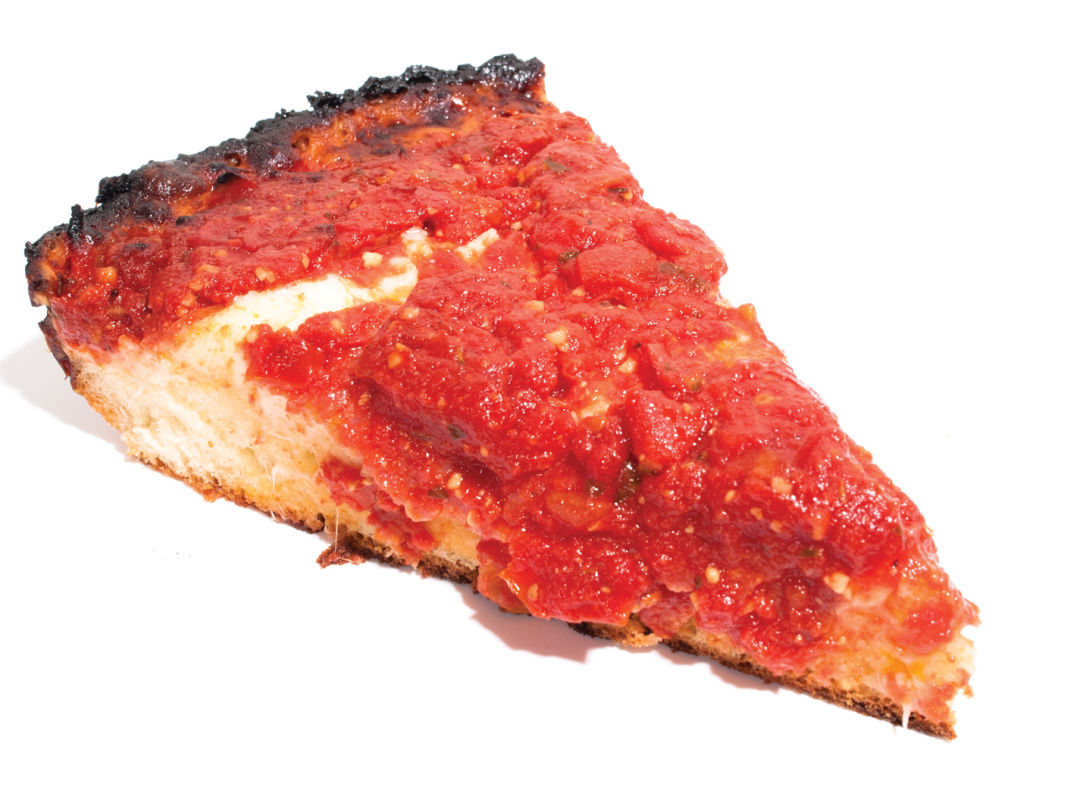
A perimeter of browned cheese distinguishes the deep-dish pizza at Windy City Pie.
Image: Sara Marie D’Eugenio
“I honestly cannot believe the pizza I received after ordering a Chicago style deep-dish,” one recent diner at Windy City Pie complained on Yelp. The author anticipated “the usual deep-dish with buttery crust, tons of melty cheese, and a generous dollop of tomato sauce on top.” Instead, she got the version owner Dave Lichterman spent years honing here in Seattle: softer crust, more restrained ingredients, and Windy City’s crowning glory—a perimeter of crisp, browned cheese on the pizza’s edge.
Lichterman’s the sort of technically minded perfectionist who will steer you away from too many toppings for fear of skewing the moisture content of such hefty pies. He's also a Chicago native who can lay out the evolution of the city's famous pizzerias the way Doris Kearns Goodwin can talk about U.S. presidents. His fan base includes both deep-dish newbies and customers who walk the streets of Seattle in Cubs jerseys. And yet, says Lichterman: “People constantly—whether they liked or disliked my pizza—will tell me it either was not authentic or is not pizza.”
Seattle might seem like an unlikely crossroads for pizza pedantry. We don’t have our own regional style of pie a la New York or Chicago. Portland, to the south, is the city whose pizza scene gets showered with national acclaim. But we do have a ton of transplants who arrive with fully formed pizza opinions. Not to mention a population segment that loves information science. Despite—or maybe because of—our lack of a signature pizza style, we are not immune.
Pizza is a cultural touchstone. There aren’t many sources of joy out there that are more primal or reliable. So why do we feel a need to parse its characteristics? The casual eater isn’t nearly this zealous about regional burger or taco styles. What is it about pizza that makes people reduce the unmitigated pleasure of a slice of pepperoni into the culinary equivalent of diagramming a sentence?
Dave Lichterman understands the desire to classify and define things we love. “It’s like genres of music,” he says. “it’s a way to navigate the world.” Fellow pizza nerds—the kind who study landmark pizzerias as enthusiastically as Lichterman does—have asserted that his pies technically qualify as “deep pan pizza” rather than deep-dish. Mostly because of browned cheese edge. He politely sticks to his preferred terminology. “Everyone has opinions, and they’re all valid,” he says. “Food gatekeeping is not interesting or fun.”
Tracing the evolution of pizza styles, though, does seem like Lichterman’s idea of fun. His restaurant’s website even includes a breakdown of Chicago-style pizzerias and their influences to help customers understand what they’re getting. Because clearly people arrive with opinions.
Our tendency to get all “well, actually” about pizza seemed to take off right around the same time Detroit-style pies surged nationally. The lore behind these is so, so good: The cheese has to be Wisconsin brick. The pans must be steel: According to the fantastic, if rather unsanitary legend, the originals were used to hold small parts on auto assembly lines; the metal held heat, which helped brown the cheese around the edges. Detroit-style pizzas usually have sauce on top of the cheese.
Some makers follow these directives with scholarly zeal. Here in Seattle, Moto pizzeria owner Lee Kindell sources brick cheese from Wisconsin (not an easy task, he reports) for Detroit-style pie that sells out as soon as orders go live for each new month. Top Chef alum Shota Nakajima studied Motor City pizza when planning the square pies at his Kōbo Pizza on Capitol Hill. But he avoids using “Detroit-style,” at least officially, to describe them, since he’s layered on influences from Osaka. “I do think there’s importance to authenticity,” says Nakajima. Even though his mochi and rice flour help achieve a crisp cheese edge and crunchy base that’s almost textbook Detroit.
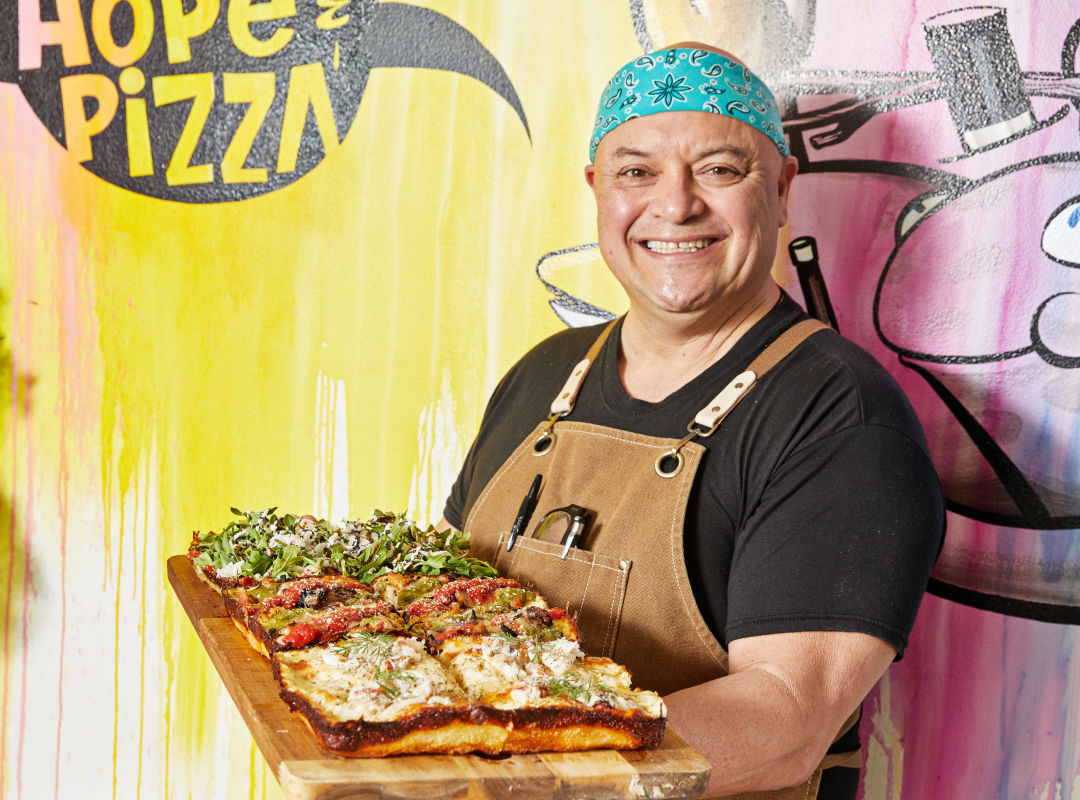
Moto Pizza owner Lee Kindell makes faithfully Detroit-style pies with some decidedly atypical toppings.
Image: Amber Fouts
Authenticity is a nebulous term. Especially for pizza. A beermaker can consult the official Brewers Association guidelines and get a definitive answer on the difference between American- and West Coast–style IPAs. In Naples, the birthplace of pizza, the Associazione Verace Pizza Napoletana does offer a certification for anyone who makes Neapolitan pies according to the methods outlined in their 21 pages of regulations.
But beyond that, pizza has no official arbiter of what makes a pie authentically Detroit. Or Chicago-style. Or New Haven, St. Louis, or Sicilian-style, for that matter. But so many of the opinions we’ve held so strongly—the ones people have debated and waved around on social media—were often built on a century-old tangle of lore, conflicting stories, and a dash of straight-up nonsense.
In January, J. Kenji López-Alt, a Seattle food writer and icon to food obsessives everywhere, landed in Chicago. His mission: visit a dozen pizzerias over a period of two days, in a quest to better understand the tavern-style pizza. Dave Lichterman of Windy City Pie tagged along; one can only imagine the taxonomic pizza debate that occurred in the rental car as they crisscrossed Chicago and headed north to Milwaukee. Technically, López-Alt pointed out in his ensuing New York Times column, the term “Chicago-style pizza” can refer to this “thinner-than-a-saltine thin” pizza just as readily as the city’s famous deep-dish.
López-Alt had to cut an entire chapter on pizza from his blockbuster cookbook, The Food Lab. A future book project—still in the very earliest stages—will delve into regional American pizza styles with typical Kenjian rigor.
“I think it’s cool to celebrate not just traditional pizza, but the way it has evolved,” he says over a slice of pizza at Oxbow Bakery in Montlake. But his Midwestern tavern-style junket proved, the closest you can get to a definitive answer regarding pizza probably involves visiting a lot of longtime spots, diving into archives, and triangulating slightly blurry information as best you can. “Your sources are often people’s memories,” he says. So far one of his most valuable sources of hard data has been older pizzerias’ tendency to frame news clippings about the restaurant, then never take them down.
As someone who grew up in New York City, he understands the strong emotions around the slices of our youth. Outside NYC, he mostly finds “The pizza that’s sold as New York–style pizza doesn’t taste like what I ate growing up.” It can be great pizza, says López-Alt, just not what he’s looking for when he wants to get nostalgic.
Pizza uses the simplest of ingredients and methods that have been around for centuries. But beneath that, he points out, runs an undercurrent of hardcore science: “You can get really gritty about hydration level, optimal water absorption, different flour types, oven temperature. There are all these numbers involved in it. It’s almost like a baseball game.”

Footage of Kenji López-Alt and Dave Lichterman scouring the Midwest for tavern-style pizza would make a great Netflix show.
Image: Courtesy Dave Lichterman
A conviction built on data and stats can make pizza fans (not actual pizza chefs, for the most part) extra confident about what’s right, wrong, or better, posits López-Alt. “In the same way sports fans get confrontational about stupid stuff.”
It’s not a huge leap to imagine Seattle’s tech community gives our region a critical mass of residents who enjoy getting computational about pizza. Among the most famous is Nathan Myhrvold, the former Microsoft Chief Technology Officer who went on to found Modernist Cuisine. A decade after its landmark six-volume repository of modernist cooking techniques, Myhrvold turned his attention to much older culinary practices. He and chef Francisco Migoya published Modernist Pizza, a guide whose three volumes weigh a collective 35 pounds.
Book one documents how the Modernist Pizza team visited hundreds of pizzerias, from São Paulo, Brazil, to Old Forge, Pennsylvania. Photos and diagrams break down the crumb size, rim depth, and topping ratio of popular regional styles. And even those guys acknowledge that pinning specifics to regional styles is “a lot murkier than it might seem.”
Like so many of his brethren, Dantini Pizza owner Garrett Fitzgerald posts a manifesto on his website, describing what his pies are all about. But his is briefer than most, just seven words: “Dantini is a Seattle based pizza shop.”
Fitzgerald’s intentional effort to not assign a genre to Dantini’s pizza doesn’t stop customers from describing his pies as New York–style. “People try to classify it and say what it is,” he muses. It’s not great customer service to tell your clientele they’re incorrect. “And to be honest,” says Fitzgerald, “I don’t think I even know what New York style is. I’m a little confused myself.” No matter. His pies are some of the best from the proliferation of popups that bloomed in the hard soil of 2020.
If someone calls Fitzgerald up (like, say, me) and demands to know how he describes his own pizza, his response is hesitant: “Hand-toss normal? Round? I don’t know how to answer the question anymore.” Fitzgerald has also heard his pies described as New Haven–style (“I think that’s just because of the char”) and, conversely, as “not New York–style.”
Dantini’s pies are 16 inches, on the small side of a traditional New York pie. They’re light and crisp and bubbled with char—the comparisons are understandable. But Fitzgerald might top pies with cilantro pesto or toasted sesame seeds with mushrooms and frizzled bits of leek. Some pies come with a wedge of lemon to squeeze on top.
Pizza taxonomists even have a name for the giant swath of chefs making pies that intentionally hew to no style: artisan pizza or chef-inspired pizza. Seattle may not have a signature style, but we do have an abundance of chefs tossing, fermenting, and baking up pies that intentionally break the mold of what came before. Many of them have gleeful crossover with bread-baking.
In 2018, Shane Abbott and Justin Harcus took over a former Via Tribunali location in Fremont. They inherited the Neapolitan-style pizzeria’s traditional domed wood-burning oven and its Vera Pizza Napoletana certification—that official designation from the governing body in Italy.
Neapolitan pizza, according to all those guidelines, must be baked at 900 degrees for 60 to 90 seconds. “It was also pretty clear, they weren’t checking it,” says Abbott of the Italian AVPN council. “They just want you to write the $500 check every year [to renew your membership] and put the sign in the window.”
A lot of the requirements just didn’t sound good to him. Cairnspring Mills had just opened in Washington, ushering in a new era of small-batch flour made from grain grown on local farms. Abbott wondered, why use the prescribed stuff from Italy when Washington has its own source of world-class flour? If Neapolitan pizza was all about using what’s local and grown nearby, “It’s almost a disservice to that tradition.”
A pie from Lupo is roughly the size of a Neapolitan pizza, with a tangy sourdough crust that’s both nonregulation and absolutely fantastic. The notion of a cacio e pepe pizza never comes up in the official VPN manual, but to live in a world without the version at Lupo would be a sad thing, indeed.
Pizza-wise, some of the most exciting things happen when people chuck tradition and taxonomy in the recycle bin and do their own thing. Portland became a national pizza darling because its parlors were too busy having fun to pay attention to canon. Even at Detroit-faithful Moto, the best pizza is arguably the one topped with our own dungeness crab.
Plenty of pizzamakers, like Abbott, learn the ways of regimented pizza styles, then use that knowledge to make a break in another direction. Some call modern takes on Neapolitan pizza “neo-Neapolitan,” though that term is about as leaden and unappealing as a cold slice of last week’s deep-dish.
Last year Abbott and Harcus expanded from Neapolitan-ish pizza to East Coast–ish pies at their second restaurant, Stevie’s Famous in Burien. Recently, Abbott and I sat at the front window, and fell into a conversation about the modern pizza landscape. About how New York pizzerias keep their pies cold, then reheat slices to order—that’s why a traditional NYC slice is so crispy. “If you buy a whole pie and it’s fresh out of the oven, it’s not as crisp.” We talked about how some canny restaurant startups hurried to “catch the wave” of Detroit-style pizza because it was new and unfamiliar—but also because it’s way easier for a kitchen to prep a bunch of pizza dough inside pans than to stretch a pie to order. We also talked about pizza’s Next Big Thing. “You’re seeing the early wave of the tavern style right now,” says Abbott. That’s the cracker-crisp thin crust pie that took Kenji López-Alt and Dave Lichterman on their Midwestern road trip earlier this year. Versions—cut into all-important squares rather than slices—are making inroads on menus here in Seattle and well beyond.
Better get familiar with it now, so you can have arguments about it later.

Up With Pizza
Inside Moto’s Enchanted Cottage of Detroit-Style Pizza

THE CARBS ISSUE