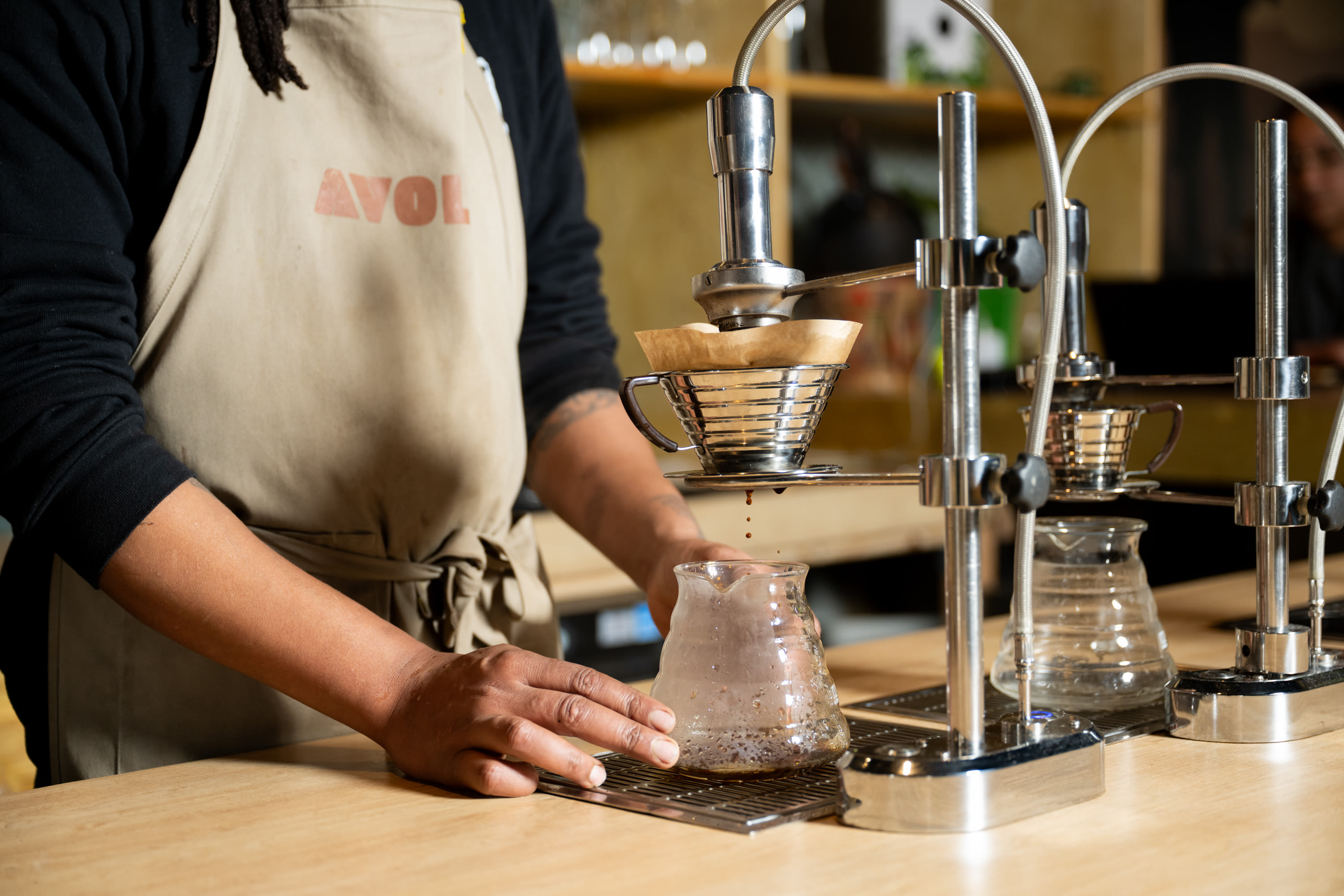
An Idea Worth Importing, from Tanuki Coffee Roasters

Image: Amber Fouts
Justin Inahara considers it his job to take coffee seriously. In exchange, he hopes that his customers will not. He started Tanuki Coffee Roasters aiming to be the bridge between casual coffee drinkers and the big bean nerds, but what really sets Tanuki apart from Seattle’s many coffee companies are his single-use pour-over kits.
The small packets unfold on top of any mug, a ready-to-use brewing apparatus with the ground coffee already inside—just add hot water. Almost as easy to make as instant coffee but infinitely higher quality, the small packets are commonplace in parts of Asia, including Japan, where Inahara first saw them while visiting family almost a decade ago. “It was nice to be greeted by quality coffee in those cute little packages,” he says, but they brought up a question. “These are so cool. Why doesn’t the US have anything like this?”

Image: Amber Fouts
The thought lingered. Inahara worked as a barista for Broadcast Coffee at the time, a job he took for extra cash while freelancing in video and photography. One day during a training, Inahara did a triangulation tasting—looking to identify which of three cups was different. “That was the moment I was like, ‘Oh, this is really interesting to me,’” he says. Combining smell and taste, and a whiff of competitiveness, showed him that coffee might be more than a side gig.
When a job in Broadcast’s roastery opened, he applied. Broadcast owner Barry Faught supported not only the move but Inahara’s own roasting ambitions. “Take some of what we’re doing here and apply it to your own thing,” Faught told Inahara. “You can use the roaster. You can store coffee here. If you need a contact to reach out to, let me know.”
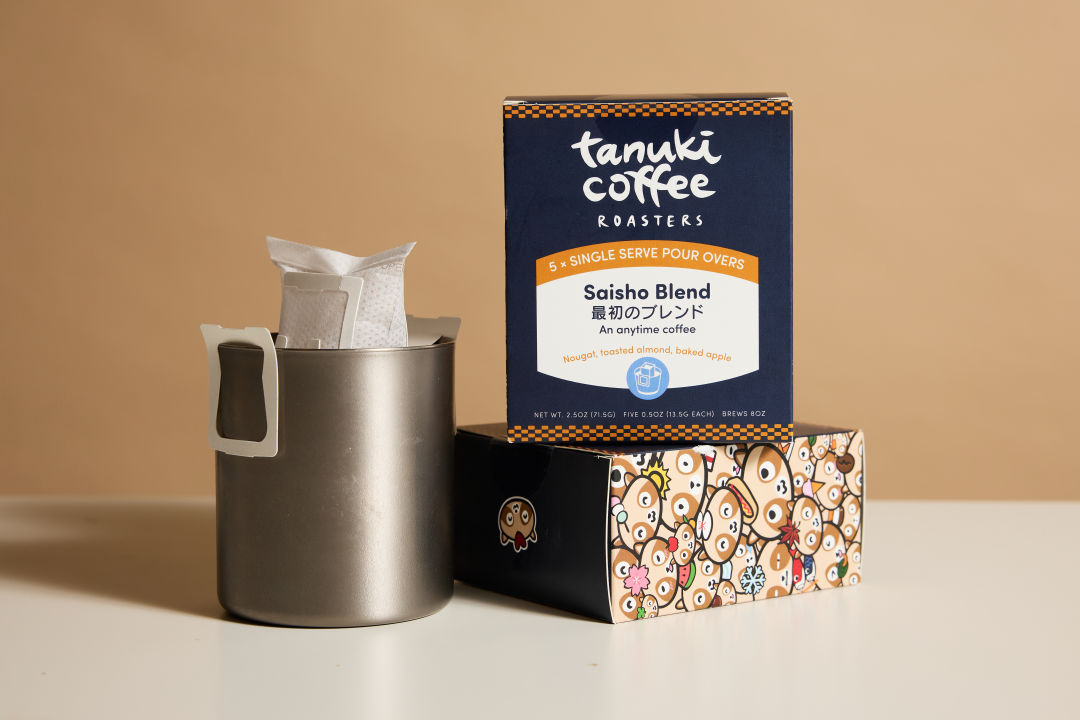
Image: Amber Fouts
At the end of 2021, the first Tanuki coffee was roasted, mostly presents for Inahara’s in-laws. He began selling at markets and pop-ups in 2022. Then, two years ago, a coworker told him about a company in Wyoming that might be able to help him produce the kind of single-use pour-over kits he’d seen in Japan.
Inahara still roasts at Broadcast, but now he ships some of his beans a few states over, where they’re ground, packed into the bottom of the kits, and nitrogen-flushed so the coffee stays fresh for longer.
To open the coffee, you remove it from the outer wrapper, tear the perforated top off, and open the sides, which become wings that rest on the edges of the cup, suspended over it. Then you just pour hot water over the exposed grounds until you have about eight ounces of coffee. Or cold water—the kits also work to make cold brew, by dropping it into tap water and leaving it overnight.
The kit requires only water, making it easy to use in a hotel room or at a campsite—but without the lesser flavor of instant. It skips the extra equipment and plastic waste necessary to brew using pods; it lowers the barrier of entry for good coffee. Most important, it achieves Inahara’s original goal for Tanuki: coffee that’s seriously tasty, but not too serious.