
The Battle for the Soul of the Churro
Steven Ramirez-Araujo’s club-worthy patterned shirt is stylistically at odds with his hairnet. He’s presiding over the Rheon KN551, the automated assembly line that powers his family’s churro business.
Imagine a cookie press or pasta extruder attached to a computer: The Rheon releases a star-shaped squirt of dough with the hypnotic steadiness of a soft-serve machine piling up chocolate-vanilla swirl. Then, a decisive snap. The machine trims these long ropes of uncooked churro into six-inch lengths—or whatever dimensions Ramirez-Araujo programs into the rudimentary control panel. A small conveyor belt ferries the churros onward to a sheet pan.

Image: Amber Fouts
The Rheon replaced a hand-cranked churro machine Ramirez-Araujo’s parents ordered from Argentina when they founded Alberto’s Churros in 1987. That original device now sits across the hall in the small conference room of the company’s small facility behind the Ace Hardware in Edmonds. Gleaming cleanliness aside, it looks like something that might power a turn-of-the-century sawmill.
Alberto’s is a wholesale operation; you can find its churros in Mexican restaurants and other venues across the Northwest. But next to Big Churro, it’s small-time. When Elsa and Alberto Araujo started their company, they encountered customers who didn’t even know what a churro was. Decades later, they’re battling a competitor so ubiquitous, it has actually shaped the American public’s perception of what a churro is.
“The ones who know ‘the other one’ will try our product and say it’s something wrong with it,” Ramirez-Araujo says. “Like, ‘it’s too crunchy.’” Ramirez-Araujo usually declines to state “the other one’s” name, but it’s not hard to piece it together.
Today, the United States has claimed this treat as its own, enshrining churros in cultural meccas like ballparks, state fairs, and, most effectively, Disneyland. The market size of churros and churro-flavored products is poised to triple from 2024 to 2032, according to one report. You can buy churro-flavored versions of everything from pretzels to protein powder. Depending on who you ask, this is a capitalism-fueled cultural travesty—or just the latest chapter in a singular food migration story that stretches across oceans and centuries.

Image: Amber Fouts
J&J Snack Foods began as a maker of soft pretzels in the 1970s. Along the way, the New Jersey–based business got into churros (not to mention Icees, funnel cakes, Dippin’ Dots, and various other desserts). Over the years it acquired multiple regional churro companies, now consolidated under its house label ¡Hola! Churros. J&J is the nation’s largest churro producer, making the confection in every permutation from bite-size to lightsaber, filled or unfilled, even whole wheat.
It hurt, says Ramirez-Araujo, when Azteca, a fellow Northwest business and chain of Mexican restaurants, switched its business to J&J after years of buying from Alberto’s. Around 2016, he recalls, J&J even offered to acquire his family business. Going up against Big Churro rankles. Especially when the stakes are cultural as much as economic.
“They have no idea what a churro is, where it comes from,” he says. “It’s not Mexicans profiting off Latin American food, and it’s not Latin Americans profiting off Latin American food. People are constantly profiting off things that aren’t theirs.”
When the Araujos emigrated from Argentina in 1972, Elsa wanted to own her own business. After the couple settled in Seattle, “We started thinking about making something that wasn’t common here,” she says, “something nobody knew.” Arroz con leche required too much equipment. Ergo, the churro. Something you could buy from street carts and at the beach back in Argentina, or even at Spanish-style churro cafés.
Neither she nor Alberto had any background in baking. They took out a small business loan—supposedly for a piano, so Elsa could give lessons. Instead, the funds procured a hand-cranked churro machine and, later, a special mixer with a burner underneath to heat the flour and water. This step is essential to the churro’s texture, says Ramirez-Araujo. Skipping it, to him, would be akin to making a croissant without laminating the dough. His parents based their recipe off ones from newspapers back in Buenos Aires and used just three ingredients—flour, water, salt—not counting the final dusting of sugar.

Image: Amber Fouts
Alberto’s began as a bakery in the University District, serving cinnamon rolls and empanadas. A Seattle Times write-up circa 1991 described its churros as “much like what you’d get if you uncurl a doughnut to form a straight stick, though not as sweet.” Elsa remembers her surprise when Mexican American customers thanked her for a taste of home. “They said that churros are from Mexico. I didn’t dare contradict my customers.”
Ultimately, the real business wasn’t in the bakery, but in the Mexican restaurants buying churros wholesale for their dessert menus. Alberto crisscrossed the Northwest, delivering orders from Portland to Bellingham. In 1996, the company expanded into the cozy industrial office park in Edmonds where it remains today.
Alberto passed away in 2003. “I don’t know how I continued with the business,” says Elsa. She had always run the books, while he worked with customers. She faced an intensive learning curve, from economies of scale to driving the company delivery van.

Image: Amber Fouts
During those trying years, Elsa became aware of J&J; their competitor’s size allowed it to undercut prices and prefill its churros with flavors like dulce de leche. To keep up, she ordered the Rheon from a company in Japan. Beyond that, she didn’t know how to compete. “If I put it at that price, I wasn’t going to have any profit,” she says. “It was a very bad time.”
Help arrived in the form of her son. In 2017, Steven Ramirez-Araujo earned a PhD in politics and Latin American studies from the University of California, Santa Cruz. When finding a job in academia proved difficult, Elsa asked if he might come help her run the business.
The arrangement was supposed to be temporary.

Image: Amber Fouts
Steven Ramirez-Araujo likes to snap photos of strange churro-flavored foods he encounters out in the world. “I find that so curious,” he says. To him, a churro is a pastry, not a flavor.
His definition, the one guided by his heritage, is straightforward. “It’s just a star-shaped pastry. It’s fried. It’s really made with water, flour, and salt. The key thing is no egg.”
You’ll notice that Ramirez-Araujo’s definition includes no mention of cinnamon. And yet store shelves swell with churro-flavored coffee creamer, KitKats—even vape juice—where “churro flavor” is shorthand for “cinnamon and sugar.”
Nailing down the churro’s definitive qualities can be tricky. Same goes for its origins. There’s a widespread legend that involves nomadic Spanish shepherds who herded Churra sheep in the mountains. Some people cite recipes from the twelfth century, during the Moors’ occupation of the Iberian Peninsula. Others posit that Portuguese explorers brought the idea back from China, since the churro resembles youtiao, the long, golden sticks of fried dough often served with congee.
Michael Krondl, a food writer and dessert historian, points to multiple flour-and-water fritters that could have been progenitors of today’s churro. His book Sweet Invention: A History of Dessert traverses medieval Rome and Germany, the Arab Middle East, and back again drawing possible connections. In cases like this, he writes, “food history turns into a guessing game.”
Eventually, things turn definitive. “To me, the churros are intrinsically Spanish,” says Pepa Lago-Grana, a professor of Hispanic and Latina/o studies at the University of Puget Sound. In these environs, churros never fly solo. “It’s always churros con chocolate.”

Image: Seattle Met Composite
Spanish colonizers brought churros to Latin America, along with wheat flour and oil for frying. And yet, says Lago-Grana, “it’s unfair to say they’re not Latin American.” The humble pastry offers a sugar-dusted lesson in food migration. Once a food takes root in a culture, says Lago-Grana, “it doesn’t really matter how it got there.” Rice and beans may have come to Latin America from China and Europe, “but don’t tell anybody that rice and beans is not theirs.”
Chef Janet Becerra isn’t surprised Mexico added cinnamon to the churro equation. “Cinnamon in general is very important when it comes to Mexican cooking,” she says, as it’s often present in both sweet and savory dishes. Becerra grew up in Kent but worked for a time at the legendary fine-dining restaurant Pujol in Mexico City. She was part of the prep team responsible for its signature churro. The Pujol version uses butter, milk, and egg (rich, ethereal, decidedly unvegan). It’s dusted in cinnamon and sugar.
At her Ravenna restaurant, Pancita, Becerra held off for several years before offering a churro as dessert. Her version is made with flavor-packed sourdough discard, piped and fried to order.
In Mexico, churros are also present in panaderías, part of the country’s culture of sweet breads, says Ignacio M. Sánchez Prado, a humanities professor at Washington University in St. Louis who grew up in Mexico City and recently published a cultural history of the taco. Spanish-style churrerías have migrated to Mexico, too. The most famous is El Moro, a 91-year-old Mexico City institution that makes its tender, curving churros the same way Alberto’s does, without milk or eggs.
Though speaking specifically as a guy from Mexico City, Sánchez Prado doesn’t consider the churro an essential part of the Mexican food identity. “The concha is probably more iconic than a churro.”
There is one place where the churro is, undeniably, iconic. In 1985, a Disneyland employee named Jim Lowman noticed a churro booth while attending Long Beach Grand Prix. Years later, Lowman told the Disney Examiner website that he tracked down the churro manufacturer’s name from an empty box—that would be J&J Snack Foods. Lowman requested a longer, more dramatic 12-inch version to sell at Disneyland.
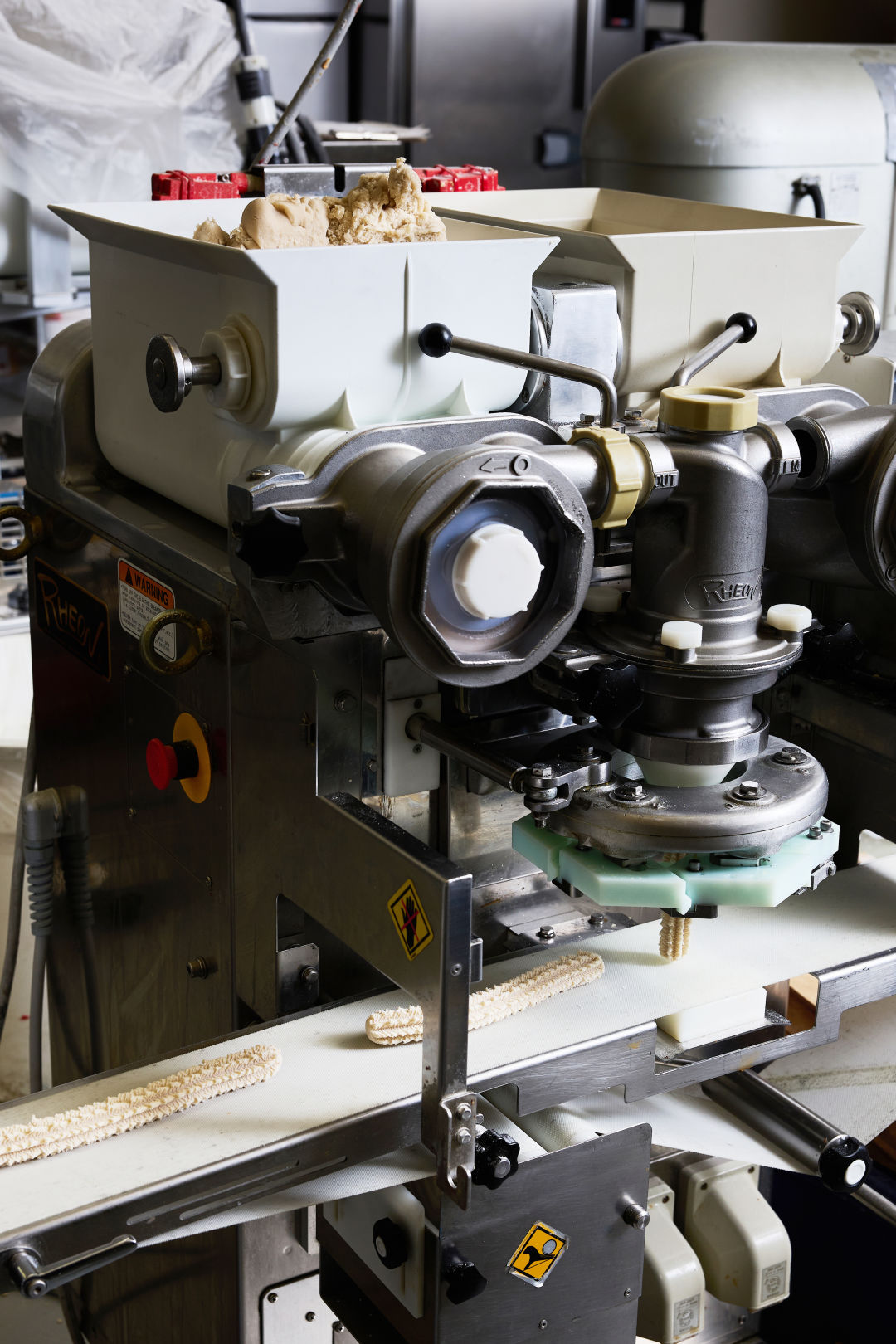
Image: Amber Fouts
That decision established the Magic Kingdom as the United States’ unlikely churro mecca. One advertising technology company crunched the sales numbers that are public and concluded churros are more profitable for Disney than its entire streaming home entertainment division. Tracking the seasonal flavors, anything from fluffernutter to sour cherry, is a pastime among Disney fans. In the United States, many people’s foundational experience with churros is less Mexico, more mouse ears.
As fried dough goes, the churro has had more eras than Taylor Swift, more personas than David Bowie. Its winding path—from Spanish cafés to Mexican panaderías to Disneyland carts—blends colonization with assimilation, industrialization with novelty culture.
In other words, the churro’s story is also universal to most of the foods we eat.
Image: Amber Fouts
Within three months of moving home to help his mother run Alberto’s Churros, Ramirez-Araujo realized he was all in.
The initial draws were more about his family’s legacy, and about being his own boss rather than the churro itself. And, yet: “Somewhere along the way, I realized we were making this authentic product. And that the competition was not making an authentic product.” It made him curious enough to research the churro’s convoluted history.
He did more prosaic stuff, too. Like adding freezers to increase storage capacity and solving a ventilation conundrum that let Alberto’s precook its churros instead of selling only the frozen dough. J&J had been selling frozen prefried churros that restaurants could have ready in just three minutes.
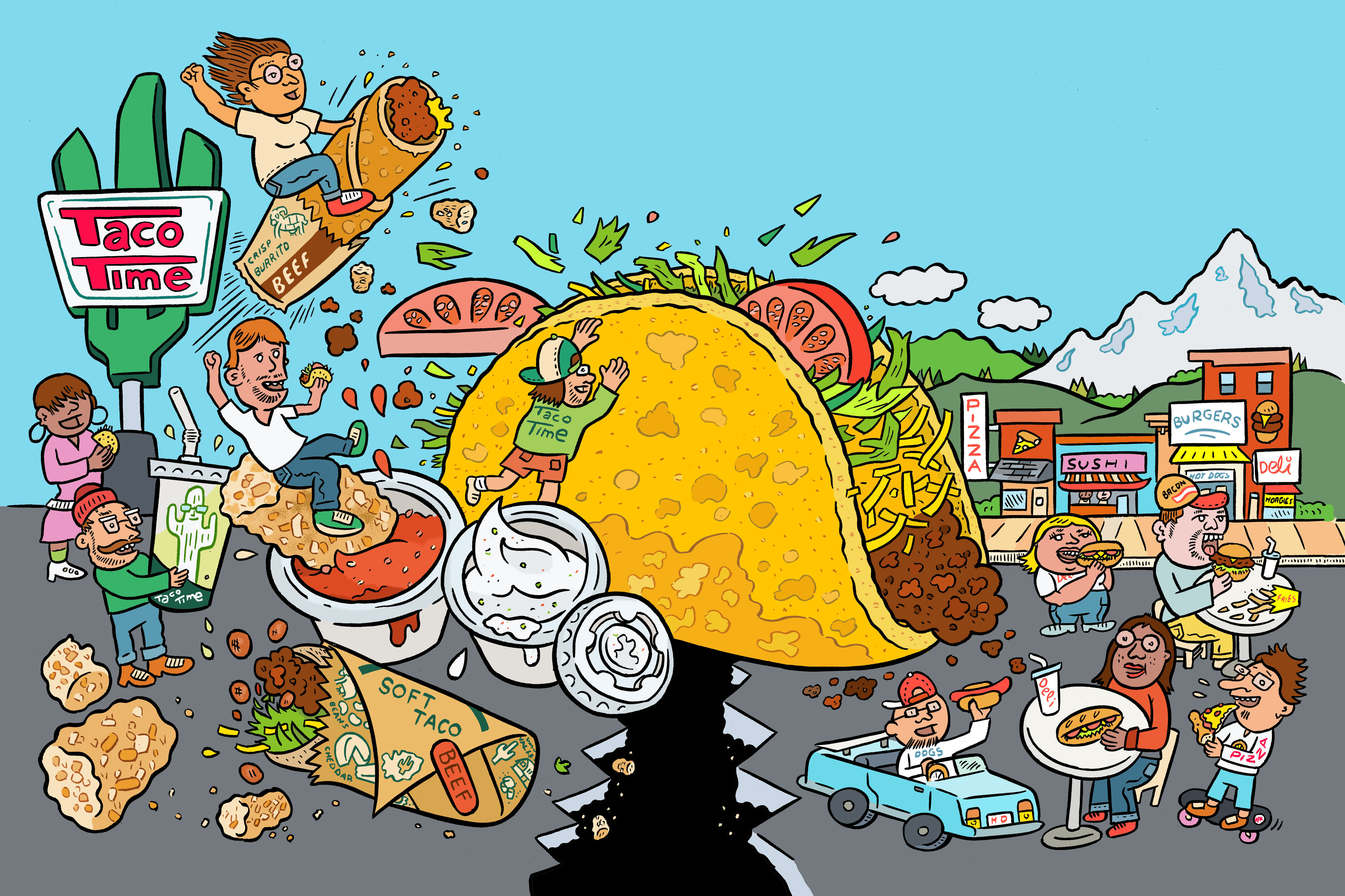
This move brought in new customers, though the company’s finances remained tenuous. Despite being a novice, Ramirez-Araujo notched some wins; today every Taco Time Northwest location has Alberto’s Churros on its dessert menu. He also learned some lessons: The churros didn’t last long at Climate Pledge Arena. That classic eggless recipe didn’t do well in the arena’s kitchen facilities.
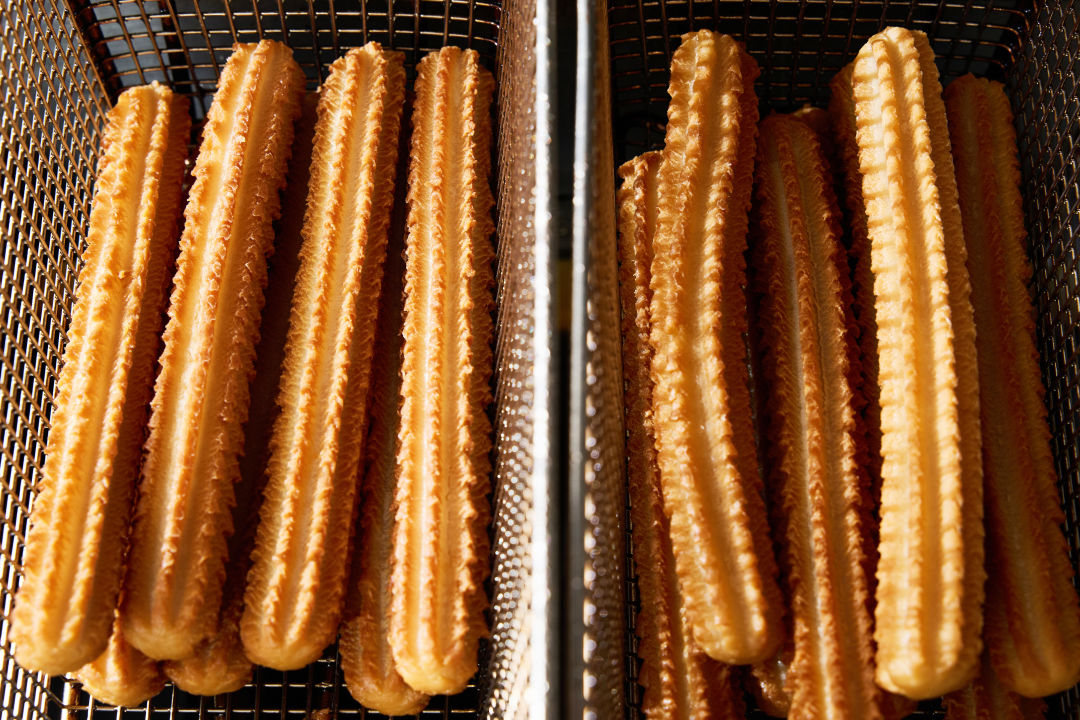
Image: Amber Fouts
J&J’s fluffy, eggy, cakelike churros continued to proliferate. Limited-time fast-food projects proved especially successful. In October 2024, Burger King ran a special Addams Family menu that included “Gomez’s churro fries.” The promotion proved so popular, the churro fries returned at Christmas.
According to its latest earnings report, J&J sold $98 million worth of churros in the most recent fiscal year. In an emailed statement, the company said churros’ cultural roots are “a foundational element to the ¡Hola! Churros brand as a majority of J&J Snack Foods’ employees on the West Coast, where most of the product is made, are Hispanic—as was the original owner of the churros manufacturer acquired by J&J Snack Foods.”
In May 2025, Ramirez-Araujo drove to Spokane and set up a booth in a big events facility. A local food distribution co-op was holding its annual expo to help its members find new products. Ramirez-Araujo envisioned grocery chains frying up his churros and putting them in a warmer to sell in the deli or bakery section. The stores that approached him had other ideas.

Image: Amber Fouts
“Everyone said, ‘Oh, this looks fantastic. This would be great in the freezer section.’” Today you can find Alberto’s Churros in various grocery stores in Eastern Washington, and a growing body of Seattle stores, including PCC.
The prefried, frozen churros are the same as before, but selling boxes emblazoned with the Alberto’s Churros logo directly to shoppers is a big change after 38 years wholesaling behind the scenes. Ramirez-Araujo had to shorten the churros’ length to fit inside your standard American air fryer. Still, they count as traditional. At least in the eyes of one Argentinian American in an Edmonds industrial park, using a Japanese machine to manufacture a treat that, we’re pretty sure, came from Spain.

Pie in the Sky
Eat This: Mexican Pizza at Pedrito's Pizzas Locas
Matcha More
Eat This: Xôi Mặn at Phê

Big Dumpers