Prince of Pork, Scion of Charcuterie, Armandino Batali Dies at 88

Image: Sarah Flotard
Armandino Batali wasn’t the first person to bring Italian food to Seattle—that would have been his grandfather Angelo Merlino, back in 1903. He did, however, revolutionize it when he opened a tiny Pioneer Square deli as a retirement project in 1999. Though Merlino's later evolved into a general distributor, in its early days as a market it sold a selection of cured meats not too different than the ones Batali crafted at Salumi. The founder of Salumi and scion of charcuterie passed away suddenly on November 28, at the age of 88.
While his maternal grandparents publicly carried on Italian food traditions in Seattle, Batali grew up on a Yakima Valley farm, where his paternal grandparents privately did the same. He attended St. Martin’s University in Lacey, Washington, and remained an active supporter of the school for the rest of his life, using his culinary connections to bring in a steady stream of food-world stars (Rick Bayless, Jacques Pepin, Guy Fieri, Lidia Bastianich, Andrew Zimmern) to headline its annual fundraising gala.

Image: Sarah Flotard
Batali spent more than three decades working in quality control for Boeing before taking up a rather atypical retirement hobby: making cured meats. Three years later, in 1999, that hobby became Salumi, a shoebox of a deli on Third Avenue S. He—and his team, heavily made up of family, including his wife, Marilyn—made fat-dappled chubs of salami, fennel-scented finocchiona, and spicy soppressata, and cooked dishes like herby slow-roasted porchetta and tender meatballs, laying them out in impressive platters or stacking them messily onto artisan bread.
His cheerful enthusiasm and serious attention to detail quickly caught the eye of hungry Seattleites and food writers, both local and national. The only complaint anyone ever lodged was about the short hours—Tuesday to Friday, lunch only. Lines squiggled down the block each day, for the standard menu of sandwiches, but particularly on Fridays, when Batali’s sister, known as Aunt Izzy, made gnocchi in the front window.
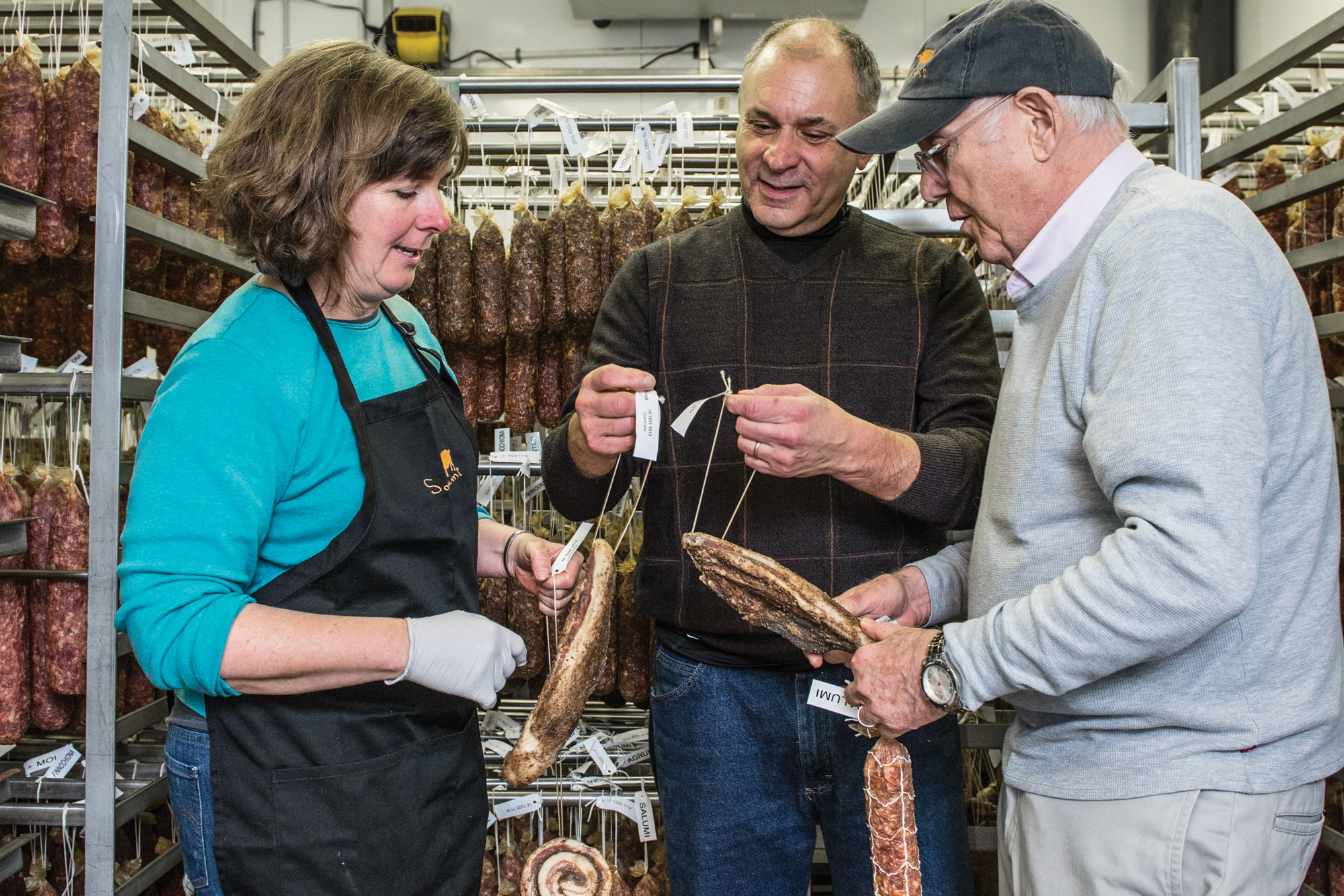
In 2004, Batali added a production facility and curing room, allowing them to produce more of their renowned lamb prosciutto and, later, culatello, a rarity in the US, and to wholesale the product to other restaurants. The onetime aviation company quality control director created the same type of precise systems to meticulously ensure his meats were nothing but the best. But he understood that hospitality was as much art as science.
The restaurant’s backroom dinners (later lunches) allowed groups of eight to 10 to reserve the table for a menuless five-course meal at the whim of the chef. It might have kicked off with excessive platters of thin-sliced salumi and lardo lollipops on grissini followed by soups whose thin broths belied their big flavors. Grand servings of fresh noodles, slow-roasted meats, and hand-pulled mozzarella ensued, with colorful pickled and roasted vegetables and seemingly infinite bottles of wine. Reasonably priced, and lasting multiple hours, the meals sold out as soon as reservations opened and became a must-stop for food and travel writers—in 2009, Anthony Bourdain told The Seattle Times, “That is a holy place for me. I love that place. I’ve jokingly said, but I’m half serious it should be a UNESCO site. It should be a landmark.”
Though Batali quietly sold the restaurant to his daughter, Gina, and her husband, Brian D’Amato, in 2007, little changed; they had been partners in the business and run day-to-day operations for years, and Batali continued a presence at the store, though in a much more relaxed fashion. The larger shift came a decade later, when the company was sold beyond the family. The new owners moved the deli, opened a large production facility in Kent, and changed the name of the wholesale business (now Coro by Salumi).
Batali’s second retirement looked a little more typical, with golf, travel, fishing, and cooking for his family and friends—and for all in need of a free hot meal on Fridays at the St. James Cathedral kitchen. Batali’s wife, Marilyn, died in 2020. He is survived by his three children, Gina, Dana, and Mario, and six grandchildren. The family suggests anyone wishing to make a donation or gesture of support direct it to the St. James Cathedral kitchen.