Why Does Canada Have So Many Great Waterslides?

“Is there a pool?” It’s a question both eternal and essential. The answer I got on one vacation, from the friend who’d picked the cheap hotel in the remote Canadian town of Revelstoke, caught me off guard: “No, something better,” he said. “The hotel gives you free passes to the town pool.”
Visions of municipal-grade concrete and dingy locker rooms came to mind. Beginner lessons and lap swimmers all crammed together, shrieks echoing off the walls—hardly a vacation vibe. But those fears vanished with the first look at the Revelstoke Aquatic Centre, where the curl of a red tube on an exterior wall showed a waterslide exiting and then reentering the building—more Great Wolf than government-issue.
Inside, a rock wall hung over the lap pool and a lazy river wound through one corner, lined with fake Disney-style boulders piled under big, fake trees. A giant mushroom-
shaped fountain dumped water back in the shallow end of one pool, and in front of the doors to the sauna and steam room was a hot tub big enough to host a family reunion.
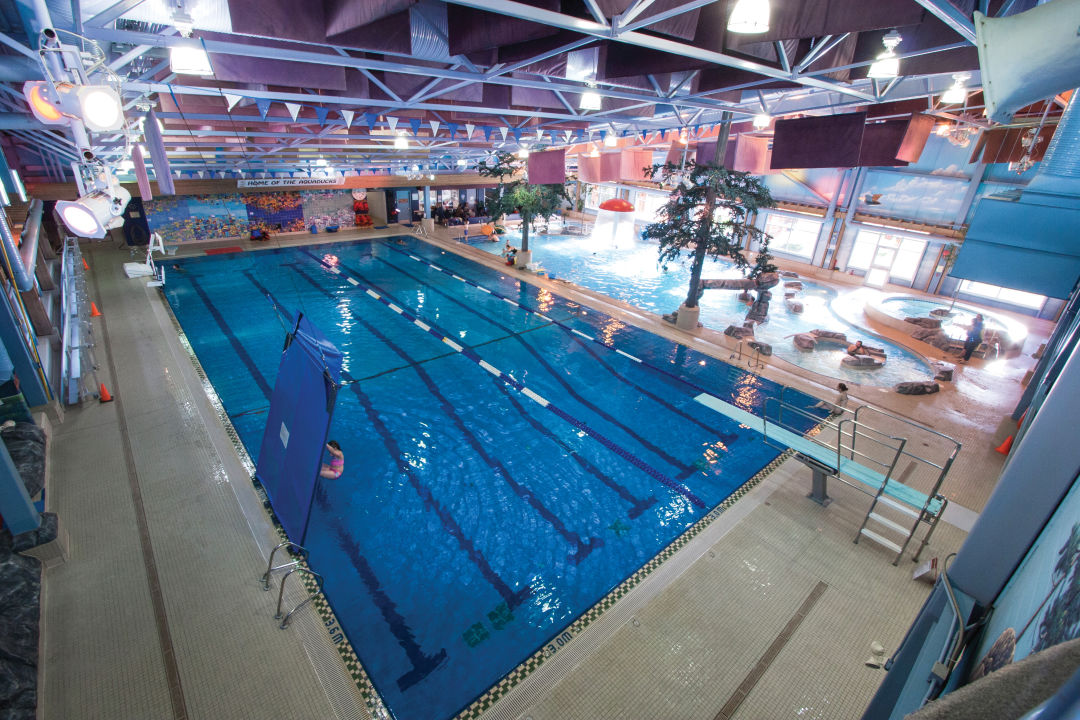
Image: Courtesy Natalie Harris
Revelstoke, despite its proximity to a world-class ski resort, is home to only 8,275 people. How does a place the size of North Bend come to have a mini water park in the middle of town? Especially one that only costs about $8 Canadian to enter? And less than that for kids?
What’s most notable about Revelstoke’s aquatic paradise is that it’s not that rare in Canada. Halfway back across the province, just north of Mount Baker, the town of Harrison Hot Springs is famous for the heated waters and the five fancy soaking pools in the town’s central resort. But while only overnight guests are allowed there, a few blocks away the town’s indoor public mineral pool pumps the same water into a pool for everyone.
Cheap, public places to swim are scattered across the country; Whitehorse, all the way up in the Yukon Territory, has a similar setup of waterslide and lazy river, and Whistler’s Meadow Park Sports Centre serves as a hot tub escape for anyone whose condo rental didn’t come with all the amenities.
Canada boasts more than 5,000 publicly owned aquatic facilities; meanwhile, New York Times editorial board member Mara Gay wrote in 2023 that “the United States is, for a majority of its citizens, a swimming desert”—with far too few pools, and many of them restricted to club members, certain homeowners, or another exclusive group. The author of a book about the subject told her that the US was “extraordinarily parsimonious in our willingness to fund public swimming pools.”

Image: Courtesy Natalie Harris
Perhaps it’s all that Canadian cold that drives public support of indoor recreation; still, those municipal facilities aren’t the only way to get in a vacation splash. Motels across British Columbia tend to have waterslides attached to their indoor pools as a matter of course, often at properties that run less than a hundred dollars a night. The Mountain Retreat Hotel and Suites in Squamish doesn’t look like much from the highway, just a cheap overnight on the way to Whistler, but I’ve taken more than a few rides down its yellow tube slide.
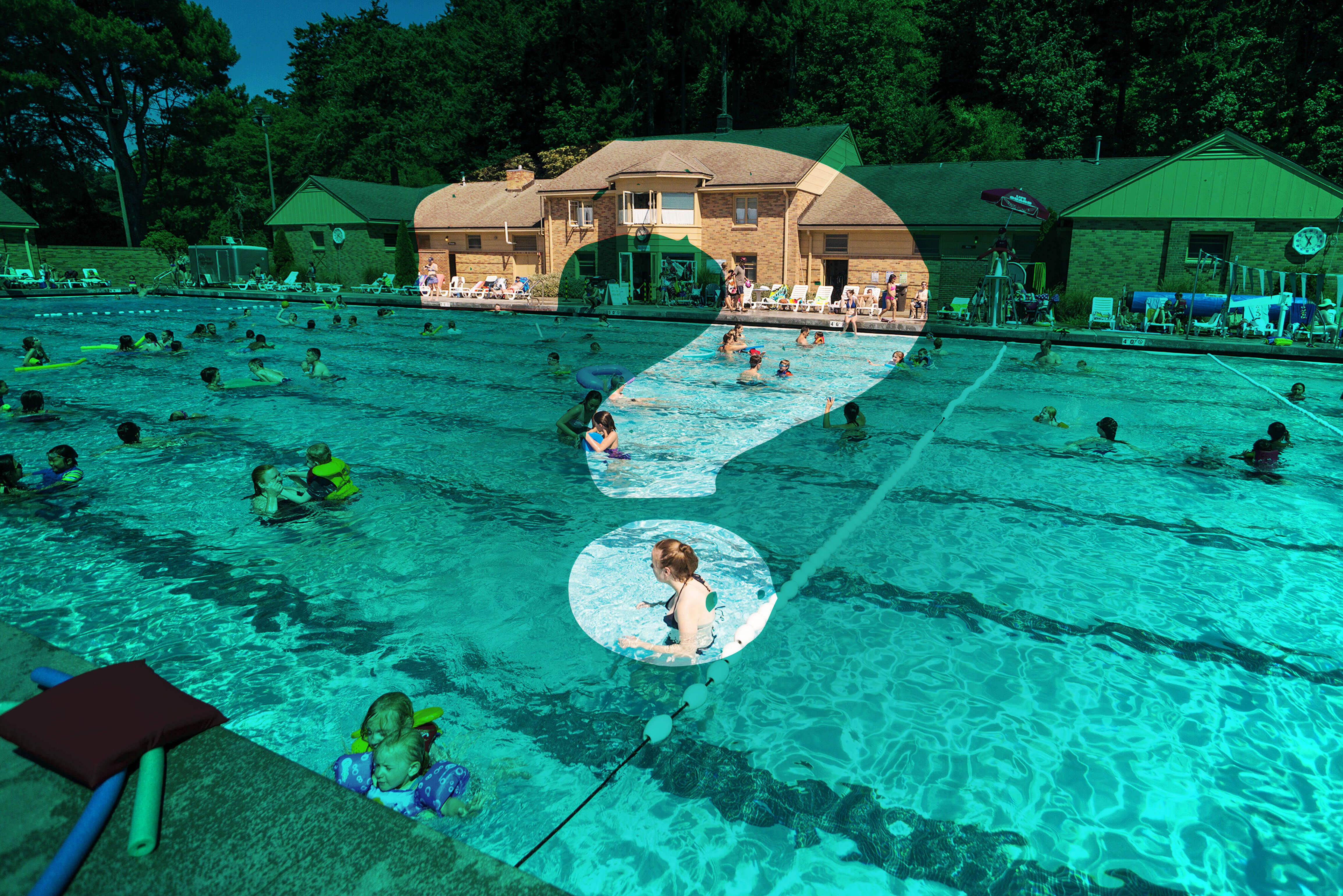
The question, then, may not be whether there’s a pool on a vacation to Canada—the question is why we can’t have nice things closer to home. Sure, we have a Great Wolf Lodge, where day passes can run as high as $100 and overnights are even steeper. And while the greater Seattle area is blessed with many great public pools, indoors and out, they’re not common in such vacation destinations as, say, Leavenworth, which like Revelstoke is a mountain town with a strong recreational vibe.
In the early 2000s, Revelstoke residents got ambitious after the town decommissioned its outdoor pool, says Laurie Donato, the city’s director of parks, recreation, and culture. They fundraised for something more. “Recreation is really important for our residents and the quality of life,” she says. The big red waterslide might be the biggest hit. (From my own shrieking ride down, I can report that you can’t really tell that the slide tunnel travels outside during its loop-de-loops.) And while the center is partially funded by city taxes, Donato notes that it’s popular with visitors as well as residents.
Could Leavenworth create something similar? In 2022, the city of Leavenworth commissioned a feasibility study on turning the city’s simple, aged outdoor public pool into something that resembles the Canadian ideal: “The hottest trend in aquatics today is the recreation pool concept,” the study notes. “Incorporating water slides, lazy rivers or current channels, fountains, zero depth entry ‘beaches,’ and other water features is extremely popular.” The second-home owners and visitors provide a big user base for a potential facility, it notes.
A new indoor aquatic center, more than 20,000 square feet in size, would cost an estimated $19–22 million. No small investment. One survey found that almost 70 percent of Leavenworth-area residents supported the idea of using an increased sales tax to fund it—but increasing property taxes was much less popular. After the report came out in 2023, the project was put on hold, though there’s a similar push underway in Wenatchee. In the meantime, our local vacation spots remain, more or less, high and dry.