A New Director at Transportation Choices Coalition, a New Way to Build Tall, and New Revelations

I'm swamped working on a feature story for the upcoming issue of the magazine, which gives me a perfect excuse to resurrect On Other Blogs Today (OOBT!) this morning, the PubliCola roundup of noteworthy articles out there.
1. For starters, Erica over at The C is for Crank has a long Q&A with Shefali Ranganathan, the brand new executive director of Transportation Choices Coalition. Erica and Ranganathan talk about TCC's evolution into a social justice organization, ST3, Ranganathan's position as a woman of color in a traditionally white male world (transportation planning), and Ranganathan's take of the commercial parking tax (pro!) and the employee head tax (mixed!)
Here's Ranganathan on the employee tax, which, under the Nick Licata/Kshama Sawant reboot would have been a straight count on numbers of employees rather than working in transit incentives.
With the head tax, the whole idea was [originally] to reward employers that were getting their employees to use transit [by providing a tax incentive for policies that encourage transit use], and so I don’t want it to be a way to sort of shift modes in the opposite direction. [The Sawant/Licata proposal would have eliminated the incentives to commute in ways other than driving alone.] That’s the question we asked Licata’s office. Theoretically, we supported the head tax and we weren’t happy when it was repealed, but if you remove all the exemptions for people who are doing the right thing, are you inadvertently creating a situation where employers are like, this doesn’t make sense for me to do anymore? If I’m paying the head tax anyway, why would I subsidize a bus pass?
But the CPT, we’re all about. We think it needs to happen and I think it’s the right time for it to happen.
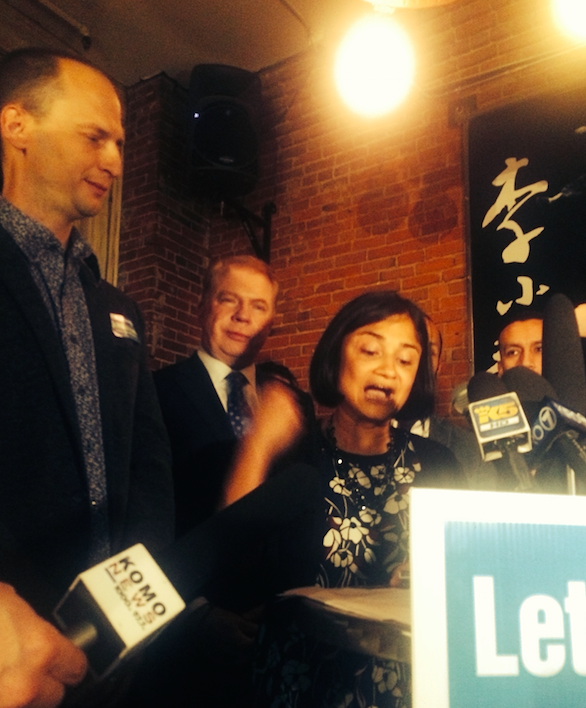
And here's Ranganathan on how TCC's focus on transit intersects with social justice.
When the bus cuts were happening, we did some mapping to see where service would be lost. But we didn’t do it in terms of, where do all the poor people live and where are the cuts coming? We asked questions like, How long does it take you to get to a community college on a bus? How long does it take you to get to health care? Where can you get in 30 minutes? And then that was where you started to see some of the disparities emerge in south Seattle and in south King County. These are transit-dependent communities that don’t have great transit service. So our focus is really pushing policy makers who are not the transit nerd, transit planning types to really think of it like, if I care about education, am I inadvertently cutting people off from transit access with cuts in service? That’s actually how ORCA Lift emerged.
ORCA Lift is the low-income fare card for Metro and light rail and Sound Transit that TCC helped establish.
2. The Portland Mercury has a (fanciful?) article about cross laminated timber (CLT), a wood-based building material that allows developers to go tall without relying on steel; the high costs of steel have limited developers from taking the city up on height-for-affordablity trade offs (like the old incentive zoning program or the current dickering over numbers in the new inclusionary zoning plan.)
From the article:
But the most hopeful part of building with CLT—at least for Portland—is that it could be a tool to help the city address its affordable housing crisis.
Framework, the new 12-story project in the Pearl, will be a mix of office space, retail, and residential, and its backers plan to include five floors of workforce housing (units that are affordable for tenants making between 60 and 80 percent of the area's median family income).
"Including workforce housing in this project has always been part of the vision," Hallova says. "We intentionally designed this building so it can be as affordable as possible, and with this type of construction we're able to minimize materials and reduce waste."
Vern Rifer, a principal at Portland-based Rifer Development and a Portland State University instructor, says the taller you build with concrete and steel, the more expensive construction becomes per square foot, because the base materials must be stronger and thicker to support the added weight up top. That's not the case with CLT high-rises.
"Wood is a material that's suited to go tall because it's much lighter and only has to support itself," Maness says.
So increasing height in tall-timber buildings doesn't mean increasing construction cost. And the affordability's helped by the fact that CLT is prefabricated. Maness compares the process to building a piece of IKEA furniture.
All that helps immeasurably when it comes to convincing developers that building below market-rate homes is a good idea. Home Forward's Buonocore says he's "never seen this much interest" in producing affordable housing, especially from the private sector.
3. And set this epic piece of journalism aside for the Thanksgiving holidays when you've got plenty of time to dig in.
The Northwest News Network's Austin Jenkins has written an in-depth report on disgraced Washington state auditor Troy Kelley.


