Remembering Seattle's Teen Music Ban
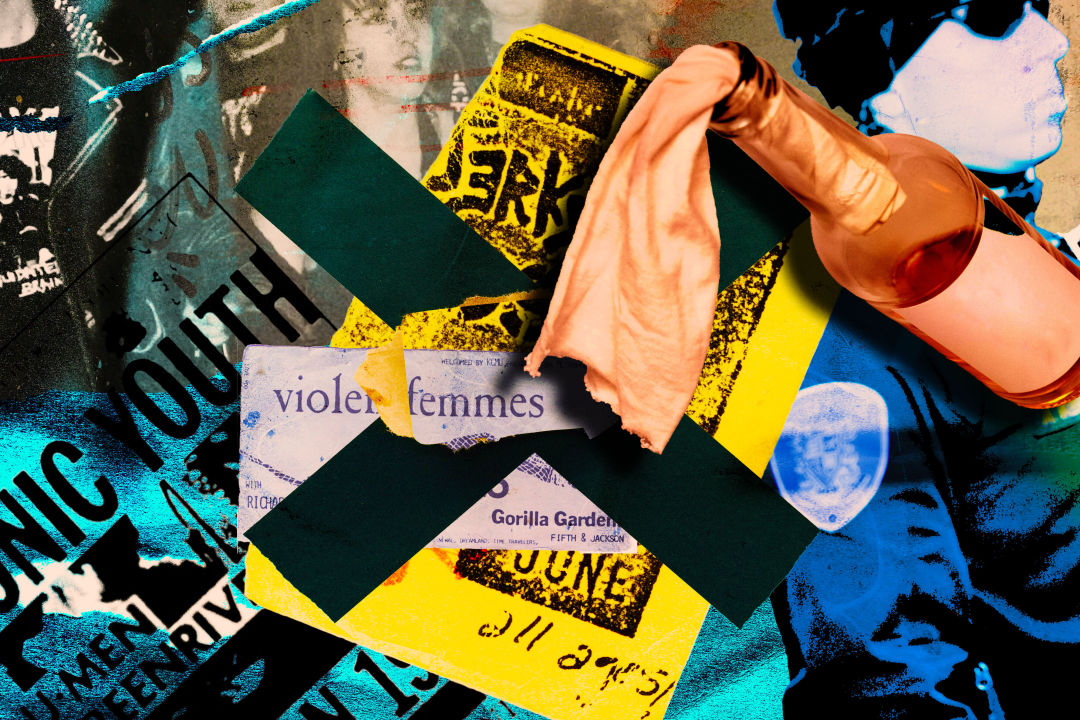
On a snowy November night in 1985, a typically quiet intersection on the south side of the Fremont Bridge became an urban warzone. The Seattle Police Department had been called in to break up a punk rock show at Gorilla Gardens, a DIY music venue housed in an old auto body shop. When SPD showed up, the punks fought back. “Several police cars and a fire department car were damaged,” reported KIRO news, “after the youths began throwing things at police.”
These “things” included snow-covered bricks and Molotov cocktails. The “youths” were upset because policemen had barged into the venue and, without any warning, cut power during a Circle Jerks concert. Showgoers tumbled from the darkened venue into an eager swarm of nightsticks.
The police weren’t operating at the mandate of an ordinary noise complaint, nor anything we’d generally think of as criminal. They were enforcing Seattle’s recently instated Teen Dance Ordinance (TDO), a statutory moral panic highlighted this month in KUOW’s podcast Let the Kids Dance!
“The Gorilla Gardens Riot,” says podcast writer and host Jonathan Zwickel, “was the opening skirmish in a war between Seattle’s music community and establishment forces, a war that waged for 17 years and in the process dramatically altered the world-changing music that would soon explode out of the city.”
Zwickel had been covering Seattle’s music scene for a decade when, in 2017, he became a board member at all-ages musical nonprofit the Vera Project. From within, he took an interest in the early-aughts legislative battle that led to Vera’s founding and the termination of the city’s infamous TDO.
Ordinance 112373 was approved by the Seattle City Council in a unanimous 8-0 vote on June 29, 1985. Mayor Charles Royer signed it into law two days later, placing an effective ban on under-20 musical gatherings by creating a series of unrealistic security and insurance requirements. It arose from public backlash surrounding lewd stories about area venues, in particular a queer-friendly, all-ages space named the Monastery, a converted Methodist church at the corner of Boren and Stewart that shuttered shortly before the TDO’s enactment.
Intrigued by this history, Zwickel did what journalists do. He dug. Why had the city enacted a widespread arts ban during its most essential years of creative output? Was one a consequence of the other?
Zwickel, 49, grew up in West Palm Beach, Florida, and moved to Seattle in 2007 to take a job at The Stranger. In the Northwest, he found an assortment of grassroots musical communities that would have been “unheard of” back home. But the more he learned about the TDO, the more it belied local reality. For nearly two decades—two recent decades—Seattle’s government had hamstrung the very thing that would put the city on the map. This suggested that the grunge era had transpired not because of Seattle, but in active conflict with it.

Image: courtesy KUOW
Zwickel’s TDO research turned up heaps of local coverage. Like him, many a journalist had marveled at the ordinance’s hypocrisy. One thing Zwickel didn’t find was a longform, source-heavy retrospective on the entire saga: the Monastery, the social hysteria, the slow-burning aftermath. He decided to write the piece himself. His eureka moment arrived, in piecemeal fashion, as he turned up archived television and audio recordings from a number of historic touchstones.
“I’d been listening to a podcast at the time,” says Zwickel. “An investigative longform piece of journalism. And it became clear to me, oh, this is the format for the story. We have all this audio, all this music. People can speak in their own voices. We can really make this an immersive thing.”
Zwickel’s project became Let the Kids Dance!, a seven-part podcast series that wrapped up mid-May on KUOW. It’s available to stream on major podcast platforms. Written and narrated by Zwickel, the story begins with the Monastery and concludes with the 2001 mayoral race between Mark Sidran and Greg Nickels. Sidran likely would have upheld the TDO; his narrow defeat spelled the law’s downfall.
Zwickel focused his research around a single city ordinance, but the tale grew into an illustrative parable of Emerald City governance. At the heart of Let the Kids Dance!, Zwickel says, “There’s this constant friction between elected officials who have a certain vision of the city—and who often kowtow to big business interests—and the people who actually live here and work for those businesses.”
“Between here and Minneapolis,” he continues, “if you’re queer or creative, and you want to make your art and be more alternative than your small town allows, you end up in this place. That’s the vision of Seattle that captured the popular imagination, and it’s music that brought it to the fore. The reality is, the city was actively trying to squash that music at the time when it happened.”
To Zwickel’s credit, his podcast narration doesn’t overdo the spin—his sources are more outspoken than he is. Let the Kids Dance! features interviews with a bounty of key TDO figures, from then-teens lamenting their lack of creative and social outlets, to Nickels, to Monastery founder George Freeman (now known for his eccentric house off I-5). Musician spots include Circle Jerks singer Keith Morris, Seattle rapper Derrick “Vitamin D” Brown, and Death Cab for Cutie guitarist Chris Walla, who speaks to the frustration of loving music in a civic environment that severely devalued it. Most effective are the reams of audio samples Zwickel harvested from radio, television, and Seattle government archives.
Listeners will leave Let the Kids Dance! with a new historical foundation to contextualize our city’s present-day politicking. It’s relevant that Mark Sidran, famous for his stifling “civility laws,” was a registered Democrat. Ostensible lefties have always tousled in the Emerald City. The Seattle Police Department has always drawn progressive ire. None of this is new—but have we learned anything? In the podcast’s final episode, Zwickel says that for today’s Seattle youth, “the enemy isn’t politics, it’s economics.” In the age of Amazon and Microsoft, he wonders if one can possibly claw free of the other.
“A lot of transplants envision a creative utopia here,” says Zwickel. “The fact of the matter is, it’s really hard to live and work here as an artist or a musician. The city has never made it easy, and has never really welcomed these people. What fuels these artists is individual commitment. Whether or not that can ever coexist with Seattle’s company town mentality—that’s compelling.”