Seattle’s Decade of Attempts to Fix the Police: A Timeline
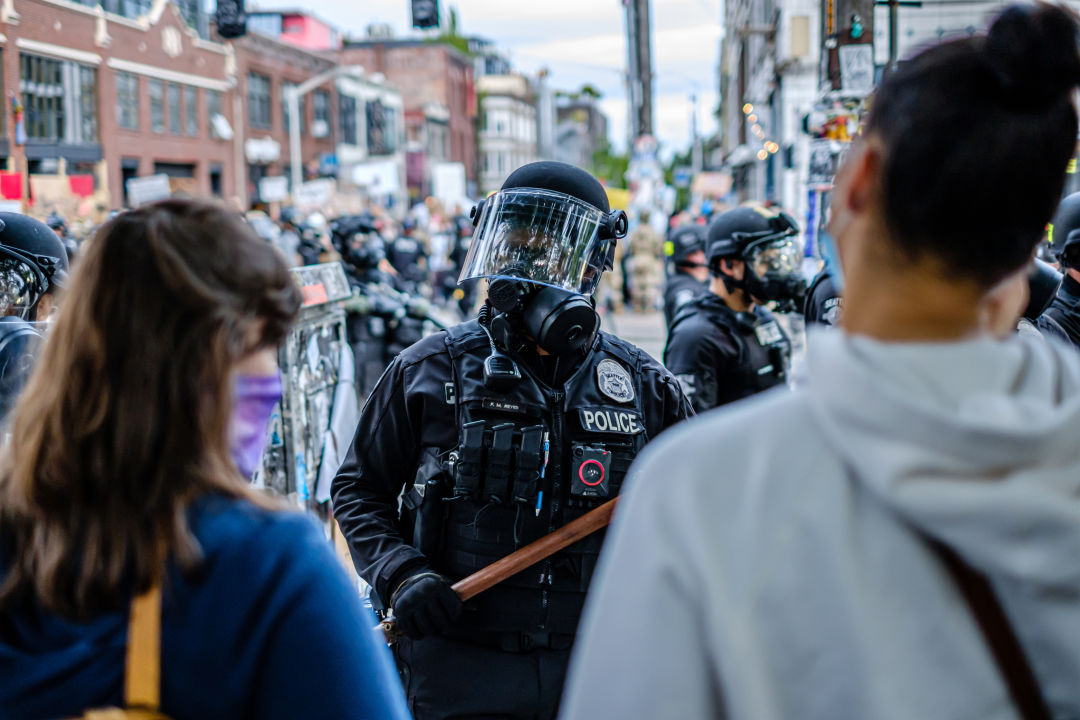
June 6, 2020: Demonstrators watch Seattle Police setting a new perimeter after dispersing the crowd with flash bangs and pepper spray.
Defund the police. That became the refrain when protests over police violence and racial bias shook Seattle in the aftermath of George Floyd’s killing this May. But in the previous decade, the city’s focus landed not on reallocating Seattle Police Department’s budget, but on reforming its existing systems. For community advocates, improvement feels infuriatingly slow. A step forward, a step back. As the conversation progresses this year, here’s a look at where we’ve been.
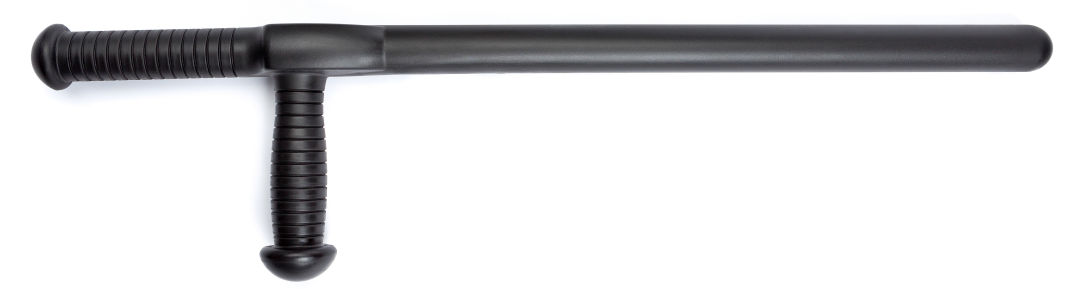
Image: Shutterstock by Robtek
2010 – The Investigation
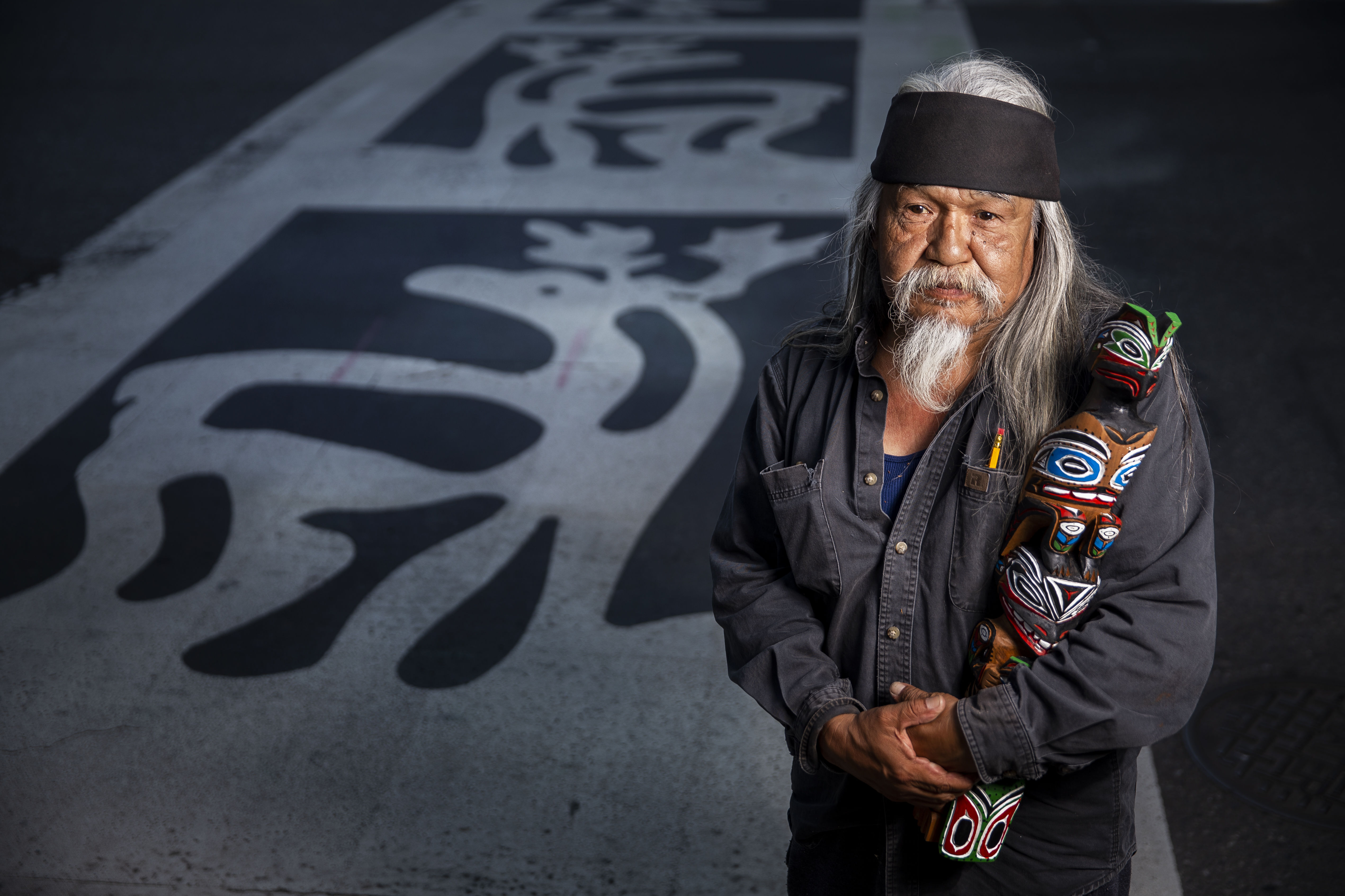
Citing incidents of excessive force and racial bias—including the killing of Native woodcarver John T. Williams—a cadre of local organizations headed by the ACLU of Washington asks the U.S. Department of Justice and Jenny Durkan (then a U.S. attorney) to investigate the SPD’s use of force.
2012 – The Consent Decree
The investigation finds ongoing “constitutional violations regarding the use of force…as well as serious concerns about biased policing.” A 2012 agreement between the DOJ and the city aims to make SPD’s actions jibe with the U.S. Constitution and laws. Certain portions of the decree can be lifted after two years of the city’s sustained compliance.
2013 – Community Police Commission
The decree also creates a Community Police Commission, a group of 15 volunteers who review police accountability and make reform recommendations. In 2014 the CPC presents a list—demanding things like “departmental neutrality” in investigations of police misconduct.
2017 – Accountability Ordinance
After three years of trying unsuccessfully to get recommendations through internally, the CPC changes course and gets city council to vote in an ordinance enacting reforms, like making it harder to reverse officer firings. The law also creates a new oversight department and makes the CPC permanent. It’s announced as a “landmark” change. At the same time an assessment of SPD’s use of force in a span between 2014 and 2016 is sent to the DOJ. It shows:
2017–2019 – SPD Union Contracts
Contracts with SPD’s two unions—SPOG (Seattle Police Officers Guild) and SPMA (Seattle Police Management Association)—later counteract the ordinance’s reforms, accountability advocates say. A federal judge agrees; the city is no longer in compliance with the consent decree.
2018 – Initiative 940
This passed initiative, called “De-Escalate Washington,” removes the requirement that prosecution prove “evil intent” or “malice” when an officer uses deadly force. It requires that another “reasonable” officer verify that deadly force was necessary to save someone—an officer, or another person—from death or serious harm. But The Seattle Times found this June that the law has “no mechanism” to hold departments accountable for not following it.
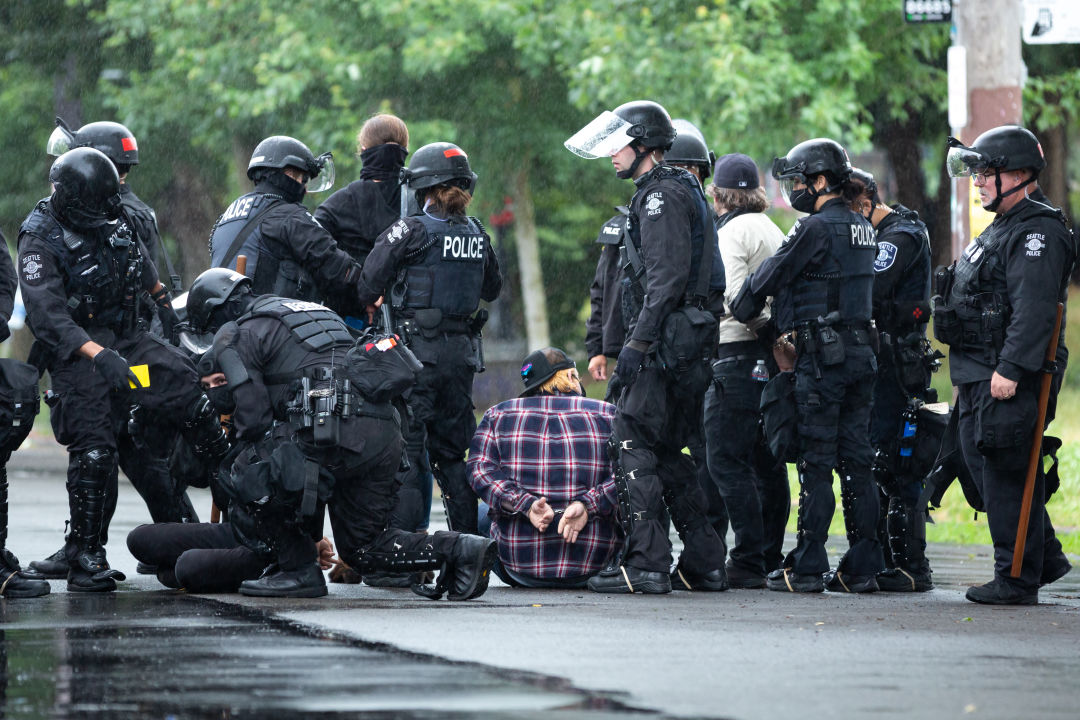
July 1 2020: Protesters under arrest by Seattle Police clearing the Capitol Hill Occupation Protest (CHOP).
Image: Shutterstock by VDB Photos
2020 – Protests
As Black Lives Matter-inspired protesters face tear gas and other forms of police aggression after Floyd’s death, the city withdraws its motion to end the consent decree. SPD will remain under federal oversight. The city held a public hearing for SPMA’s contract in September 2019. SPOG’s contract expires at the end of this year.
Seattle’s 2020 $1.5 billion Adopted General Fund Budget

► Administration 19 percent
► Arts, Culture, and Recreation 12 percent
► Health and Human Services 10 percent
► Neighborhoods and development 5 percent
► Utilities and Transportation 4 percent
► Other Public Safety 23 percent
► SPD 27 percent – $406,980,000
Use of Force
In 2019, SPD broke this spectrum of behaviors into three types. In these a cop might…

► 1. Point a gun or hit or restrain someone hard enough to cause pain. 77 percent of UoF in 2019
► 2. Taser, pepper spray, or take someone down in a way that likely causes physical injury. 21 percent of UoF in 2019
► 3. Shoot a gun, hit someone in the head with a baton, or hold them by the neck. These cause, or can be expected to cause, “great bodily harm… or death.” 5 percent of UoF in 2019
Terry Stop
An officer stopping a person under “reasonable suspicion.” A review of 2019 found that 31 percent of those stopped were Black. Officers frisked 26 percent of those stops and found weapons 16 percent of the time. Here are the white numbers: 51 percent of stops (Seattle is 65 percent white); 18 percent frisked; 25 percent had weapons.