How an Immigrant Craftsman Gave Us the Aurora Elephant
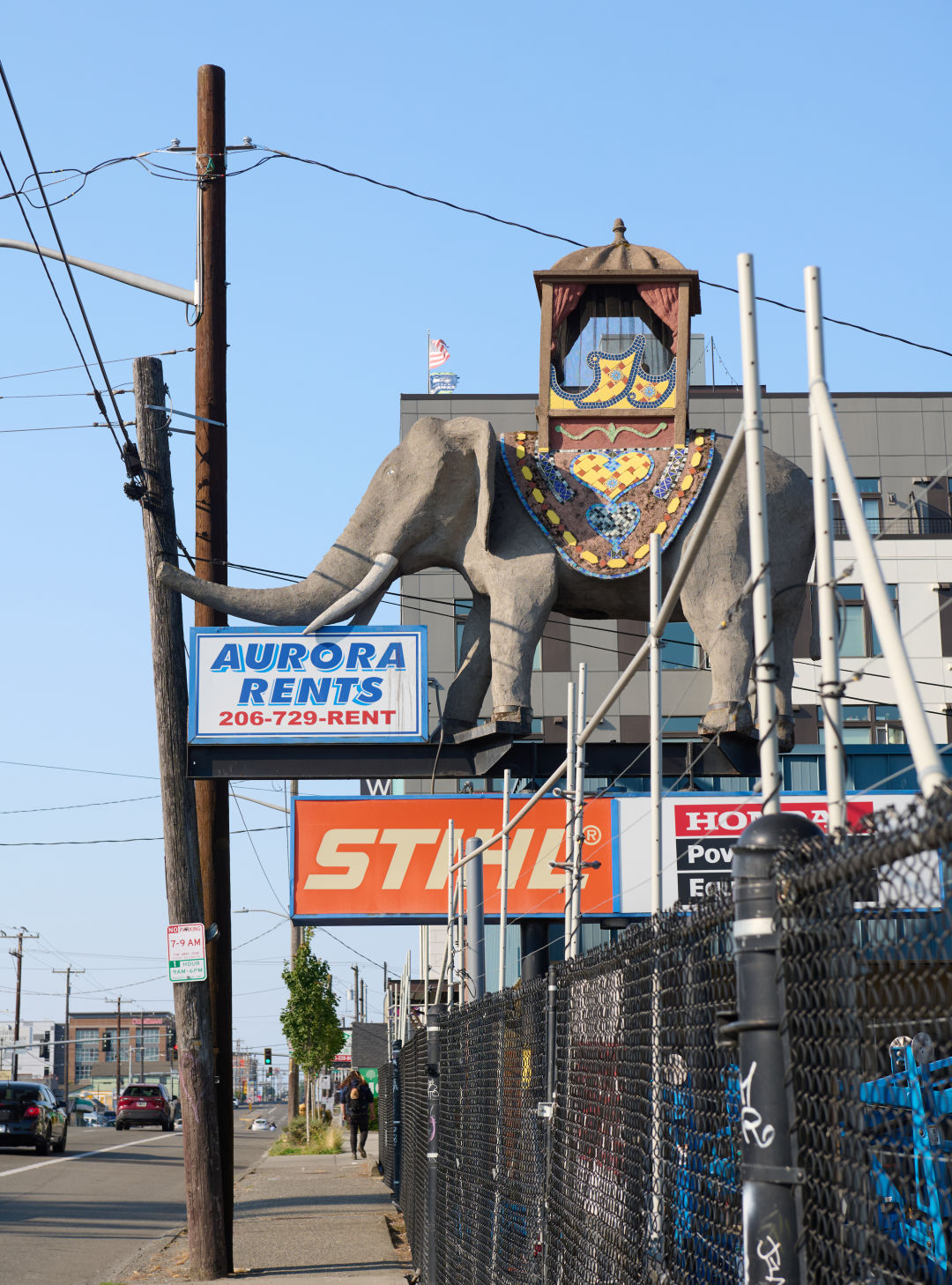
Image: Chona Kasinger
There hasn’t always been a 9,500-pound bejeweled elephant looking down on Aurora Avenue. When Giovanni “John” Braida, the person most often credited for the elephant’s creation, first migrated to the United States in 1888, Aurora hadn’t yet been platted by city leaders, much less become a major thoroughfare, or state highway.
Today the elephant, which stands on a pedestal on Aurora and North 88th Street, has become a fixture in the Seattle landscape. The story of Braida and his creation is representative of how cities are made. What may seem like roadside kitsch is in fact a window into Seattle’s history. Our icons all come from somewhere.
According to immigration documents, Braida was born in 1873 in a region of Italy near Venice called Friuli. For hundreds of years, it had been famous for its marble mosaic and terrazzo artisanship. Craftsmen spread their work throughout Italy, then Europe, and eventually the world. When Braida was 15, he got on a steamer headed for New York. It was 1888. In America, he started going by John. He made his way to San Francisco, where he opened a terrazzo store, and eventually, census records indicate, settled in Seattle, where he set up shop in 1915 as a terrazzo artisan in a house near the Gas Works (still an actual plant then, not yet a park).

The Aurora elephant back in 1976.
Image: Courtesy MOHAI
Braida and his crews built the elephant out of chicken wire and concrete in his yard, then decorated the saddle blanket and covered seat on its back with colorful mosaics. At the time, a streetcar line still ran nearby; riders could spot the elephant as they rounded a curve. The work of art grew into a local landmark, built with skills that had been passed down for generations in an Italian village. It was also a uniquely American bit of showmanship that drew customers to Braida’s business.
The streetcar was dismantled in 1941, and Braida passed away in 1943. A few years after that, his son Hector sold the elephant to a flower shop owner, who transported it via Model T to his storefront on Aurora and North 88th Street. By then, Seattle had become a car city, and over the ensuing decades the elephant itself became a roadside landmark, perched over one of the city’s busiest thoroughfares.
For more than a half a century, the elephant suffered the wear and tear of constant exposure to the sun, rain, wind, and smog. Then, in 2009, the owners of Aurora Rents, the tool and party supply operation that had taken over the flower shop’s address, removed it temporarily for repair. It was a big job.
There’s something wistful about the fact that this weird, massive work of art has spent most of its life living in a place where people only see it as they speed by: a blur among the billboards and streetlights, the precision and craftsmanship of the man who built it all but invisible. But then again, it’s remarkable that we can see it at all.
Editor's Note: This story was updated on June 20, 2023.


