The Massive Charm of Wine Country’s Smallest Towns

It’s just after sunset on a Tuesday, and the empty main street of Dayton, Washington, glows as if it had been painted by Norman Rockwell. A classic movie theater marquee sits on one side of the street, the newspaper office on the other. All along the empty main road, historic stone facades are covered in old-timey murals.
There’s not a vineyard in sight, but Dayton sits right on the fringe of one of America’s best wine regions; the even tinier Waitsburg is 10 miles down the road. We’re just north of Walla Walla, a sizable city with more than 120 wineries, three colleges, and an airport. Walla Walla is Washington’s undisputed wine center. And yet with the recent addition of two charming little hotels, the twin towns of Dayton and Waitsburg have become my favorite way to do wine country.
In dead-quiet downtown Dayton, things are a little more bustling indoors at the Bobcat Room that forms the street side of the new Hotel Hardware. Padraic Slattery, a longtime Seattleite turned small-town hotelier, tends bar. Two years ago, when he and wife Jin Ah bought the property, its Victorian rooms were life-size dollhouse tableaux of doilies and canopy beds. Now updated with bold patterns and cheeky detail, it has a full wall of natural wine bottles for sale and stirrup-shaped door knockers.

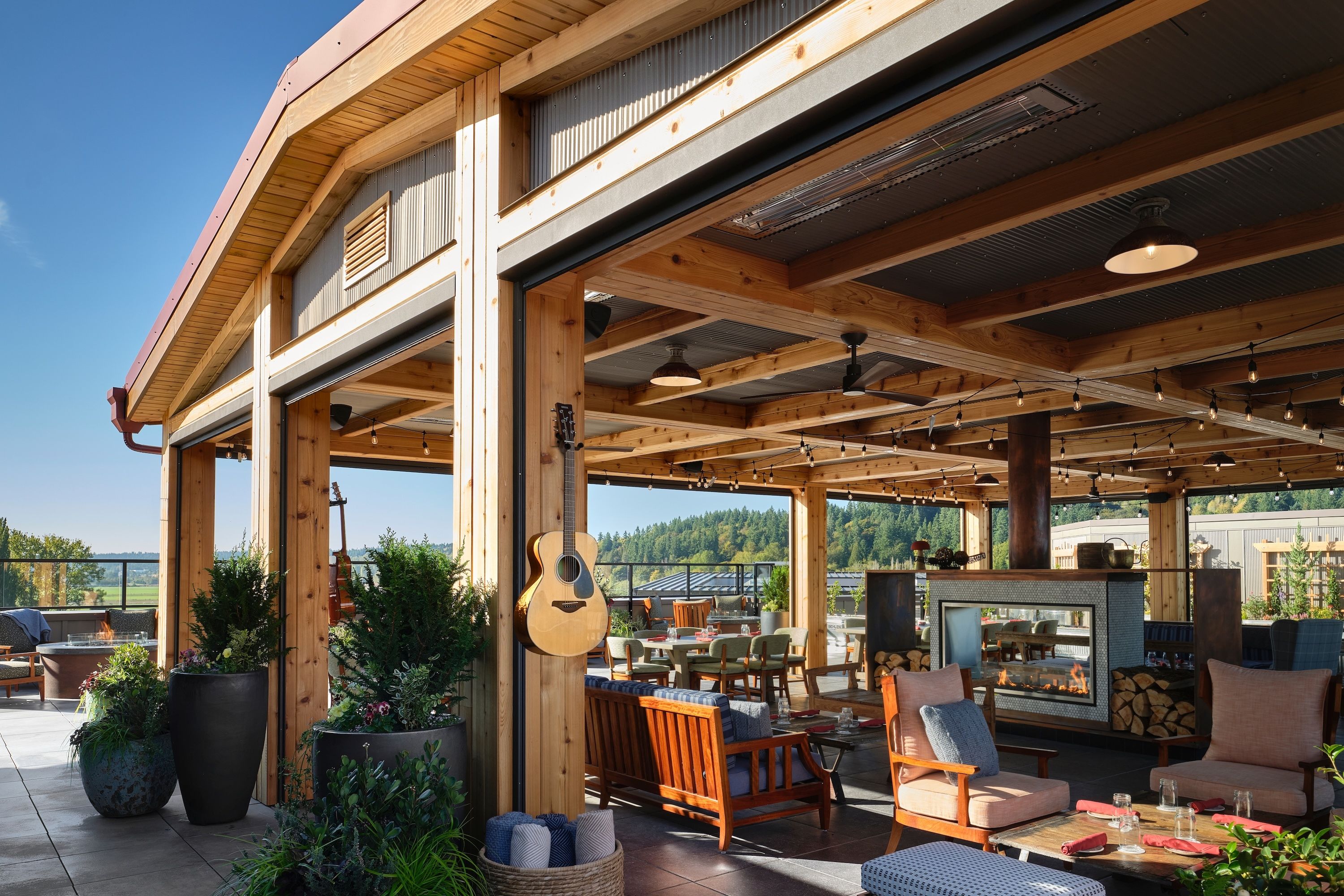
Like the decor, the bar menu hits a note between grown-up and fun; Slattery leans toward his favorite tiki flavors, even as the dark leather chairs feel ready for a cigar bar. In summer, a rooftop deck opens with a firepit and sunset views. A few taxidermy animals stand watch, a brass placard somberly identifying one bear as Paulie Two Paws, and the exterior door handle is shaped like an outstretched hand. These tiny bits of kitsch accomplish for the bar what a dash of bitters does for a cocktail—give it depth without taking over.
The pace out here is wonderfully, refreshingly glacial. At Dumas Station, a lone
winery out among the vegetable fields, tastings are a casual $10 affair in what used to be an apple-shipping train depot. Later, I pop into Walla Walla to visit one of downtown’s glassy, modern tasting rooms, but after only an hour I miss the country’s languid rhythm.

The charms of this rural stretch of Eastern Washington are legion, but there’s one corner known to people who may not have otherwise heard of Waitsburg: Bar Bacetto. When Mike Easton decamped in 2022 to this town that barely fills up two full blocks of historic stone and brick, he took over a space that had gained renown as Jimgermanbar in the 2010s, a stellar cocktail bar that drew acolytes from Walla Walla and even Seattle. There, Easton created a sequel to his beloved Seattle pasta restaurant Il Corvo.
The laurels came fast: The New York Times, a James Beard Award nom. It was shocking to see Bar Bacetto close in June 2024, with Easton announcing he would open a Detroit-style pizza joint in Walla Walla, then that he’d serve as executive chef at the Kitchen at Abeja, one of the region’s toniest hotel-wineries.

Only a few months later, the pizza venture had closed and Easton was back in Waitsburg to a waiting audience (though he still oversees Abeja). There are six more seats than before—a whopping 18 total now—but the fare is as dreamy as ever, the pasta pitch-perfect. A bitter chicory salad is topped with a jammy soft-boiled egg, and a lemon-and-artichoke-topped tagliatelle is sublimely creamy. With only four pastas listed on the wall chalkboard, priced $29–36 each, it’s puzzling to imagine not ordering everything on offer. My leftover pasta buffet the next evening was one for the ages.
After he’s finished cooking for the night, Easton laments that Walla Walla wasn’t receptive to his adults-only pizza concept but says he’s happy to be back in Waitsburg for the time being—his family loves the small-town life. Nearby, his wife, Erin, conversationally runs the front of house; at one point a patron mentions the Midwest and she immediately raises her own hand in a mitten shape to discuss Michigan geography. With the best pasta in the state, somehow this is still a neighborhood joint.

Bar Bacetto 2.0 is worth building a trip around, but it stands best paired with the Royal Block at the other end of town (meaning about 100 yards away). The five-room 1888 hotel was a pandemic project from Tiina Jaatinen and Joseph Roberts, a couple who moved from Western Washington.
They run a wine bar in the lobby, and in various spaces throughout the hotel host winemakers, artists, musicians, and a regular vintage market. There were raccoons
living inside when they took it over, but now gleaming reclaimed wood surrounds a space that’s more art salon than simple hotel. Roberts’s collection of painting and sculpture, on display around the hotel and even in rooms, feels museum-worthy.
Royal Block is a little more sophisticated than Hotel Hardware, a little more established, but they make for an ideal two-night pairing. It’s after the last check-out that I realize the one common thread among Dayton’s tiki-heavy Bobcat Room, Bar Bacetto’s 21-and-over pasta revelation, and Royal Block’s adults-only overnights: This is no vacation for children. But somehow these artsy, rural retreats manage to achieve what every grown-up vacation needs: a sense of playfulness. Out here, small towns take that seriously.