Has Washington's Hiking Boom Finally Begun to Fade?
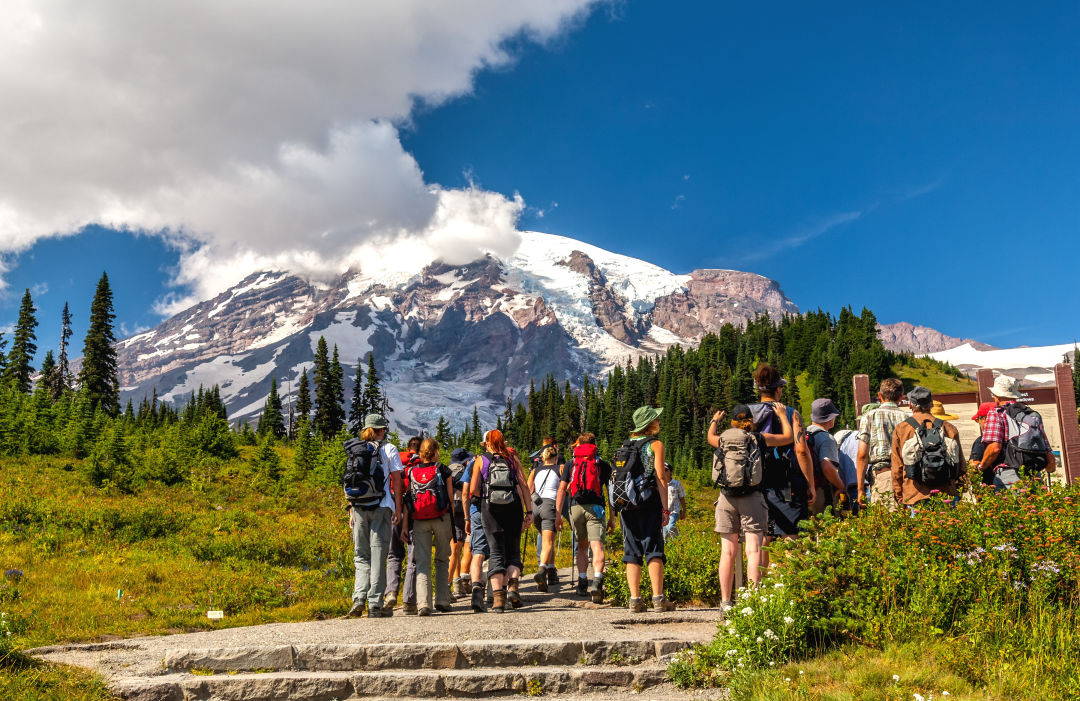
Washington's trails draw crowds, especially at Mount Rainier National Park.
Image: 4nadia/istockphoto.com
The pandemic changed society in more ways than we can count—our health, our finances, our ability to hang without awkwardness at a social gathering. But on Washington hiking trails, the change was one of volume: Starting just after Covid-19 hit, locals flooded outdoor spaces looking for exercise and escape. Parking lots overflowed, mountain meadows turned into conga lines. Camping reservations became more of a thing. Three years on, does that boom look like a short-term trend or a new normal?
It's hard to say conclusively. Hiking may be Seattle's unofficial sport (unless pickle ball finally edges it out) but the decentralized and noncommercial aspects of it make it hard to quantify. But there's the fact that REI made a record amount in sales in 2022—almost $4 billion—and ridership on King County Metro's Trailhead Direct bus, which runs from Seattle to North Bend hikes, almost doubled between 2021 and 2022.
The wave of hikers has stressed the infrastructure around the area's most popular routes. Lee Jacobson, a Seattle lawyer who runs the 260,000-member Facebook group Washington Hikers and Climbers, recalls the chaos: "It was just completely out of control. The reports were as bad as people ripping out 'no parking' signs and throwing them over a cliff to make a parking spot for themselves." Users took photos of trash and toilet paper left in the scenic wilderness.
A few years on, has anything changed? By the numbers, well, a little: Trailhead Direct numbers were slightly lower in June and July of 2023 compared to the previous year, though not by much. Discover Pass sales, which represent users at Washington State Parks, peaked in 2021 with almost 1.5 million passes sold and 43 million individual visits. But while the numbers came down a bit in 2022, preliminary 2023 numbers suggest it's no nosedive.
And the most popular spots have definitely not cleared out. Colchuck Lake, part of the vaunted Enchantments region, is so in-demand that parking around the trailhead has required increased oversight from the U.S. Forest Service; spots fill before sunrise even on some weekdays. In a Reddit group dedicated to Pacific Northwest Hiking, one user put it in all caps: "DO NOT GO HERE ON A WEEKEND UNLESS YOU LOVE CROWDED HIKES."
And just last weekend, Mount Rainier National Park's Sunrise and Paradise visitor areas were hit with huge crowds watching the Perseid meteor shower. Visitors parked and picnicked on high alpine meadows, destroying fragile landscapes and further fueling ongoing discussions on limiting access to the national park.
Still, there's a sense that the popularity may have reached its crest, at least for the short term. In my own summer hiking, I've seen lots of other people enjoying the outdoors—but always found a parking spot. Artist Point, a popular viewpoint and trailhead near Mount Baker Ski Area, still had plenty of room for visitors at 9am on a recent sunny Saturday.
Jacobson says that from his anecdotal perspective—one informed by moderating thousands of hiking posts of Facebook in his spare time—things are cooling. But maybe only a very little bit. Complaints about bad parking and trash on the trail on the Washington Hikers and Climbers group are, for the most part, "residual complaining about what's happened over the last few years" rather than new reports. Though Jacobson knows that many people blame social media like his group for increased crowds, he says statistics show that the Northwest's hiking boom started in the early 2010s, before there were a million photos of Colchuck Lake on social media. Seattle's population surge, then, may have as much to do with crowds as people hiking it for the 'gram.
Crucially, the Pacific Northwest has so many access points for outdoor recreation that there will always be more places to get away from others. Jacobson estimates that the truly popular trails in the state only number about two dozen—largely the ones with famous photo spots (like Colchuck Lake or Mailbox Peak) that draw first-timers seeking an iconic vista. "It's not that there are too many hiking," he says. "There are too many people hiking the same hikes."


