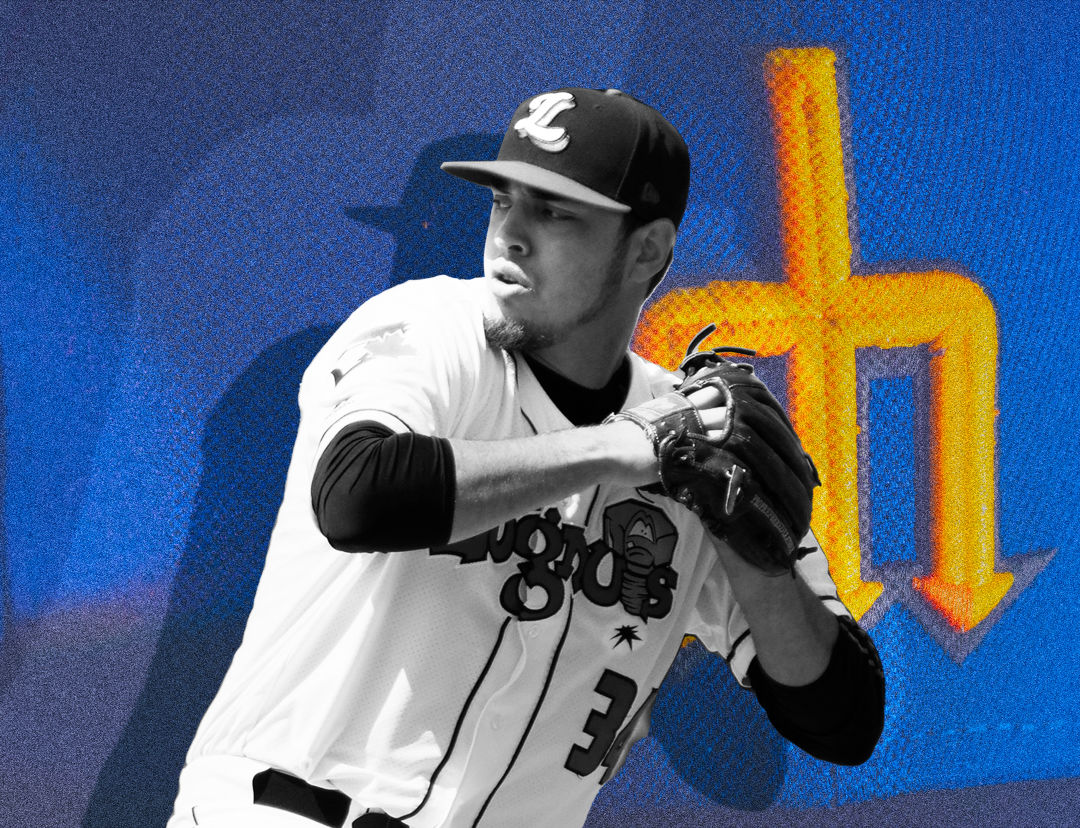
How Mariners Pitcher Tayler Saucedo Found His Way Back Home
This story contains a discussion of suicide. If you or someone you know is in crisis, text or call 988 to reach a trained mental health counselor. The service is free, confidential, and available 24 hours a day.
Last month, Mariners relief pitcher Tayler Saucedo shared a particularly insulting message he’d received from a random fan on Instagram.
“Do society a favor. Put the barrel of a 12-gauge down your throat and pull the fucking trigger.”
The fan went on to use a homophobic slur, too.
In posting a screenshot of the fan’s message, Saucedo also shared his own.
“I don’t normally pay attention to this stuff but this is unbelievable,” he wrote. “I understand being disappointed about a loss but to message me to kill myself and using this language is truly disgusting. I battled mental health and luckily I have found ways to overcome that. I hope you take the time to be better as well.”
It was the kind of thing Saucedo would not have been able to write a few years ago. Back then, Saucedo, who grew up in Sammamish and Maple Valley, was not yet pitching for the team he loved as a kid. He had not yet found big league success or stood on the mound at T-Mobile Park in a Mariners uniform, looking out to where he used to sit as a kid, thinking, “Man, I used to watch games right over there, and now I’m in the game.”
In 2020, he was not even pitching at all. After five seasons in the Blue Jays farm system, he was back home in the Seattle area while the minor leagues were shut down due to Covid. That was when he “started going through some mental health stuff.”
For his entire life, Saucedo’s routines had been built on playing organized baseball. Yes, it had been a bumpy journey, but it had always felt like he was going somewhere. First at Tahoma High School in Maple Valley, where he bounced back from a winless junior season on the mound to lead the team to a division title as a senior. Then at Tacoma Community College and tiny Tennessee Wesleyan University, and finally in the minors, where he had clawed, city by city, to Triple-A—one level below the majors.
For Saucedo, there was a pattern. He struggled to adjust at each new level—whether with grades at TCC or with loneliness in Tennessee, living by himself in a studio apartment in a small town far from home, or with the on-field challenges of facing increasingly tough competition. But he always managed to persevere. “It was hard, but I was just going to follow it no matter how long. I told myself that I’m going to continue to play as long as I can, and once I feel that I can’t compete at that level anymore, I’ll call it.”
Saucedo never got to that point. Instead, his life was about doing whatever it took to reach the next level. Then, with the onset of the pandemic, that structure was gone. Without baseball, without the purpose that had driven him forward in a career that had been defined more by determination and what he calls “naïve” belief than talent than actual results, Saucedo fell apart mentally.
He had always been able to deflect negative thoughts, and overcome the pressure he put on himself to succeed, trusting his innate competitiveness to carry him through. But now he couldn’t push them away. He thought about ending his life. Finally, he realized that he would have to face this directly. For the first time, Saucedo reached out for help. And he started making changes. One thing that worked for him was purposefully writing down his feelings—an activity he picked up after reading the book Atomic Habits by James Clear.
And amid that lost season, Saucedo learned something: Acknowledging his mental health actually made it easier to deal with. He began to create new routines, slowly lifting himself out of the funk.
“Once I went through all that stuff, I realized I had some issues to take care of that I’d been pushing away for a long time, and I’m grateful for it,” he says. “Obviously I don’t wish for people to go through that stuff, and have those thoughts in your head, but it helped me become who I am now.”
Over the past few years, more and more pro athletes have spoken out about their mental health struggles. But that doesn’t make it any easier, in a sport with a macho culture.
“You obviously don’t want to show that softer side, because then everybody thinks you're weaker for that,” Saucedo says. “And, you know, unfortunately, I think it’s affected a lot of people. But I think now we're doing a really good job of acknowledging it and bringing it out there. And we have all the resources now to talk about it. It's getting better.”
When Saucedo reported to spring training in 2021, he himself felt better than ever. It was the last year of his contract, and the Blue Jays had told him he might not cut it in the organization—he simply didn’t throw hard enough, they said. But for Saucedo, that took the pressure off. He didn’t know if he could actually add the velocity they wanted, but he knew he’d given it his all to get back onto the mound.
“Before, the world was weighing down on me,” he says. “A bad [game] would just eat at me. But I was like, no matter what I do, no matter how the season goes, I’m just gonna go out there and enjoy as much as I can. And I think that really elevated my game along with everything else, just because like, I didn't have any stress. I didn't have any worries. It was just a game again to me.”
Saucedo realized that he was proud of the journey he’d already taken as a 21st-round draft pick. (That round no longer even exists, as Major League Baseball has since shortened its draft to 20 rounds.) He told himself he was just going to go out and enjoy his last year. And he ended up enjoying it all the way to the majors—and eventually, all the way back to Seattle.
After pitching regularly for the Blue Jays in 2021, Saucedo was limited the following year by a hip injury. The team placed him on waivers after the 2022 season, where he was claimed by the Mets. A couple months later, before he even pitched for them, the Mets waived Saucedo, too. The next thing he did was check the Mariners roster to see if there might be room for a lefty like him. They seemed all set. But then the phone rang.
“They called me seven days later and said, ‘Hey, you’ve been picked up by the Mariners,’ and whatever she said after I don’t remember any of it.” Saucedo ran into the kitchen of his parents’ house, where his mom was cooking dinner and started jumping up and down, yelling, “I’m a Mariner, I’m a Mariner.”
Saucedo reported to spring training in Peoria, AZ in February, then to Triple-A with the Tacoma Rainiers in April, not far from where he had played juco ball after high school. A few weeks into the season, he was promoted to Seattle.
When Saucedo was a kid in Sammamish, one of his favorite players had been Mariners centerfielder Mike Cameron. One year for Christmas, Saucedo even got a broken Cameron bat as a gift. (His aunt’s boyfriend at the time, who was working as a Mariners bat boy, brought it home.)
As the years went on, Saucedo held onto the broken bat. He kept it as the family moved to Maple Valley, where he struggled, then starred at Tahoma High School. He kept it throughout his bumpy baseball journey at Tacoma Community College, then Tennessee Wesleyan; kept it through minor league seasons in Bluefield, Virginia, Vancouver, BC, Lansing, Michigan, Dunedin, Florida, Manchester, New Hampshire, and Buffalo, New York.
He kept it when the minor league season was canceled in 2020, and when he was finally called up to the Toronto Blue Jays in 2021, the day before his 28th birthday. Kept it all the way until his first day pitching for Mariners, the team he loved, the team that employs Cameron as a special advisor. One day, he brought the bat with him to work.
“Obviously Mike’s here a lot of the time, and I actually got him to sign it,” Saucedo says. “I brought it in, and I was like, ‘I’ve had this bat since I was 11 years old,’ and he was like ‘Oh my god, let me see that’, and he was showing everybody.”
It was, Saucedo says, a “full circle moment.” The kind of thing that makes the journey seem sweeter, and the kind of thing that reminds you that there isn’t such a big gap between the fans in the stands or on social media, and the players on the field. This is something Saucedo thinks about when he gets messages like the one he shared on Instagram.
Saucedo says that if he had received a message like that in the past, he “probably would have believed what they were saying.” But because of everything he’s been through, and all the work he’s done, he’s able to handle it now. “I’ve already said all the stuff that people are saying to me, I've already said it to myself. But now I know that none of that is true.”
When he was a young fan, yelling from the bleachers, Saucedo didn’t fully grasp how hard it was to do what the players on the field were doing. “I was probably on that end, too. You always say, like, ‘This guy sucks, why is he here?’ and stuff like that.” And now, with social media, those voices ring louder than ever. Even as a Seattle Mariner, Saucedo can’t change that. But he can at least talk about it.
“Obviously, for some of those that say stuff like that, they might be going through something themselves,” Saucedo says. “So hopefully they get the help that they need. And when I posted that [response] on my Instagram, it wasn't to attack him or expose him in any way. It was just to set an example of like, 'Hey, you can't say stuff like that.' Maybe next time, he'll think twice. I'm not expecting to change anybody, but hopefully just get him to realize that like, hey, words have effects.”