How Science Is Rewriting Cruising in Antarctica

Most everyone who goes to Antarctica wants to cuddle a penguin. On this, his first trip to the continent, Dr. Ashley Olson is the only one in his group who actually gets to, sort of.
At Brown Station on the Antarctic Peninsula, a few cherry-red wooden huts break up the landscape of glaciers. The structures are uninhabited, even though they’re among only a handful of buildings on the whole continent. Olson and his research partner, Dr. Meagan Dewar, step carefully through the gentoo penguin rookery as the birds lurch about, placing rubber boots gingerly on snow and rocks slick with penguin guano. After deliberation with Dewar, Olson grasps a penguin, but not exactly with a hug. It’s just enough time to perform a quick nasal swab, more akin to performing a Covid test on a toddler than cuddling with one.

This scientific research has an audience. Tourists line the snow around the rookery, agog at the absurd-looking birds who wobble up on paths called penguin highways. We’re all—minus the penguins, of course—on a unique cruise together, here at the end of the world. Unlike most sea voyages, this one appeals to the science nerd in me, the one that thinks we need a good reason to poke our noses into the fragile continent.
“Mainstream cruise ships are, in my perception, mostly inward-looking,” says Alex McNeil back on the MS Fridtjof Nansen. I was invited on this 10-night trip to see the science program, and the chief expedition officer for cruise line HX happened to be on his first postpandemic voyage on the Antarctic route. He’s trying to build a style of cruising “very rooted in amplifying what’s going on outside the ship,” he says.
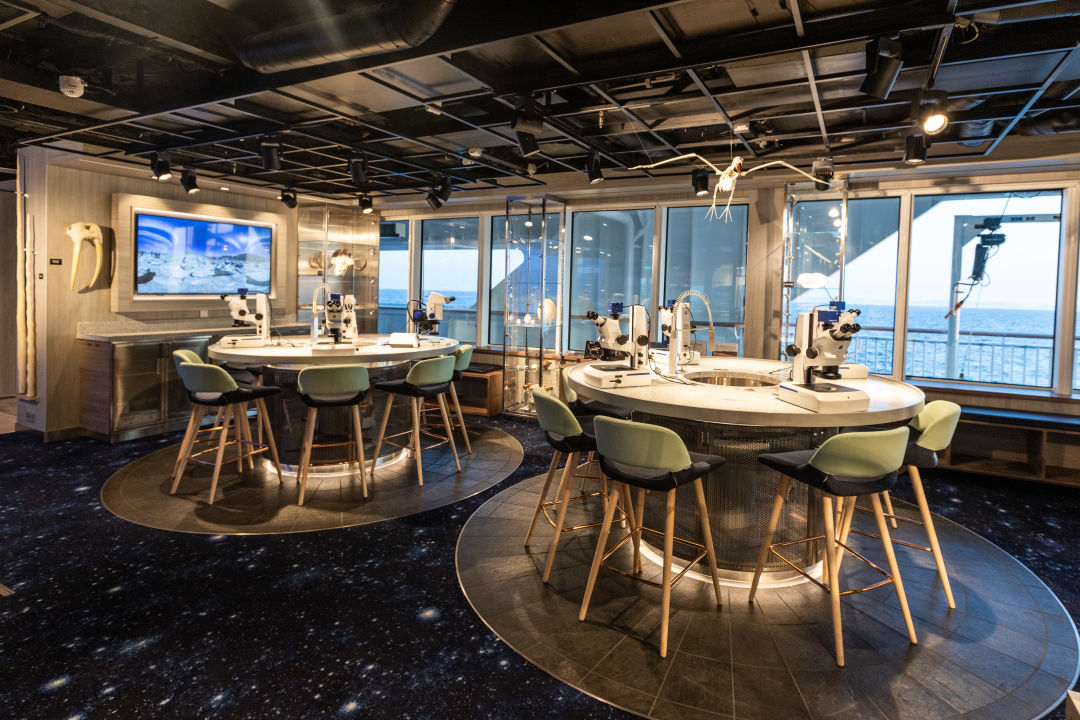
We’re in the ship’s science center, next to a round table of microscopes whose eyepieces are (like those mainstream cruise ships) looking inward; they’re targeted on slides of crustacean antennae and whale baleen. But metaphorically, everything inside is about what’s outside. Nansen, launched in 2018 as one of the first ships built specifically for routes like this, has no casinos, no waterslides, and only one small gift shop.
It’s been a little more than a century since explorer Ernest Shackleton famously trapped his ship in ice in Antarctica, and in 2024 more than 80,000 people set foot on the continent simply to sightsee. HX spun off from parent company Hurtigruten, which began as a Scandinavian ferry route, several years ago, and today the brand aims for something a bit more luxurious than Shackleton’s ill-fated Endurance; here, dinner is pistachio-crusted lamb and mini macarons.
It took two full days for the ship to travel to Antarctica from Ushuaia at the foot of Argentina. It doesn’t get much more remote than this, the only continent with no indigenous population, one discovered by humans only in the 1800s (more recently than the invention of the tin can). Antarctica is a wild place shaped by gusty winds and enormous glaciers, but also so delicate that global warming is disintegrating its edges at an alarming rate.
The 390 passengers on the Nansen take turns going ashore, following rules instituted by the International Association of Antarctica Tour Operators (IAATO), which also dictates how big a ship can be and still allow its passengers to set boots on land there. Those boots must be power-washed every landing to stop the spread of biological matter or pathogens, and there’s no snacking or even sitting down while on Antarctica itself.

From the rookery at Brown Station, we can see the Nansen anchored in Paradise Harbor. The words HYBRID POWERED are inscribed in giant letters on the hull, even bigger than the ship’s name. It advertises the new ship’s battery-supported propulsion system, the first of its kind in the cruise industry, which allows the ship to reposition itself silently among the icebergs that bob along the of the peninsula. This feels more impactful than the sustainable measures that take place inside (reusable water bottles, minimized food waste). To the extent that “green” cruising is possible, HX does better than its peers; Friends of the Earth environmental group gives the company a B+ on its annual Cruise Ship Report Card, the top score awarded in 2024. Carnival Cruises got an F.
Every day, staff naturalists explain how to log wildlife or weather sightings into citizen science projects, so passenger views of birds, whale flukes, or cloud formations can join large, internationally used data sets. And 15 times across the five days the cruise spends in Antarctica, 10 or 11 new guests pile into a Zodiac and putter just a few hundred yards from the ship for something called the science boat.
Using a mesh net whose holes are 0.02 mm wide, guests help gather seawater samples to collect phytoplankton, or microscopic organisms floating at various depths. By the end of the season, the Nansen will have collected five months of data to examine what glacier melt is doing to the ocean. It’s a crash course in climate change research with a stunning backdrop, like the world’s most spectacular grade school field trip.
“I’m doing science!” says one passenger gleefully while hauling up the line of a sample net with dorky enthusiasm. Everyone is bundled in waterproof pants and fuzzy hats.
Back on land at Brown Station, few of us tourists are jealous of the scientists who get up close to the wildlife. Penguins may waddle around like delightfully drunk little cater-waiters, but they bite, slap, and “will happily poop all over you, and stuff as well,” says Dewar. The explosive sprays of guano make my nose hairs tremble in disgust, so even if IAATO didn’t mandate a five-meter perimeter from the birds, most of us would give it. But the data the penguins offer is key to the research the two scientists undertake at Australia’s Federation University; they trace polar pathogens, specifically the avian flu and cholera that are inching across Antarctica.

Last year, Dewar was on a private yacht in these waters collecting samples, spending 16 days and with eight scientists in tight quarters. The trip cost close to $100,000—funding the scrappy biologists had to pull from nonprofit grants, national programs, universities, and even IAATO itself.
This year, the pair has rooms on the Nansen. They eat in the cruise ship’s Aune dining room with its menu of American and Norwegian dishes. “The biggest problem with science at the moment is that nobody wants to fund it,” says Olson. “If we can jump on board…it’s a great opportunity.”
Over the course of more than a month in late 2025, Dewar and Olson collected more than 1,000 DNA and RNA samples, even beginning to process the material during the long sea days as the ship crossed the Drake Passage between Antarctica and Chile’s Cape Horn. It’s a game changer, says Dewar, even if fiddling with penguin poo in front of people who are on vacation does feel a little strange.
Three days later the Nansen pauses in a different harbor across the Antarctic Peninsula’s Gerlache Strait, and I join a sea kayaking trip led by an HX guide. As we paddle past sculptural icebergs, we spot Olson and Dewar’s black Zodiac. We can see them reaching with a long pole to take a nasal sample from a leopard seal napping on a chunk of ice.
From our red sea kayaks, we can get close enough to the reclining animal to notice how it cranes its neck to observe us. But it doesn’t move its gray spotted body. The sample taken by Olson and Dewar could be an important data point in understanding the mammal-to-mammal transition of avian flu. As I watch them, and faced with this sleek, dozing predator, science feels like more than an onboard distraction or a mere excuse to take a trip. It’s both the how and why of visiting Antarctica; it’s the lens through which an entire end-of-the-earth trip makes sense.