What Will Happen to Capitol Hill's Magnificent Russian Murals?

Image: Joshua Huston
During the last week of service at the delicate Eurasian eatery, Cook Weaver, I sat at the bar to enjoy one last tasting menu from chef Zac Reynolds. I tried not to alarm other diners as I gazed over their heads at the restaurant's beautiful walls, trying to soak them in. As Reynolds passed me a scallop doused in coconut and beet sauce, I lamented that it could be the last time I would be surrounded by the neighborhood's coolest dining room.
I shouldn't have worried. A week later, I asked Brett Bankson, part of the space's incoming Cafe Lolo, whether he and his team would hide or feature the artworks. His answer was emphatic: "So, so, so, so, so, so visible," he says. "We are not touching the murals and we are thrilled with them."
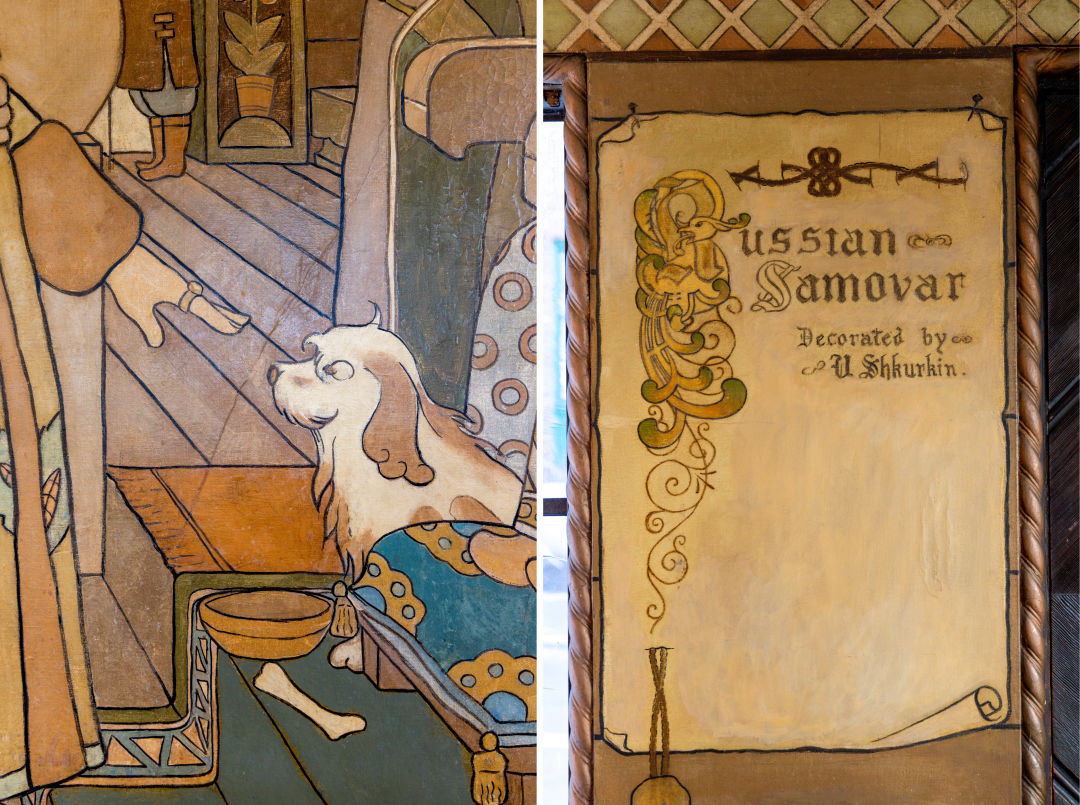
Image: Joshua Huston
Why is it so important? Because the walls of 806 East Roy Street—formerly Cook Weaver, soon to be Cafe Lolo—are more than a backdrop to fine dining. They're art, history, and thoroughly Seattle.
The space is part of what's known as both the Loveless Building and the Studio Building, built by architect Arthur Loveless, head of a firm that also made many of University of Washington's fraternity row houses and Lincoln Park's Colman Pool. The low, stone facade marked with arches and dormer windows looks straight out of a fairy tale, more Cotswolds cottage than American urbanism.

Image: Joshua Huston
Inside 806 East Roy, the walls are coated in paintings of people in long robes and elaborate hats, done in earthy tones. There are kings, soldiers, a drunk, a dog; the art illustrates "The Tale of Tsar Saltan," an 1831 poem by famed Russian writer Alexander Pushkin. Though the story is mostly about a swan princess, singing squirrel, and jealous sisters, the murals, fittingly, mostly center on royal feasts.
Why Russian fables? A restaurant called the Russian Samovar occupied the space shortly after the building went up in 1931, and that tenant hired Chinese-born artist Vladimir Shkurkin to paint the walls. In 2014, art historian Steven Vroom wrote that the murals were a remnant of Russian settlement in Seattle during that era and were inspired by muralists like Diego Rivera.

Image: Joshua Huston
It's a lot for a brand-new restaurant, especially one like Cafe Lolo, fresh off the farmers market scene. But Bankson and his partners, Leah Engel and Alex Halmi, aren't worried.
"The walls are more-is-more-is-more," Bankson says, but they're folding that into the restaurant’s design concept. "We're taking this, like, Baltic-Slavic, continental-folk aspect with strong rococo baroque," he says. Plus a dollop of "coastal, casual, grandma, comfort" vibes. More is more, indeed.
Unlike Cook Weaver's special occasion, date night vibes, Cafe Lolo will be more of a daytime destination with a pastry case and, eventually, some fine-food retail. Engel and Halmi (who worked at Cascina Spinasse) specialize in handmade pasta and have sold at the University District and West Seattle farmers markets, so they hope to include pasta kits on their shelves. The restaurant will be open for brunch and lunch, plus some dinner service.
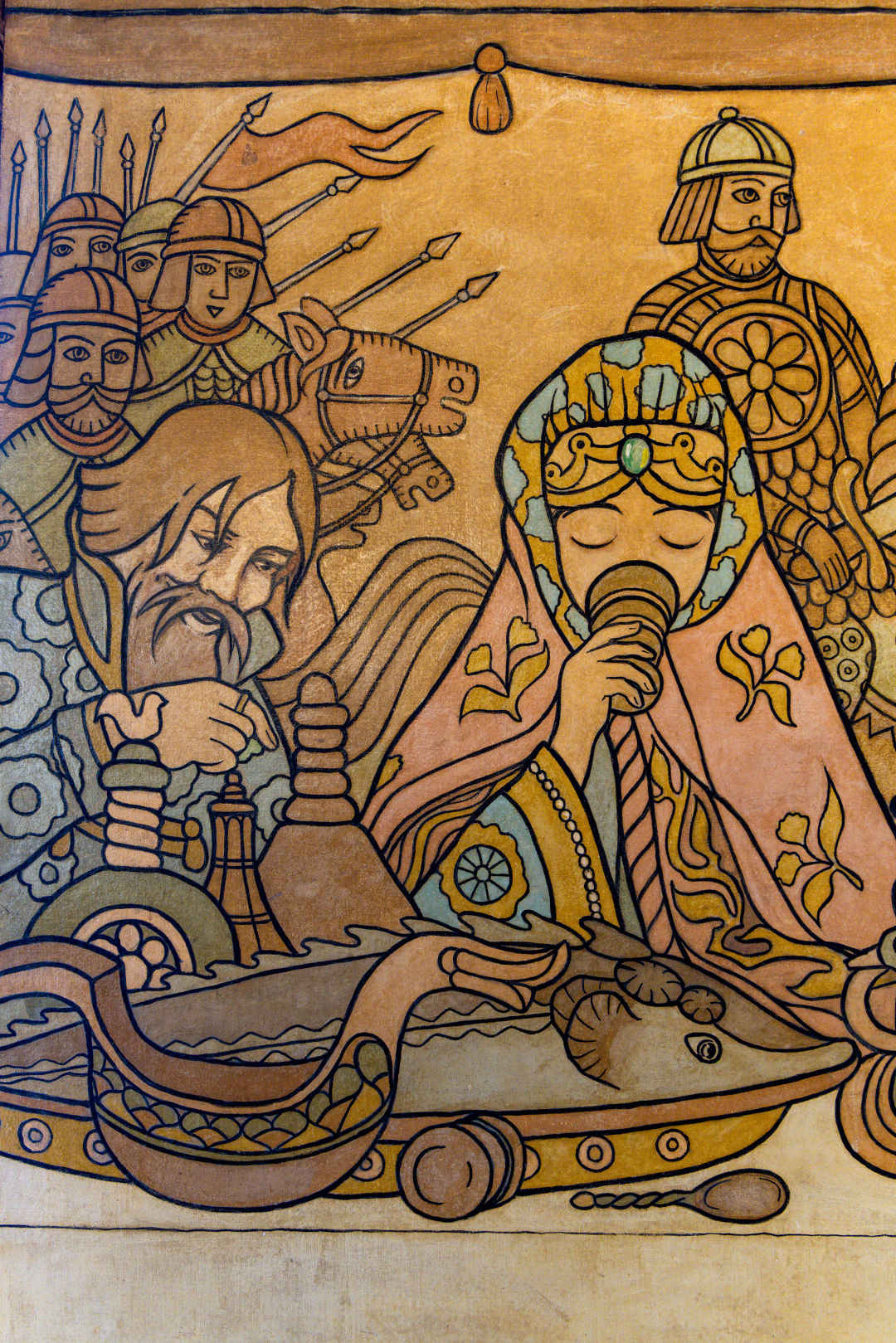
Image: Joshua Huston
For Engel, the idea of a quirky space isn't overwhelming. She grew up in Seattle, in a house now known as the Ravenna Trollbooth for its maple tree stump surrounded by ceramic creatures. Engel's father, Gregory, has made more than 500 of the creatures since 2004, and she says she hopes to incorporate some similar "secret little elements" hidden around the restaurant.
While the building is part of the city-designated Harvard Belmont Landmark District, that designation mostly protects the building exteriors and landscaping from being altered. The sign Cafe Lolo hangs outside will be thoroughly compliant with the district guidelines ("Keep signs relatively small and subordinate to the building") even as the stunning interior decor isn't.
Aiming for a March opening, the Cafe Lolo team is thrilled with inheriting the artwork. "Having the murals is almost a weight off our shoulders of creating a vibe and an aesthetic," says Engel.