Still Secret
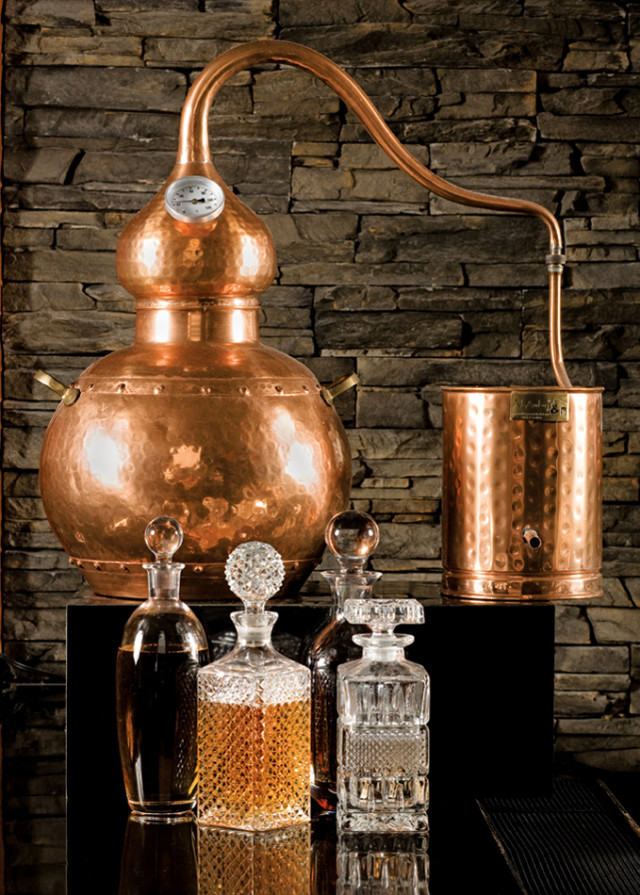
Downlow spirits Distillers can buy copper alembic stills, invented in the Middle Ages, online. But using them to make booze is illegal without a permit.
Image: Lindsay Borden
ON A BREEZY spring day, guests gather for a backyard barbecue near Green Lake. As our host flips the bratwursts, a man introduced as Bob unscrews the cap from an unlabeled bottle and pours short slugs of rum into a row of tumblers. The rum is dark and thick, with an aroma of raisins and sulfur and a taste of plums and molasses. It’s rich, it’s potent, it’s delicious.
It’s also illegal. With his white hair, tinted glasses, and “Heya, neighbor” demeanor, Bob has the bearing of a golf-playing retiree. But he fermented, distilled, and bottled this rum at home, without acquiring any licenses or permits or paying a penny in taxes. While the rum was made as a hobby—the same way people make beer and wine at home legally, with none of it exchanged for cash—in the eyes of local police and the Treasury Department, Bob is an outlaw.
There’s no reliable metric for gauging the popularity of home distilling, but signs indicate it’s on the rise. At the internationally popular website homedistiller.org, membership grew from 4,900 to 5,500 between February and April, and the “New Distillers” Yahoo! group has close to 4,000 users. “The cops used to say that for every moonshine still they found, there were nine more in operation,” says Max Watman, the Hudson Valley–based author of Chasing the White Dog, which chronicles America’s moonshine tradition. “You can estimate there’s at least five times as many people now distilling at home, and it is booming.”
The word “moonshiner” tends to conjure the image of a jug-toting hillbilly, but Watman says today’s home distillers are mostly in their 30s and 40s, with locavore inclinations and a taste for good liquor. “We’re in a cultural moment when people make their own pickles and cheese and cure their own meat—whiskey just shows up next,” Watman says.
Contributing to this boom is the relatively easy availability of home-distilling equipment and information. Online shoppers can find and legally purchase stills starting around $150, with top-of-the-line equipment peaking around $11,000. (U.S. retailers of complete stills must provide a customer’s address and details to federal authorities upon request.)
And while learning the craft of distillation once required either a lengthy apprenticeship, a studious demeanor, or a taste for danger, today’s distillers have plenty of how-to options, ranging from the aforementioned online resources to books such as Moonshine!, by Matthew B. Rowley.
Spirits poured on the sly around Seattle (word-of-mouth is the way to find them) include exceptional homemade absinthe from Wallingford, a Tacoma kirschwasser made from Rainier cherries, and a Queen Anne apple brandy as heady as any commercial Calvados. (As for liquor distilled from Walla Walla onions, the less said, the better.) Resource-strapped federal agents have higher priorities than confiscating someone’s handcrafted grappa; the only moonshine busts in recent memory took place in Eastern Washington around 20 years ago. But that’s not to say there aren’t consequences. Mike McCaw heads Seattle’s Amphora Society, which produces and sells books and equipment for home and commercial distillers. He says he gets calls all the time from people who want to buy a still and don’t know it’s illegal to distill spirits at home. “You need to get a permit or be comfortable with being a criminal, and if you tell me you’re going to break the law, I’m not going to do business with you.”