I Found a Family at the Tacoma Paper Mill
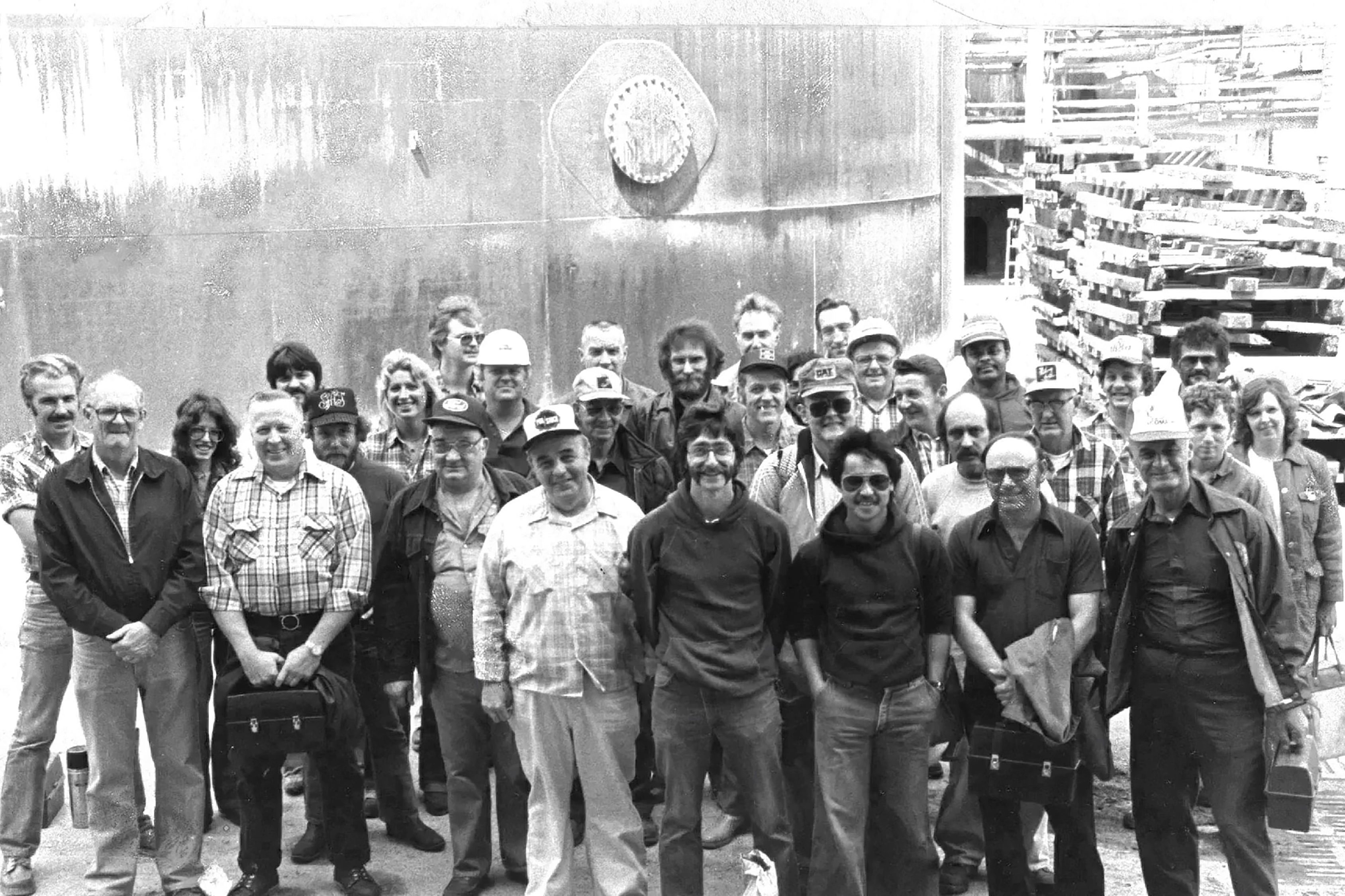
Shift workers at the mill, 1981. Photograph courtesy Chuck Whitt
On November 30, 1977, I walked into the paper mill known to me only as the source of the “Aroma of Tacoma.” The mill, operated by the St. Regis Paper Company of New York, intimidated the hell out of me, puffing huge columns of white smoke from its many stacks, emitting that sulfurous smell. But, with a starting wage of $6.63 per hour, more than tripling the pay at the job I was leaving, going to work there was not all that difficult of a choice.
Neither was staying for what would become a 45-year career that took me across various jobs and departments, from the Recovery Boiler, which produced those clouds of billowing steam, to the lime kiln, primary source of the notorious aroma. It wasn’t the path I envisioned myself on when I left high school, but it was the one that would take care of me and my family for decades to come. The mill became a place where I made lifelong friends. It became a place that was part of my identity.
It was crisp and clear outside. I drove up to the security gate and was escorted to the assistant HR manager’s office, where I received a quick orientation, then was led into the mill to go get my safety gear. As we walked out of the offices, I was greeted with the hustle-bustle of mill activity. We walked down the main road dividing the mill into the pulp side on the east and the paper side on the west.
Having lived just across the tide flats in Hilltop, I was familiar with the “aroma” broadly speaking, but being at the mill I learned that it was actually comprised of many individual odors. Suddenly I could smell all of them.
As we passed the entrance to the paper machine building, I smelled stewing potatoes, just a few more steps down the road and I was assaulted with flatulence. I glanced over at the assistant HR manager and he just smiled and said, “it’s not me.” The smell of turpentine and other unidentifiable sulfurous gases greeted us as we made the turn to the storeroom.

The mill from a boat in the Tacoma Tideflats. Taken 2016.
Image: courtesy Chuck Whitt
Safety gear in hand, I was introduced to the shift foreman and told to come to his office later that day. I was going to learn to be a loader during that afternoon’s swing shift. With that I was sent home. For the next several hours, as I thought about what I had just seen, heard, and smelled, the anxiety built as to what the immediate future held for me. What was a loader anyway? Would I be shoveling coal into one of the boilers? What exactly would I be loading? Was this skinny 19-year-old up to that kind of labor?
When it finally came time to punch my timecard, I was led to the pulp machine room, where a slush of raw fiber was made into a 20-foot-wide sheet that continually rolled off a machine and was dried by steam, coming out looking like cardboard. This wide sheet was then cut into four squares, pressed into 500-pound bales, wrapped with wire, and sent down a conveyor to be loaded by me, the loader, onto wooden pallets for shipment. Phew! No shoveling coal!
And this was a slow process. I had come from a job where if you were not continuously moving, you would have had a manager breathing down your neck. As a loader, my job was to sit and wait for the conveyor line to fill. This could take about 30 minutes. Thirty minutes of doing nothing. I was so nervous about sitting there that I got up, found a broom, and started sweeping the floor. Almost immediately, a senior employee came up to me and told me to stop, that wasn’t my job.
As a trainee, I saw the entire mill. It was a massive place. Every day seemed to bring a new shock. I worked at the batch digesters, hoisting a massive steel lid over an opening down which wood chips and sodium hydroxide would be poured, then heated at extreme pressure until the wood chips broke down. I remember my first night shift, riding a rickety old elevator to the top of the digesters.
As we got closer to our floor, the sulfurous smell got stronger with every foot we ascended. I asked, “What is that smell?”, and to a man, they responded, “smells like money to me.” The inside joke being that the smell permeates everything you have, including the leather wallet that holds your money. I found that out the next time I pulled my wallet out in a grocery store and suddenly noticed the sideways glances I was getting.
While we waited for the digesters to run, which often left us with nothing to do for the 45 minutes between blows, we sat on a bench near the window to get as much fresh air as possible. I remember looking up once and seeing my coworkers asleep. I was mortified. But slowly, I became accustomed to the ways of the mill and the culture of the shift worker. I was becoming one of them.
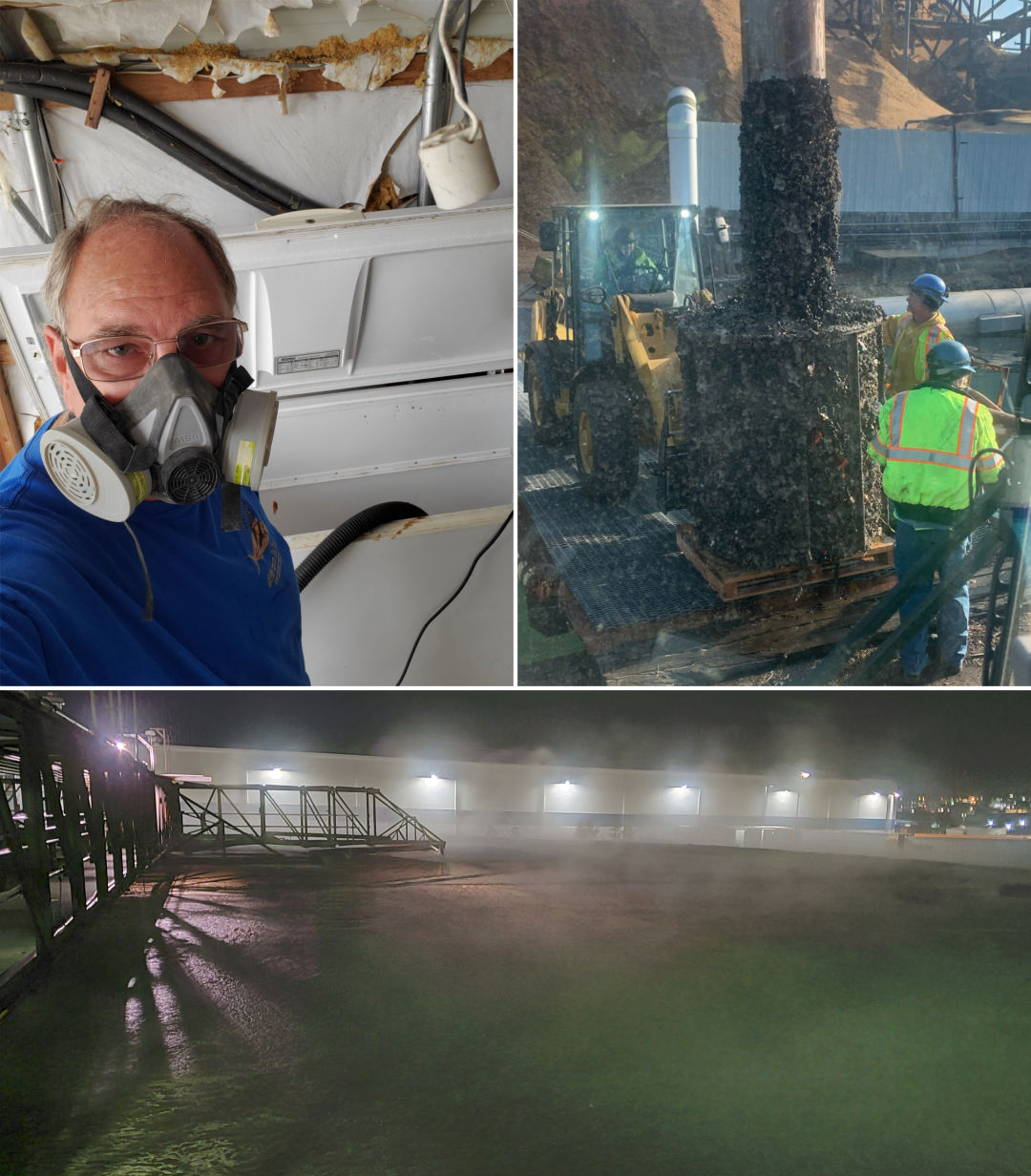
Clockwise from left: the author; a saltwater filtration screen covered in mussels; steam over one of the mill's clarifiers, which separate chemicals from water used in paper and pulp-making.
Image: courtesy Chuck Whitt
The mill was a 24/7 operation, shutting down only for July 3 and 4, and December 24–26. Those shutdowns would subsequently be lost in negotiations, making the mill a true 24/7/365 operation by the time it closed. It was run with three shifts: days (7:30am–3:30pm), swings (3:30pm–11:30pm), and graveyard (11:30pm–7:30am), with four crews and a permanent day staff. The crews would rotate through the schedule from days to graveyards to swings, on seven day rotations. But as a new hire, I was not assigned a shift yet. I was an extra board employee, working to cover vacation days, sick days, and whatever else came up.
Everyone hired for mill production started out on the extra board. This made it near impossible to schedule doctor or dentist appointments, or to know if you could make some important life event. But it was the price we paid for the job on an assigned shift. Getting a permanent job was the Holy Grail, and it was accomplished by “bidding” your mill seniority to job openings as they became available. Usually it took a year or two after getting hired to become permanent.
Shift work was difficult on your personal life, whether you were extra board or permanent. Constantly rotating shifts meant missing holidays with your families (only one of the four shifts would be off for Christmas, only one for Thanksgiving). It was common practice with shift workers to move holiday celebrations to another day. The question, “What day are you having Christmas?” was not unusual at all. But that also meant that our shift work affected our families too. And for fixed events, like graduations, it meant you either took one of your limited paid days off to attend, or you missed it.
Shift work also meant that, though you may know many of the people at work, it was difficult to develop relationships with those who were not on your shift. But we managed. We formed friendships, and in many ways became an extended family. We laughed together, partied together, cried together. Sometimes all at once. This was how we compensated for the time we lost in the “normal working world.”
We didn’t lament our chosen careers. On the bright side of shift work, your days off allowed you to interact with the world outside of the nine-to-five grind. When you’re not rushing with everyone else to get stuff done on your weekend days off, you find more space, more service, more time. That was often the complaint of many of my coworkers who left shift jobs for a day job at the mill. Everything seemed so much more crowded to them.
Things changed over the years. We eventually switched to a 12-hour workday, working four days on and then four days off. And new hires were assigned to a shift right away. We got used to the longer days. There was some semblance of normality returned to us and our families. The extra time off also afforded us the ability to interact with our respective communities, to attend that school board meeting, to make that overnight trip to a see a relative, to haul the boat to Neah Bay for a long fishing weekend.
The mill’s construction on reclaimed land in the Tacoma tidal basin was started in 1928 by the Union Bag Company. But they would never operate the mill. After the onset of the Great Depression, Union Bag sold to the St. Regis Paper Company of New York, who began full-time operations there in 1935. It was still the St. Regis Mill when I started there in 1977. In 1984, Champion Paper bought the St. Regis Corporation and the name on the mill changed for the second time. A year later, they sold it to the Simpson Paper Company.
Simpson would operate the Tacoma mill for the next 29 years. It was during Simpson’s ownership that the “Aroma of Tacoma” largely disappeared, the shoreline was rehabilitated, and a serious commitment to environmental stewardship took hold in the mill. But the paper business was brutal. One by one, Simpson sold all of its other paper mills, keeping the Tacoma Mill as its sole entity until 2014, when it announced the sale of the mill to the Georgia-based RockTenn paper, which soon merged with MeadWestvaco of Virginia. As a result, in 2015 the mill changed its name one last time to the WestRock Tacoma Mill.
Unionization began in the mill almost as soon as it started up. The 1930s were a time of widespread labor strife, as the American Federation of Labor (AFL) competed with the Congress of Industrial Organizations (CIO) to organize the working class into local unions. The Tacoma mill was a hotbed of organization in those early days, with the AFL and the CIO vying for members from the various groups within the mill.
Unlike most of the other mills on the West Coast, where workers affiliated as a single collective, putting all their various trades under one union umbrella, Tacoma mill workers organized into different unions depending on their trades. The United Papermakers originally consisted of the senior machine employees and their underlings. In the competition to organize, though, they soon expanded to encompass the whole of the paper machine crew and became the United Papermakers and Paperworkers Union, Local 586.
On the pulp side, the International Brotherhood of Pulp, Sulphite, and Paper Mill Workers worked to organize the other members of the mill as Local 237. Ultimately, the two unions merged nationally and in 1975 became the United Paperworkers International Union (UPIU), representing about 800 Tacoma mill employees, with Local 586 representing the paper making side of the mill and Local 237 representing a larger group of employees on both the pulp and paper sides.
I was sworn in as a member of UPIU Local 237 raising my hand and taking an oath at the Odd Fellows Temple across from Tacoma’s Wright Park. Though I had taken an oath, I didn’t immediately get involved with union activities.
In July of 1978, we went on strike (the second of only two strikes at the mill since it started up, the other being in 1975). This piqued my interest a little, but not enough to get involved. Actually, to this kid one year out of school, the July to September strike was just another summer vacation, with periods on the picket line to get my $25 weekly check. For me, unladen with the debts of life, it was a great summer.
There was no “this is the moment” moment for me as far as union involvement was concerned, but as the ’80s progressed, I started becoming familiar with the contractual language, and began to speak up more at our meetings about how we could negotiate with the company. Then in 1991, the company built a new recausticizing plant, where used chemicals were reconstituted into the sodium hydroxide needed to digest the wood chips in those giant vats. This was the area where I worked—and suddenly I had a more personal stake in negotiations. I began to raise arguments only to find union leadership disagreeing with me. Soon I was being nominated for leadership positions myself.
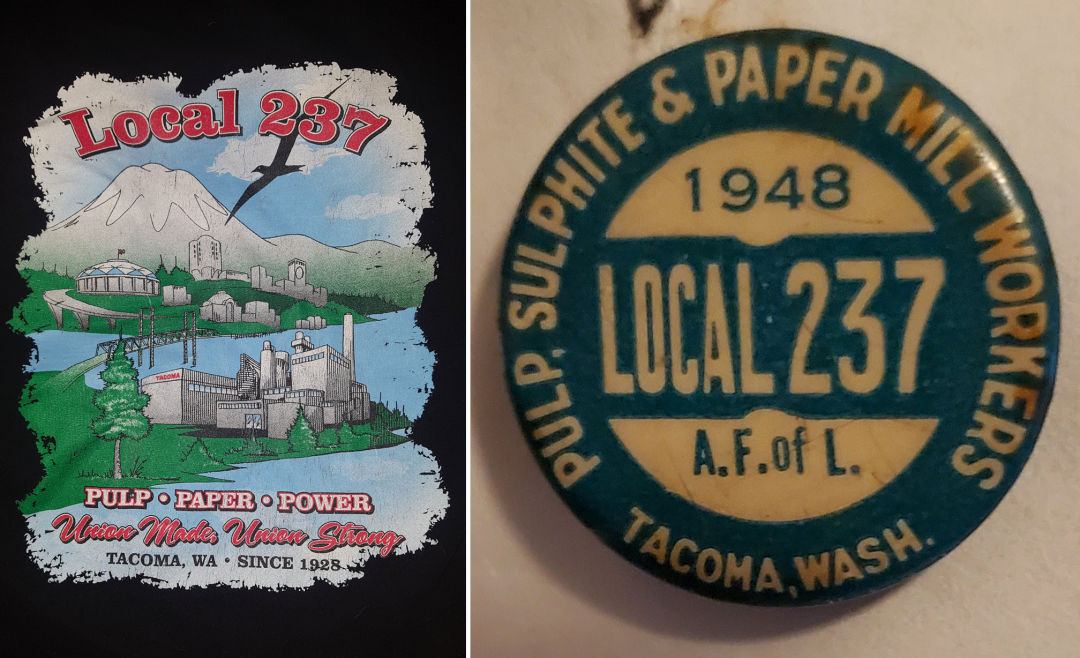
Left: Local 237 T-shirt logo designed by Lenn Richter. Right: Local 237 button from 1948.
Image: courtesy Chuck Whitt
Elected in 1992 as a member of the bargaining committee, I helped negotiate six different contracts with company. In 1992 I was also elected as vice president of UPIU Local 237. Four years later, I was elected president and served in that position until 2005.
As the years passed, and unions lost members through modernization, closures, and offshoring, UPIU merged repeatedly with other industrial unions. By the time I retired this year, Locals 237 and 586 were both under the umbrella of United Steelworkers. The two locals are now negotiating the final status of their members ahead of the mill’s final closure.
On August 1, my phone started pinging with messages from friends throughout the paper industry with news that WestRock would be shutting down the Tacoma mill. In disbelief, I started trying to verify the information. Many of my former coworkers, those on their days off and with no access to their work email, were getting the same third-hand information I was. But those who did have access to their email confirmed that the company had notified them of their intent to shutter the mill—not sell it, but shut it down completely.
This was a shock to me. The mill still has life in it and was still profitable. (Employees were frequently given updates of the mill’s economic condition.) But WestRock has decided to close it rather than sell, and put over 400 people out of a job in the process. My heart bleeds for the people I’ve come to know and love over all these years. They deserve better.
As the closure of the mill sinks in, as we recognize our lives are going to diverge, we have started saying goodbye, often referring to our fellow coworkers as brother and sister. Many of us spent more than half our lives there. The remaining workers will soon go their separate ways, but we will all forever be united by the spirit we carried through those gates, and the bonds we built on those machines.
Soon after the announcement of the closure, I started receiving requests from news organizations for contacts within the mill of people affected by the decision to close down. In forwarding those requests to my friends and former colleagues, I learned that they were told that talking to the press would put their severance pay at risk. Though they won’t engage with the press, they were not reluctant at all to engage with me.

The Waste Water Treatment Plant crew clowning around. From left to right: Bill Archer, Lorenzo Villa-Real, Paul Hart, Paul Iha, and Chuck Whitt.
Image: courtesy Chuck Whitt
My friends, particularly those who feel they’re too old to start over again, are walking around in a daze. They know life will go on, but processing this moment and figuring out how to move forward will take time. Some folks in the region may only know the mill for the smell that wafted over the city, but that small piece of land on the Tacoma Tideflats was also home to a community—a family. It is for this community that I feel so much sorrow.
I’m gone, retired. I will forever have the Tacoma mill to thank for putting me in the place to enjoy that retirement. But my friends still there won’t have the peace of mind of a long career rewarded. They’ll have to start again, and finish somewhere else. My sincere hope is that they find a place to do that. My sincere hope is that the Tacoma mill community endures, if not in that place, at least in our hearts.

Love and Football
What the Super Bowl Means to Me

Detained
