Pioneer Square on the Rise
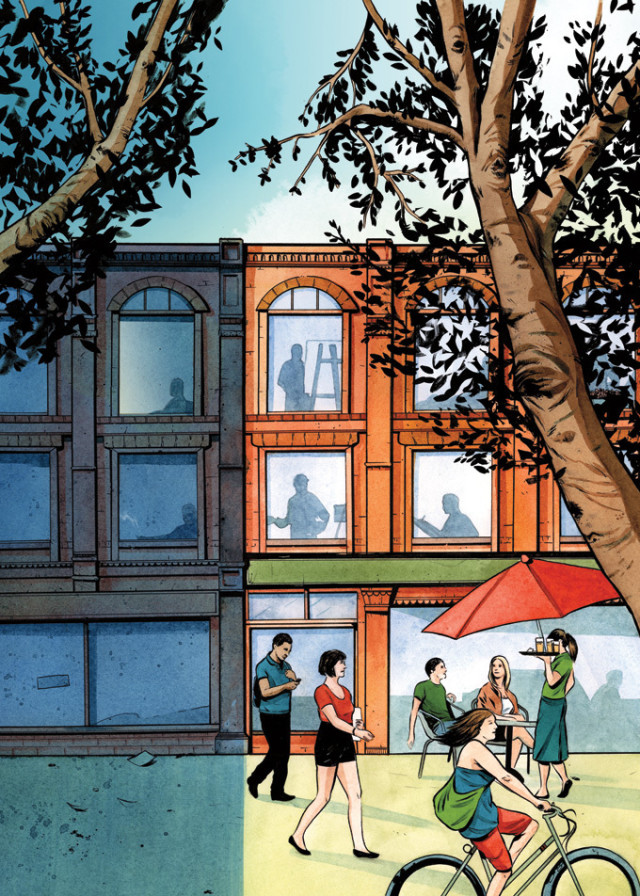
Image: Joel Kimmel
THE CLINCHER WAS the night of February 27, 2001. Mardi Gras.
More than one Pioneer Square booster will tell you that’s the moment those who love every red brick of Seattle’s oldest quarter are now fighting to overcome.
The riot made the more infamous WTO uprisings 15 months earlier look like a Shriners parade. Video footage of the Fat Tuesday celebration that spiraled into pandemonium shows men punching women repeatedly in the face, slamming their skulls against metal Dumpsters. A roving band of rioters overturned a car. Bullets whizzed through the crowd, wounding two people. By the time the police tear gas clouds cleared, multiple women had been sexually assaulted—and a man bludgeoned to death.
A decade later, Steve Johnson, director of the city’s Office of Economic Development, speeds past that part of the conversation, a quick transition between talk of early Jimi Hendrix performances and the waterfront streetcar.
Yes, the Mardi Gras riot reinforced the perception that Pioneer Square was a dangerous place, and it hurt an area already struggling to compete economically with the downtown retail core. The neighborhood founded by the Denny Party in 1852 maintains much of its original Romanesque Revival and Victorian architecture, yet dozens of empty storefronts leave the regal buildings looking like toothless smiles. But you’d be hard-pressed to call Pioneer Square dead, Johnson insists. And he’s got the numbers to prove it.
From 2003 to 2008, the neighborhood’s gross receipts grew 126 percent. To compare, Capitol Hill’s grew only 57 percent during the same period. The problem, says Johnson, is perception.
Most of those receipts came from businesses not likely to be found at street level, such as accountants, architects, attorney’s offices, and consultants. Above the empty storefronts, clicking away at keyboards, yammering about stock prices, thinking through the next iPhone app, is one of the most advanced workforces in the city: ING, the world’s largest banking firm; Zynga, creators of the Facebook game FarmVille; Nuance Communications, which built the Dragon mobile-dictation app; and—lured by the announcement that Comcast would be laying down high-speed broadband in the nabe—OneHub, a file-sharing developer from Bellevue.
Fueling all that brainpower is the city’s most buzzed-about sandwich district. Salumi, Delicatus, BuiltBurger, gyro impresario the Berliner, and Tat’s, a philly cheesesteak joint so popular the owners installed a webcam so office dwellers could monitor the length of the line, which, come lunchtime, wraps around the corner of Second and Yesler.
The trick is to keep that crowd around after 6pm, says Jen Kelly, who maintains the New Pioneer Square blog (thenewpioneersquare.com). See, the area bounded by Cherry Street to the north and the stadiums to the south, between Second Ave and the waterfront is hardly residential. Of the only 2,000 inhabitants in Pioneer Square, 80 percent live in homeless missions or subsidized housing. And a new condo development breaking ground this month on the north end of the parking lot of CenturyLink stadium (formerly Qwest Field) will bring a scant 700 additional living spaces.
So Kelly and the Alliance for Pioneer Square—which includes former Seattle Mayor Charles Royer—are pushing to turn weeknights into Pioneer Square nights, capitalizing on the abundant art galleries. They moved a failing Saturday outdoor market to Thursdays, to coincide with the city’s First Thursday art stroll. And they’ve helped reclaim alleys, long the domain of public drug users, and transformed them into public party spaces, with live music and movies projected onto walls.
“Far from being a commercial district in its last gasp, Pioneer Square is a commercial district of both relative economic health and extraordinary economic opportunity,” said Donovan Rypkema, a DC-based economist who specializes in historic preservation districts, in a report commissioned by the city of Seattle. But, added Rypkema, all the stakeholders need to be on board.
That could be yet another challenge. Says Kelly: “There is a guy who owns two condo units, one for him and one for his son. They don’t even live there! It’s just for the parking space on game day and to wait out traffic afterwards. That’s not the kind of ‘resident’ who’s going to be a valuable stakeholder.”


