


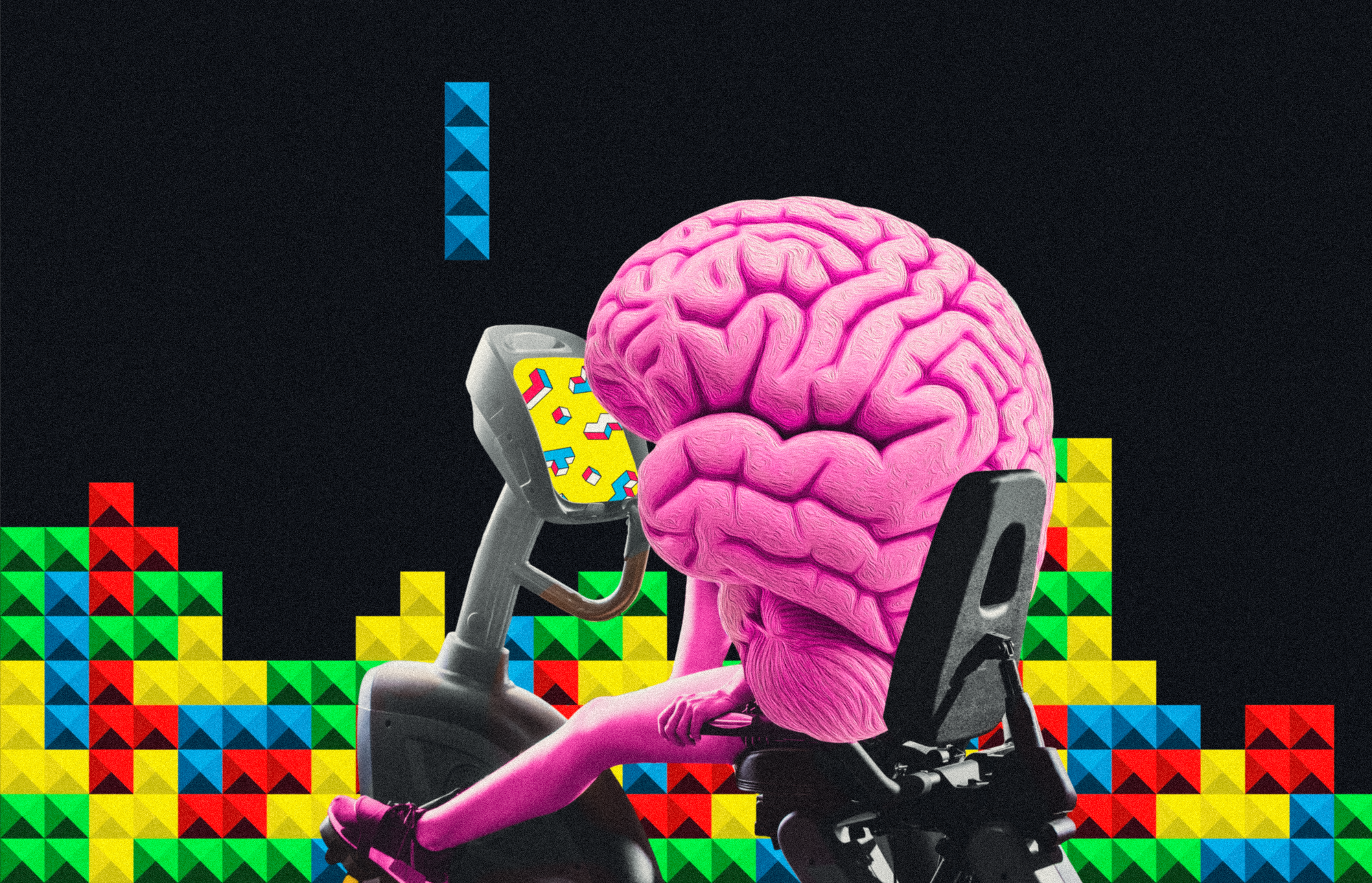
On a summer Saturday morning, I pedaled a recumbent exercise bike in a chilly room, hooked up to compression cuffs and longing for the warmth just outside—at least until the Tetris-like video game started, and then all my concerns about temperature fell away. Later, I alternated bike sprints with resting my palms on cooling packs while strategically chosen music put my brain into a focus state, and fun facts about brain health flashed across a screen. I finished with calming music in a toasty red-light bed. My poor toes never did warm up from their time in the ice box, though.
My session at Green Lake’s Mindeo was designed to help me think and focus better, but other workouts help with energy, mood, sleep, memory, and stress resilience. The temperature was intentional, keeping the body from losing energy through sweating and making the activity feel easier. That Tetris game while pedaling? It forces different parts of the brain to coordinate with each other. (The button placement was not intuitive to me, but I take Tetris seriously in all contexts, so I did my best to rack up a high score.) Mindeo, the brainchild of biomedical engineer Xenia Kachur, combines physical exercise, cognitive challenge, technology, and personalized coaching to create something akin to a gym for your brain.
In 2016, Kachur was on a rock-climbing trip in Oregon when she felt herself begin to fall. In a matter of a second—which felt like an eternity—she was fully extended on her back. Her gear bag cushioned the impact, leaving her with only a bruised tailbone and a “mild” concussion, which turned out to be a lot more serious than she ever imagined. “It flipped my life upside down,” she says. “I went from being active and healthy to not being able to work or sleep through the night.”

Image: Courtesy Mindeo
Nine months after the accident, she still wasn’t feeling better, and doctors had no answers. She struggled to remember details like her best friend’s name and what she’d eaten for breakfast. She couldn’t walk her dogs around the block without resting. Her thoughts were hopeless. They offered her medications, but each addressed only a fraction of her problem—something for sleep, something else for anxiety, another something for focus. “I was not interested in Band-Aiding one of my symptoms,” she says. “I wanted to treat the root issue.”
Desperate for a solution, Kachur started digging into hundreds of studies on brain health and realized there are techniques to strengthen the physical fitness of the brain that aren’t common knowledge, given that it can take time for novel findings from academia to be proven and then developed into a protocol that can be widely implemented by healthcare professionals.
If Kachur had broken a leg, she likely would have done an ongoing physical therapy course, but no such thing existed for the brain—at least not outside labs or pro sports facilities. “What we hear from our medical advisers is that it takes about 20 years to translate research into general medical knowledge and practice, and that’s if it even makes it,” Kachur says. Through Mindeo, she’s working to fill that gap between what’s clinically studied and what trickles down to the public—all so that others don’t have to suffer the way she did.
Just as physical therapy can be beneficial without a specific injury, Mindeo’s programs can be helpful for the general fitness of the brain, too. Their clients range from age 25 to 85; some, like Kachur, suffered a concussion or noticed a decline in their cognitive ability. Others want to be proactive about their health, giving themselves the best shot possible at avoiding later-in-life challenges like dementia. Some may think of it as a form of biohacking, but Kachur prefers to call it bioaccelerating. “Our approach magnifies natural processes in the body to create faster changes,” she says.
Results vary, but clients report feeling clearer and more mentally energized, having greater confidence, and being able to better manage cognitively demanding days. One of her clients recently told her she feels like herself again, one of the biggest compliments Kachur could receive—and the outcome she’s happy to have for herself 10 years after that fateful accident.
|
|
|