


Image: Ryan Johnson
Sometimes you have to dream big. While great minds across the city are making concrete new inventions—like the 10 best we picked here—some of us are thinking in more abstract terms. We picked four pie-in-the-sky ideas for Seattle’s future and investigated what it would take to implement them. Possible? Maybe not today. But tomorrow is just around the corner.
What if…
Seattle Went Car-Free?
Several European metropoles have tried it—in Oslo, Slovenia, and Italy’s historic centers. But in the US, going without wheels is rare, and it usually only happens in small tourist towns, like downtown Leavenworth. Seattle seems like it might be amenable to going car-free: We have a decent, still-growing public transportation system and don’t have severe weather. Hills aside, our city is relatively walkable, too.
In 2016, Paris closed the Champs-Élysées to cars on Sundays, showing that a city without private traffic would mean people walking, biking, and riding buses instead of a sea of parked cars and gridlocked traffic. If we did something similar here, bikes could have multiple lanes, and cyclists would ostensibly be safer. With far fewer fossil fuels being burned up, greenhouse gas emissions would drop drastically, and air quality would soar.
Of course, not everyone is able-bodied enough to walk, ride a bike, or travel by public transit citywide, so there would be a litany of accessibility issues to solve. Parents of young children would need to figure out how to get kids to school and themselves to work in a short amount of time. Boosting public transit to compensate for lost cars would be a serious stumbling block, and regional transit agencies would need billions of dollars to accommodate added riders.
Andy Katz, a member of the Seattle-based Transit Riders Union and a seasoned bike enthusiast, has some insight on how a car-free Seattle might work out: “No more thunderous I-5 canyon, no more Dodge Chargers with straightened exhaust,” he says. “It would suck for downtown commercial real estate investors who depend on a hub-and-spoke car model, but every neighborhood would flourish, socially, and commercially, and culturally.” He also imagines that urban-nervous Seattleites might finally feel safe enough to walk, bike, or scoot downtown, potentially even with kids.
As for the cash needed to enhance our existing transit systems, Katz says, “Some of that transit money could come from fewer collisions, fewer 911 dispatches, fewer visits to the ER.” Conversely, he points to the fact that some significant percentage of Sound Transit’s revenue comes from the Motor Vehicle Excise Tax, which would go away if nobody had cars anymore.
He concludes that a total vehicle ban wouldn’t be practical in Seattle, “even if feasible politically and logistically,” he says, pointing to the needs of the supply chain and emergency services. “But making them safer and separating them from pedestrians and cyclists—and minimizing their emissions—would be great harm-reduction steps.”
Pike Place becoming car-free in 2025 was a long time coming, and just this year, Seattle Streets Alliance (SSA) triumphed in convincing Mayor Wilson to close Lake Washington Boulevard between Mount Baker and Seward Park on summer weekends. SSA is also coordinating with other advocates who are pushing for similar pilots on the Ave, Alki, and elsewhere. You might say—pun intended—that the wheels are in motion.—MVH

Image: Ryan Johnson
What If…
Seattle Banned Tipping?
Believe it or not, tipping used to be against the law here. In 1909, Washington passed the first anti-tip law, citing moral and social implications: “Every employe [sic] of a public house or public service corporation who shall solicit or receive any gratuity from any guest shall be guilty of a misdemeanor.” People giving those gratuities were guilty of the same.
“The prohibition was essentially unenforceable” and largely ignored, writes retired attorney and amateur historian John Caldbick on HistoryLink. But he notes that there was nationwide pushback against tipping at the time, supported by progressives. The Seattle Times, which came out in support of the 1909 ban, called it “beggarly” for a man to accept a gratuity. It went on to say that “the acceptance of a tip is indefensible on moral grounds.”
If tips were banned today, the next few questions are obvious: What would happen to menu prices? Would workers quit, even if their hourly wages went up? Would guests find a way to reward super fabulous service?
It’s safe to say that restaurant guests overwhelmingly dislike tipping. Some local restaurants have taken note; Seattle is home to several “tipless” restaurants, Dick’s Drive-In, Ciudad, and The Shambles among them. The restaurants pay workers above minimum wage ($21.30 in Seattle, as of fall 2026), hypothetically replacing the amount workers would get via tips.
Other restaurants, meanwhile, have swapped out the standard tipping model for an automatic service charge (usually 3 to 22 percent), with optional tipping beyond that. Service charges typically divert a portion, if not the whole thing, to the owner’s pocket.
The fact that diners are expected to supplement the paychecks of someone else’s employees is still a bitter pill for many, exacerbated by the increasingly higher suggested tips. (These days 35 percent is possible.) Conflated with those progressively higher menu prices, it’s not a nice user experience.
I talked to a server and a tipless restaurant owner to collect their thoughts on a tip ban. While they both had opinions, neither was willing to put them on the record—one cited how temps get heated around the subject, and for the other, the mere question really pissed him off.
But Seattle-based food writer Mark DeJoy puts it pretty succinctly: “It’s such a weird model, the tipping thing. ‘I pay my employees a little bit, and you pay them the rest of the way.’” People only accept it, he says, because “that’s the way it’s always been.” And changing it would require a big shift in how restaurants are run.
It’s theoretically possible for new restaurants to hit the ground tipless, but with the hospitality industry’s famously razor-thin profit margins—and restaurant operation costs jacked up to begin with—most extant Seattle restaurants probably aren’t going to survive a wage hike substantial enough to replace the income their workers make from tips. Dismantling the platform completely would be a long, messy process, and while it could ultimately benefit everyone, the pain points would be plentiful.
Seattle’s old tipping ban was repealed in 1913, only four years after it was put in place. For now, tipping culture is a particularly sticky Band-Aid that’s not even close to being ready to be ripped off. —MVH
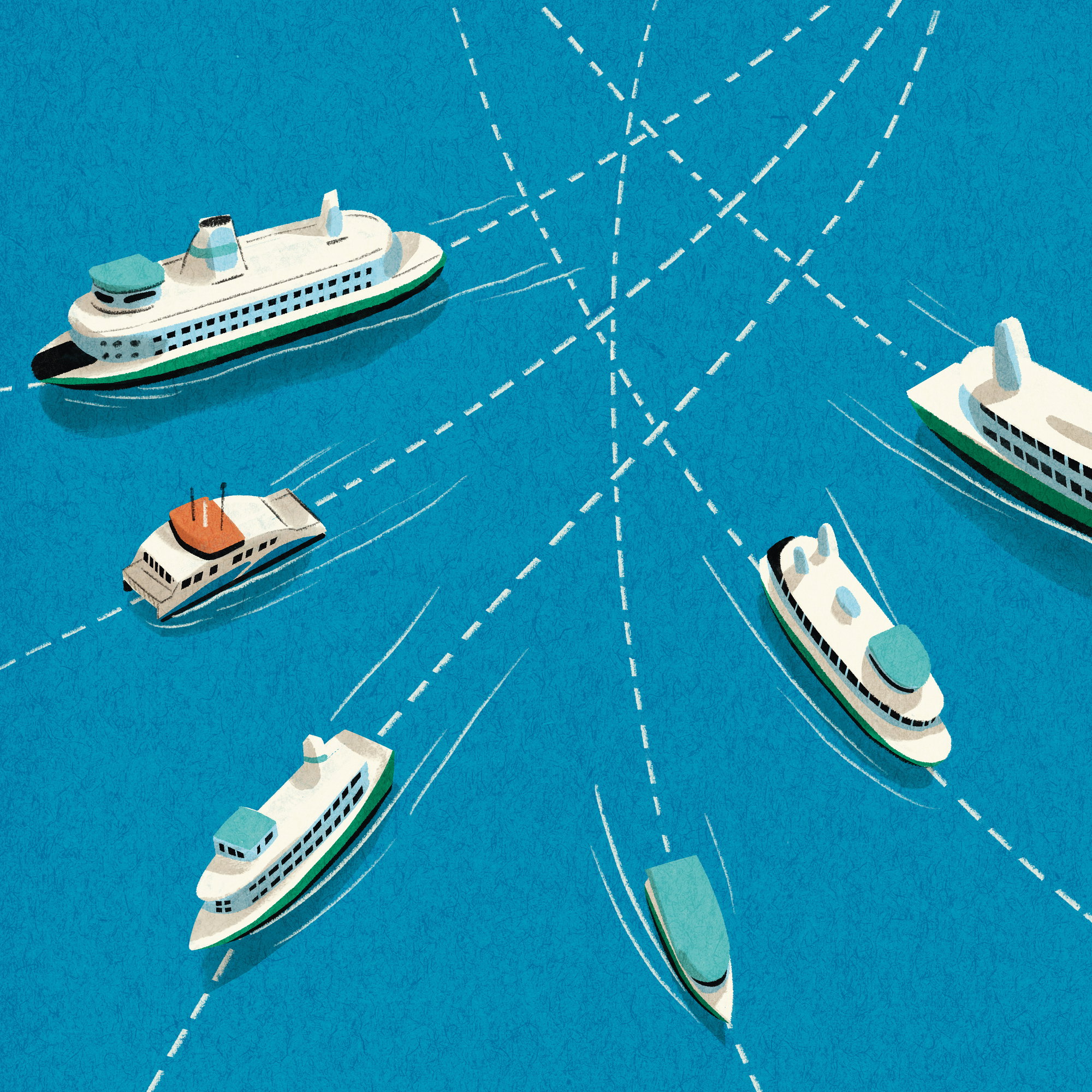
Image: Ryan Johnson
What If…
Ferries Went Everywhere?
Just picture the departures board: Seattle to Bellingham. Seattle to Tacoma. Seattle to Port Townsend. Dozens of routes, everywhere the Salish Sea touches. The idea of a giant spiderweb of ferries is nothing new; starting in the 1880s, dozens of steamships zipped around Puget Sound, carrying passengers, mail, and freight. They were dubbed the Mosquito Fleet (a nickname for a collection of small, fast ships that dates back before the Civil War).
Our throng of sidewheelers and sternwheelers tied the state together even as highways were still made of ruts in the mud. But in the age of cars, people started to prefer ferries that could transport them; vehicle-carrying boats arrived, and Washington State Ferries (WSF) launched in 1951. Eventually, it grew to become the largest ferry network in the world—but today it serves a mere 10 routes.
“In many ways, we were more connected back then,” says state representative Greg Nance. His proposed legislation—House Bill 1923, a.k.a. the Mosquito Fleet Act—calls for a serious expansion of smaller, largely passenger-carrying boats for Puget Sound. The idea isn’t a total throwback; already water taxis link Seattle and Vashon Island, and Kitsap Transit ferries connect Bremerton to Port Orchard, Annapolis, and, of course, Seattle.
Pushback comes from folks who want to focus funding on WSF and upgrading that aging fleet. After all, the big white boat shape is so iconic that it spawned a collectible frenzy as french fry holders at T-Mobile Park. But they’re much more expensive, notes Nance, and those vessels aren’t made locally; he compares the cost of one big white WSF behemoth, $400 million, to a passenger ferry with a $6 to $25 million price tag.
And just imagine, as Nance does, a passenger route straight from the San Juan Islands to downtown Bellingham, so elderly island residents can get to a large hospital without battling for space with tourists on the main Anacortes sailings. Or maybe an airport-minded connection between Olympia and Des Moines, letting South Sounders skip I-5 on the way to Sea-Tac. And, yes, even a ferry route on Lake Washington, maybe between the University of Washington and the Eastside. One can picture them the size of Vancouver, BC’s adorable Aquabus and False Creek Ferries, which look like little bath toys in front of the city’s skyscraper skyline.
Washington’s rugged geography and crowded development mean that a European-style train network is probably never in the cards. But the aquatic version is tantalizingly close; in the 2025 and 2026 sessions, Nance’s bill inched forward, though it has still not reached final agreement between the House and Senate. Put it this way: A ferry resurgence is more likely than an expanded monorail or flying cars, so it’s one retro future we might all live to experience.—AW
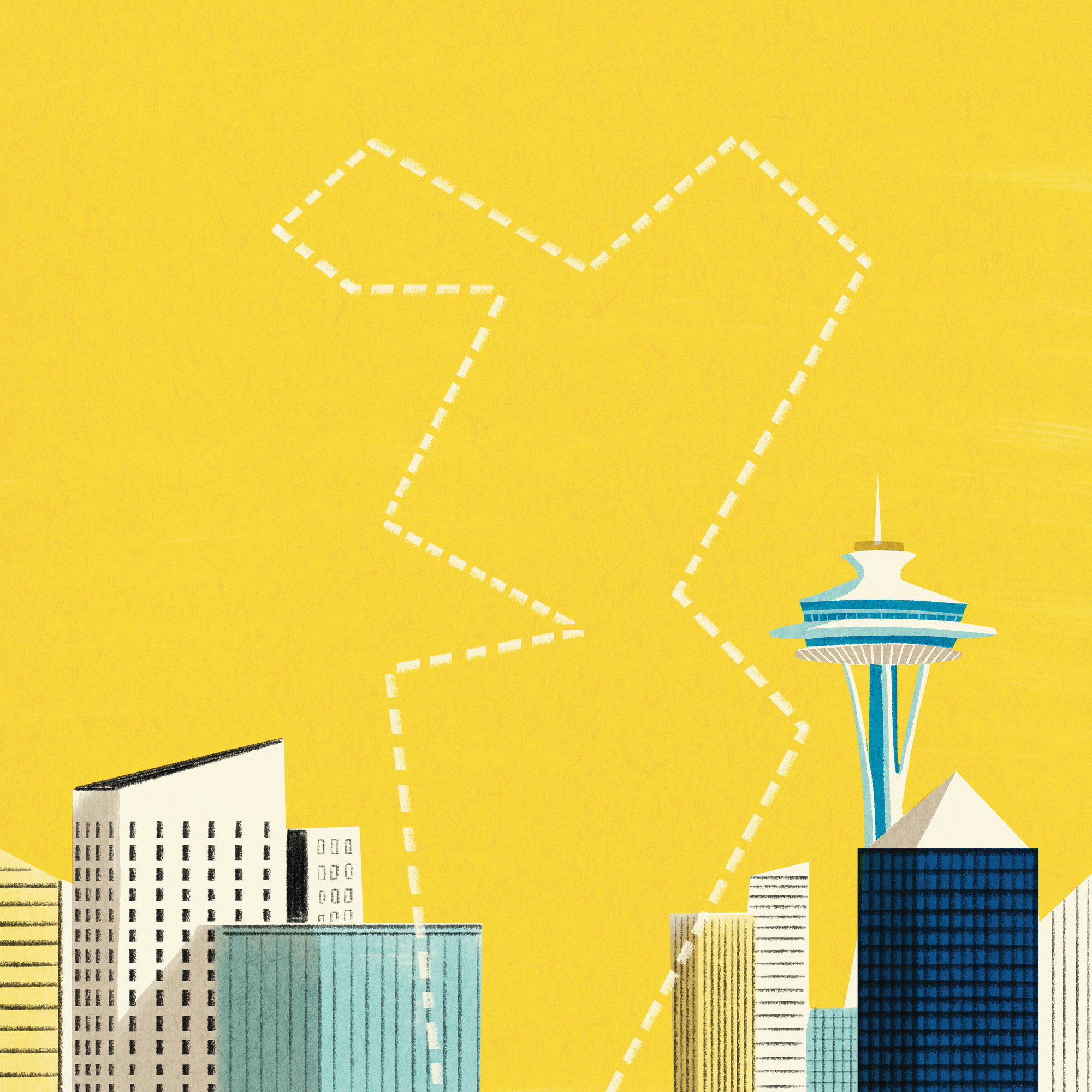
Image: Ryan Johnson
What If…
We Built Another Space Needle?
Sure, Seattle probably doesn’t need an exact twin of the Space Needle. Our signature tower won’t retire any time soon, despite the fact that it is about to turn 65 and has presumably been getting pointed mailings from AARP for a few years now. The structure got a soccer-themed facelift for the World Cup and just upgraded to double-decker elevators.
But could Seattle swing a second icon? Something so unique it becomes shorthand for the region, an instantly recognizable international symbol? Most places with more than one famous edifice are bigger cities—think New York City with the Statue of Liberty and the Empire State Building, or Paris’s duo of the Eiffel Tower and the Arc de Triomphe. Modest St. Louis, on the other hand, has only the one Gateway Arch.
It has been a long time since the US launched a signature art-first attraction; Chicago’s Bean sculpture is already two decades old, and South Dakota’s in-progress Crazy Horse Memorial has been slowly evolving since 1948. These days, big new construction projects usually put their concrete to a more concrete purpose; think New York City’s Oculus train station-slash-mall, or Las Vegas’s concert venue the Sphere.
That’s why Seattle’s next icon would probably swing more utilitarian. In 2020, architecture firm ODA New York released a rendering of its proposed Seattle Tower, a skyscraper that would take the tallest-in-Seattle crown from Columbia Center. It has an outdoor garden halfway up, an eye-catching sky park. The result is a striking image, sure—but it was also designed to have more than 1,000 residential units. (And half a decade later, it’s still just a rendering.)
But the biggest hinderance to the appearance of another Space Needle–size structure is right there in the name: space. The city’s skyline has shot up since the 1960s, but the Needle still has breathing room around it, making it visible from afar; in 2013, the city debated whether legal “sight line” preservation for the privately held structure was appropriate. There’s not much wide-open space left; the Amazon Spheres made a splash when they first bounced onto the scene in 2018, but they’re invisible until you turn onto Seventh Avenue.
These days, local icons are a little more subtle, like the stairs-and-terraces Overlook Walk that connected Pike Place Market to the waterfront last year. We got the first floating bridge light-rail section, too. They may never appear in a list of the country’s most iconic landmarks, but they do important jobs. And after all, who needs two Space Needles?—AW
Published in the The Innovation Issue issue of Seattle Met.
|
|
|