



Image: Ryan Johnson
“Welcome to the Future!” That’s how the Seattle World’s Fair program opened in 1962, directing fairgoers to the monorail, bubbleator, and spacearium exhibits, all focused on “the exciting realm just past the edge of tomorrow.” Seattle made good on its promise to create what’s next: Boeing boomed here, Microsoft ushered in the personal computing age, grunge redefined cool, then Amazon remade the world in its own e-commerce image.
Seattle ingenuity wasn’t just about big, successful companies. In 2002, a University District puppeteer invented a 7-foot Johnny Jetpack, a human model that flew 120 feet in the air powered by its own little rocket. A Magnolia housewife created the Slinky Dog toy. We thought up the Sonicare toothbrush and, er, Clippy. We’re imaginative, yes, but reliably a bit weird.
And that hasn’t changed, even in the age of artificial intelligence. Sure, Seattle’s tech companies are refining AI into targeted tools and biomedical research applications—but our local innovators still think outside what’s expected. High school students bring ideas to PhDs, and inventors are still tinkering in their own backyards and spare bedrooms. Whatever the future holds, it’ll probably arrive here first.

Sustainability Headquarters
When developing the Seattle Climate Innovation Hub in 2025—a collaboration between the city, UW, and private companies—VertueLab’s Aina Abiodun knew that big environmental solutions require connecting people. The downtown space
facilitates that. “Investors don’t show up,” Abiodun says, “unless they know there’s an ecosystem where people are trying to build businesses.” She thinks Seattle is ripe for the next breakthroughs in housing materials and battery technology.—AW
Sponging up Salmon
Sometimes big ideas come from connecting the dots; to make a salmon sponge, it was a high schooler introducing two scientists. Lakshmi Agrawal, a student at Bellevue’s Interlake High School in Bellevue, introduced Benjamin Hsiao at New York’s Stony Brook University to University of Washington’s Ed Kolodziej over Zoom, and it “was like a matchmaking process,” she says. She combined their work to create a sponge that could capture a material that was hurting Washington’s signature fish.
Kolodziej had researched the salmon-killing 6PPD-quinone, an oxidized chemical used in vehicle tires (and the main contributor to devastating urban runoff mortality syndrome among fish). Hsiao’s lab had developed hydrosponges that could pull dangerous fertilizer products out of the environment. Realizing that hose sponges had the exact properties needed to filter out 6PPD-quinone ended up winning Agrawal a Regeneron Young Scientist Award at just 18.
The “really, really squishy” sponges not only physically filter the compound, she explains, but also chemically bind and trap it. Plus, the practically zero-waste production means hydrosponges “use 80 percent less energy while costing 98 percent less,” than existing methods. “It’s a much more scalable and deployable solution than what we currently have.”—TG

The Robot Feeder
ADA is here to serve. The robot developed at University of Washington’s
personal robotics lab—assistive dexterous arm (ADA)—wields a 3D-printed fork, designed to allow people with motor impairments to eat independently. As a PhD student working in the lab, Amal Nanavati worked with researchers who have lived experience as paralyzed adults, and they shared feelings of self-consciousness when asking a caregiver for bites and generally not being able to eat how or when they’d like.
The robot feeding arm can spear and deliver bites of precut fig pizza, cucumber kimchi, and avocado toast. A connected web app, controlled by existing adaptive technology like a sip-and-puff device or chin joystick, lets users drive each meal. ADA, Nanavati says, “is still not faster than caregivers, but what we’ve heard when talking to users is how impactful that is, to be able to feed themselves.”—TG
Online Organization
Can paperwork (or the online equivalent) be revolutionary? It is in Seattle, where online applications for government programs like the Seattle Preschool Program or emergency bill assistance have all been fast-tracked in the past couple years by the CiviForm Platform. It’s quietly a big deal, especially for vulnerable populations.
The seed was planted in 2017, when Mayor Jenny Durkan called for a centralized affordability portal for residents to learn about and apply for benefit programs. It would combat the time-sucking quagmire of repeat forms, hide-and-seek links, and never-ending phone holds that stand between government benefits and those who could use them. In 2021, Google engineers teamed up with the City of Seattle—through the tech company’s philanthropic arm—to craft CiviForm.
The result was a dashboard that replaces a dozen or so individual applications with one central, survey-like form. Seattle’s average application time for a single service dropped from 30 minutes to seven. It’s now gone nationwide, and its collaborative adaptability means that the state of Arkansas’ current project, onboarding WIC and SNAP into their CiviForm, could serve as a road map for other places to do the same. The product was named one of Time’s best inventions of 2025.
“The benefit landscape is constantly changing,” Ethan Elisara of CiviForm’s steward company Exygy says. The quicker governments can adapt, “the more they’re able to get benefits to people as quickly as possible.”—TG

Image: Courtesy Tin Can
Vintage Communications
A ringing phone (that actually sounds like a bell), a receiver, even a curly phone cord—they’re all back, at least for kids. The analog, screenless phones that children are picking up are the brainchild of Seattle startup Tin Can.
Co-founder Chet Kittleson’s three young kids were early product testers of his quest to tether an old-school, corded phone to Wi-Fi, integrate the system with a caregiver-controlled app, and give kids independent, safe communication without screentime. As Kittleson and his two co-founders installed prototypes in his neighborhood, they couldn’t get phones into homes fast enough for their local demand.
The phones look like landlines—made in bright colors, with real buttons and the ability to be physically hung up—but operate in a closed communication ecosystem. Caregivers add approved contacts, either real phone numbers (with the Party Line plan, a monthly subscription) or other Tin Cans (free to call). Those are the only calls that can come in or out, nixing stranger danger and scammers.
The product has proved popular among parents who are eager to encourage homework chat or grandparent calls without the complications of a smartphone. Launched in 2025, the first batches sold out immediately; by mid-2026, new orders took more than a month for fulfillment. The company’s pitch is as simple as one of its taglines: “Twirl that cord.”—TG

Eyes in the Sky
The Museum of Flight called Seattle “the satellite capital of the world” in 2025, and about half of all active orbiters today were made in Western Washington. Manufacturers include Starcloud, Xplore, and Space X, whose Starlink satellites are made in Redmond. This summer, Department of Defense supplier K2 Space announced a new satellite engineering location here. —AW

Image: SNEHIT PHOTO/Adobe Stock
The AI World
In 1998, seven strangers were picked to live in a house for The Real World: Seattle. Almost thirty years later, the same place—Pier 70 in Belltown—became an incubator for AI innovation when it was dubbed AI House. Startup founders collaborate and advocate for small-business AI innovation and presumably have stopped being polite and started getting real.—AW
Solid Seaweed
The lettuce of the sea isn’t just for sushi anymore. In 2025, a collaboration between Microsoft and UW led to the creation of cement made from seaweed, which is a lot greener to make. Notable, too, was the speed at which study author Eleftheria Roumeli and her team made the recipe: Wielding a custom machine learning model, they refined the ideal mixture in less than a month.—AW
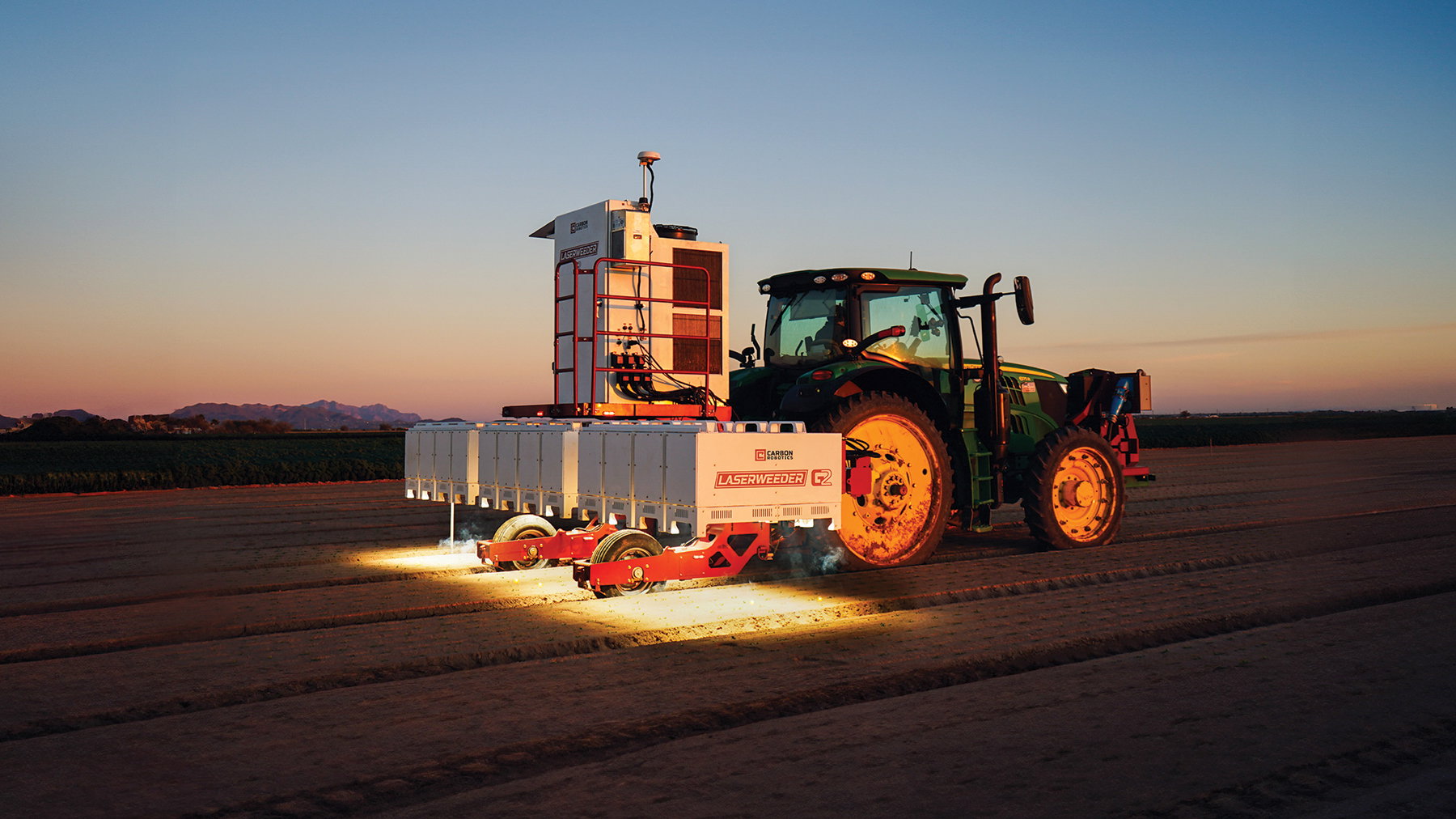
Image: Courtesy Laser Weeder
Tractor Factor
One of Seattle’s newest breakthroughs took root—or perhaps was pulled by the root—in a Bellevue backyard. Paul Mikesell began testing lasers on weeds in his own garden, eventually growing Carbon Robotics into a farming innovator, with much of its manufacturing in the Tri-Cities and its design and prototyping done in Mountlake Terrace. Its LaserWeeder is a tractor armed with AI to identify invasive plants that would hamper the growth of much-desired food.
First, the company developed a “large plant model” to identify species. “You have to be able to identify plants at every stage of growth—distinguish between a small onion emerging and a blade of grass,” says marketing vice president Brett Goodwin. Then, focused thermal energy kills the problem greenery only; by heating the water in the weed, its cell walls explode so it can’t photosynthesize. The withered weed is reabsorbed by the soil as organic matter—without pesticides. “It doesn’t use chemicals, doesn’t disrupt the soil, doesn’t kill the biome or throw dirt on plants,” notes Goodwin. The LaserWeeder is already used to protect more than 100 crops in 15 countries, arguably more impressive than just the founder’s own backyard landscaping.—AW

Image: Courtesy Scott Heimendinger
A Sonic Slice
Engineer Scott Heimendinger considers his invention the newest iteration of a process as old as humanity. “We’ve always wanted to make knives better,” he says. “We started out with sharp rocks and went to copper and so on.” The cutter he brought to market last year, the C-200 Ultrasonic Chef’s Knife, rethought commercial technology (how do you think Little Debbie gets such perfect cuts?) for the home kitchen.
The $400 tool doesn’t quiver like an electric knife; it resonates 30,000 times a second, fueled by piezoelectric ceramic crystals. It feels like a normal knife, but every cut requires less muscle from the chef holding the grip. Heimendinger, who previously worked at Modernist Cuisine and at a sous vide startup, appreciates Seattle’s geeky culture: “This is a city that encourages you to go as far down the rabbit hole as you want.” —AW
Published in the The Innovation Issue issue of Seattle Met.
|
|
|