


Image: Tegra Stone Nuess
Everything is a window at Moonpass Lookouts. All sides of the one-room, 14-foot-square cabin are glass; every ceiling panel see-through. The floor, 30 feet in the air, is the only solid surface, though the ground is visible when the trapdoor entrance is open. Every part of the indoor space steers the gaze outside.
That makes sense, given the vacation rental is modeled after a utilitarian workspace, the fire lookout. That term refers to two things at once: the workers historically tasked with spotting wilderness fires, and the tiny huts perched atop mountains where they worked—person and purpose meld into one. At Moonpass, that practicality is reinvented into escapism.
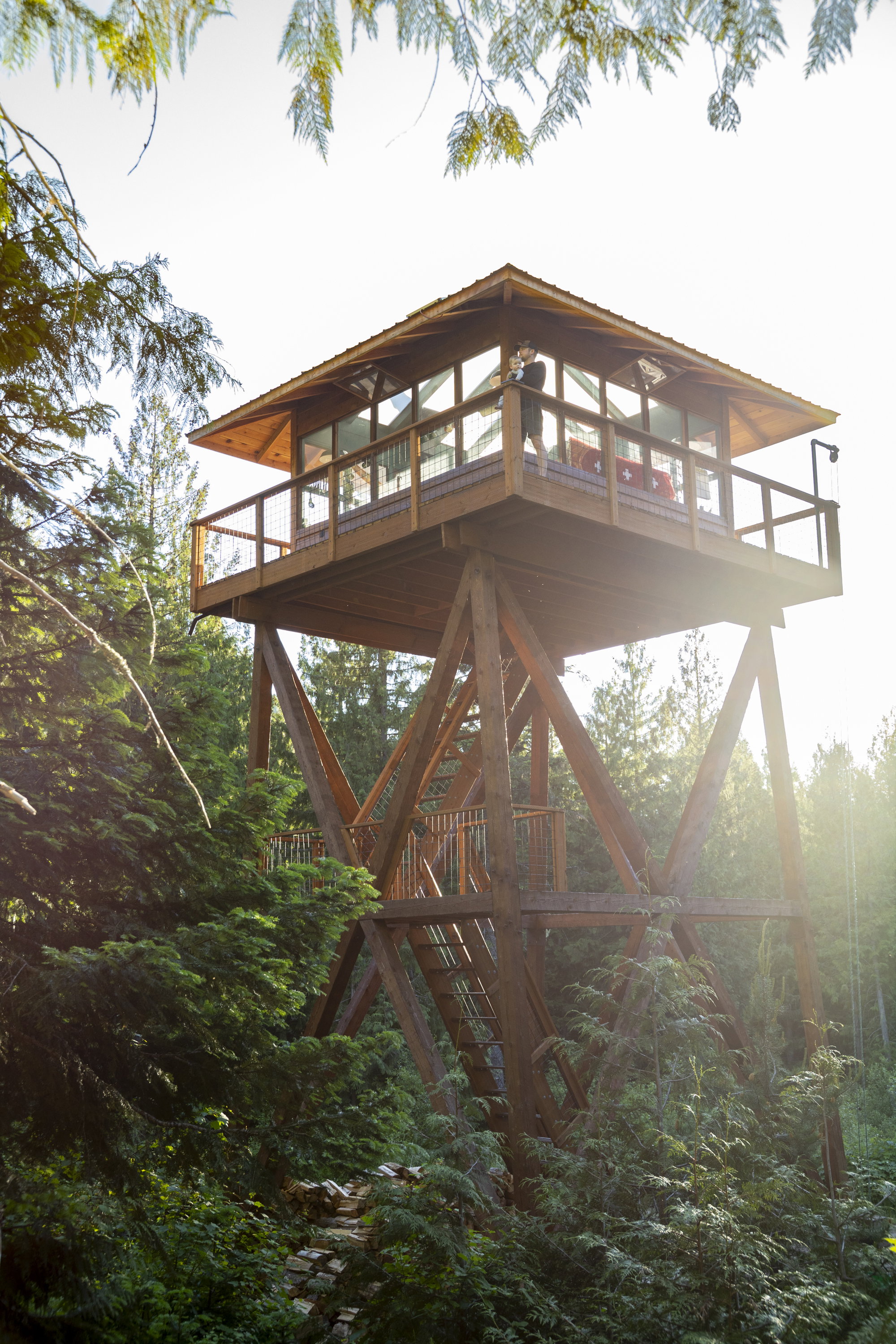
Image: Tegra Stone Nuess
Permanent fire lookouts (the buildings, that is) have dotted the West since one wildfire in particular, a 1910 conflagration that ripped through Washington, Idaho, and Montana with such destruction that it became known as the Big Burn and the Great Fire. Small huts were constructed to provide refuge while fire lookouts (the workers) scanned the whole landscape; the ultimate home office.
The romance of it all—distant, lonely, beautiful—peaked when Jack Kerouac and Gary Snyder, famous Beat poets of the 1960s, sought jobs at the remote posts to indulge in creative solitude. In his autobiographical Desolation Angels, Kerouac wrote that when he was left atop Desolation Peak alone for his season-long shift, he would “come face to face with God…and find out once and for all what is the meaning of all this existence and suffering and going to and fro in vain.”
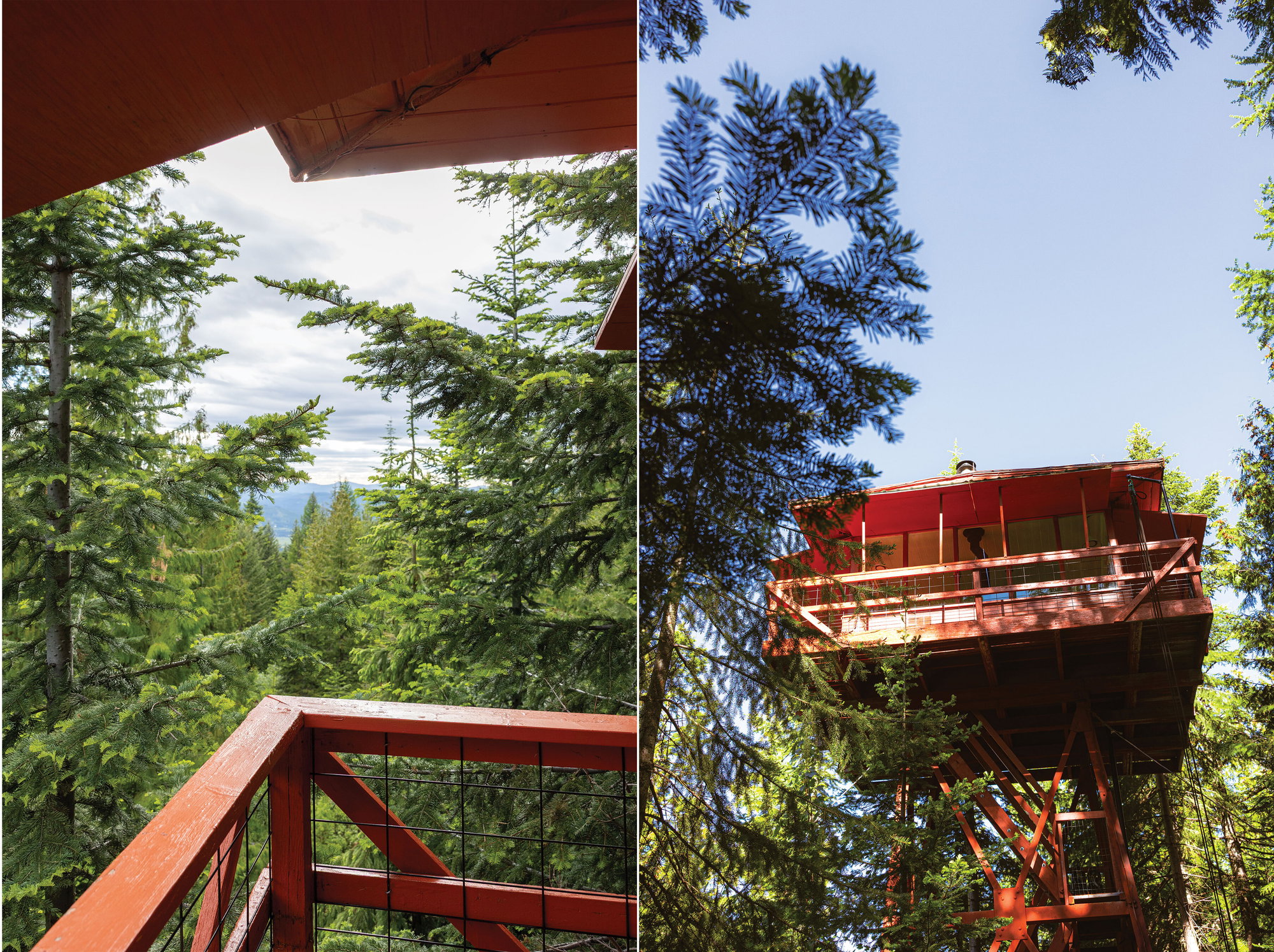
Image: Allison Williams
Almost 100 lookouts still exist in Washington, kept up by the US Forest Service, state or national parks, or volunteer groups. (Though manned lookouts have largely been replaced by satellites and aerial cameras, some workers remain, providing key naked-eye information when clouds foil the fancy technology.) Heybrook Lookout, atop a towering scaffold near Stevens Pass, is available for one-night visits; so is Mount Spokane’s Quartz Mountain Fire Lookout. Austere and often sparsely furnished—and without running water—the rentals nevertheless tend to book out months in advance.

Image: Tegra Stone Nuess
Here at Moonpass, in the woods just outside Wallace, Idaho, it’s not quite a historic escape; original lookouts had no glass roofs, no reason to stargaze. Owner Kristie Wolfe built the lookouts from scratch, replicating the structures before adding upgrades like saunas and these see-through ceilings. Comforts include woolly blankets and a hand-cranked coffee grinder, a DIY trail mix bar and soft pillows. So far three replica lookouts stand in her 55-acre plot, with two more to come.
In an echo of the famously solitary job of fire lookout, Wolfe has built the structures almost completely solo, even weaving rebar herself. With long, wavy hair and a pink-toned plaid Carhartt jacket, she strides through Moonpass pointing out where she wants to erect a fire lookout museum and host former lookouts to come tell stories to day visitors.

Image: Tegra Stone Nuess
Wolfe has been building short-term rentals full time for 12 years, but before that she worked in factories while remodeling houses. “Not just, like, changing out cabinets,” she says; “adding walls, demolishing.” She was “raised handy” by her mother, who reworked their house to accommodate the six-child family in eastern Idaho.
Her first vacation rental was a lark, a tiny house in the shape of a giant potato. (The Idaho roots run deep.) Drawn to novelty, she constructed a tree house in Hawaii, refurbished a cabin shaped like a ship on an Idaho lake, and built a hobbit home near Lake Chelan (though that one burned in a wildfire earlier this year). Her early success on Airbnb led the company to rope her properties into the 2022 launch of its OMG! category, highlighting quirky rentals.

Image: Tegra Stone Nuess
Wolfe bought a 1930s fire lookout that had been relocated to Fernwood, Idaho, but quickly questioned the logistics of running a vacation rental somewhere so remote—it sits a half-hour up a rutted, unpaved rural road. Instead, it inspired her to create the kind of from-scratch cluster that would never exist among real fire lookouts. She found a plot near the kooky small town of Wallace and enlisted backers in an Indiegogo campaign to fund the lookout resort. (Wolfe knows her business models rarely rely on conventionality: “A bank’s not gonna loan on a potato,” she says.)
Because these are copies of the real thing, the lookouts don’t have the all-horizon vistas of the historic versions; here, the outdoors are always visible, but sometimes that means thick Northern Idaho pines a dozen feet away. Still, the sense of isolation is strong, with no cell service and no power beyond a little solar juice to light a few lamps.

It’s less than five miles from Moonpass to Wallace, and a sign between the two notes a historic trailhead: In 1910, when the Great Fire tore through the woods in late August, a firefighter named Ed Pulaski led his crew to a hiding place in an old mine near here, a move that saved dozens of lives. The wood supports of the Pulaski Tunnel still show signs of char from the flames, and Pulaski is still remembered as a hero among firefighters.
Wolfe likes that the reminder is so close to her newly built lookouts, and that the hand-cranked coffee and 30-foot stair climb demand a little elbow grease from her visitors. The legacy of labor is still there, even as visitors huddle in the cozy confines of a brand-new cabin. Here, guests have to look back a little, and look out a lot.

Image: Tegra Stone Nuess
|
|
|