


Image: Elizabeth Rudge
Donated organs save lives, and there are never quite enough of them available at the exact moment they’re needed. But what if there were massive banks of organs awaiting recipients? It would flip the script on the current organ transplant landscape, where more than 103,000 patients sit on waiting lists in the US. It’s a future that the scientists at UW’s Center for Cryo-Biomedical Engineering and Artificial Organs can imagine.
It could happen by freezing organs as they are donated, then holding on to them until the right match comes calling. Freezing larger organs—or more accurately, an ice-free process called vitrification—has been well-documented, but “rewarming has become the bottleneck” in the march toward an organ-abundant future, associate director Dr. Zhiquan “Andy” Shu says.
The challenge, he says, comes from a need to rewarm entire organs both rapidly and evenly. Miss the mark on either, and the organ won’t survive; if it’s not warmed fast enough, ice will form, killing cells and tissues. If the process isn’t uniform throughout the entire organ, the tissues can crack and break, like a cold glass filled with boiling water.

Image: Elizabeth Rudge
What we essentially have, he explains, is a classic kitchen problem: a frozen chicken breast can defrost painfully slowly in the fridge over several hours, or the microwave can spit out something that’s half cooked and half solid in a few minutes. Replace the chicken with a human organ, and you get the issue that researchers at the UW center have spent over 20 years working to solve.
The scientific community has largely solved preservation for small cells—take fertility procedures, for example. “It’s very easy to cool and rewarm the small sample, like a human egg,” Shu explains. But “when we scale up the size from the cells to tissues to organs, then the complexity will increase exponentially.”
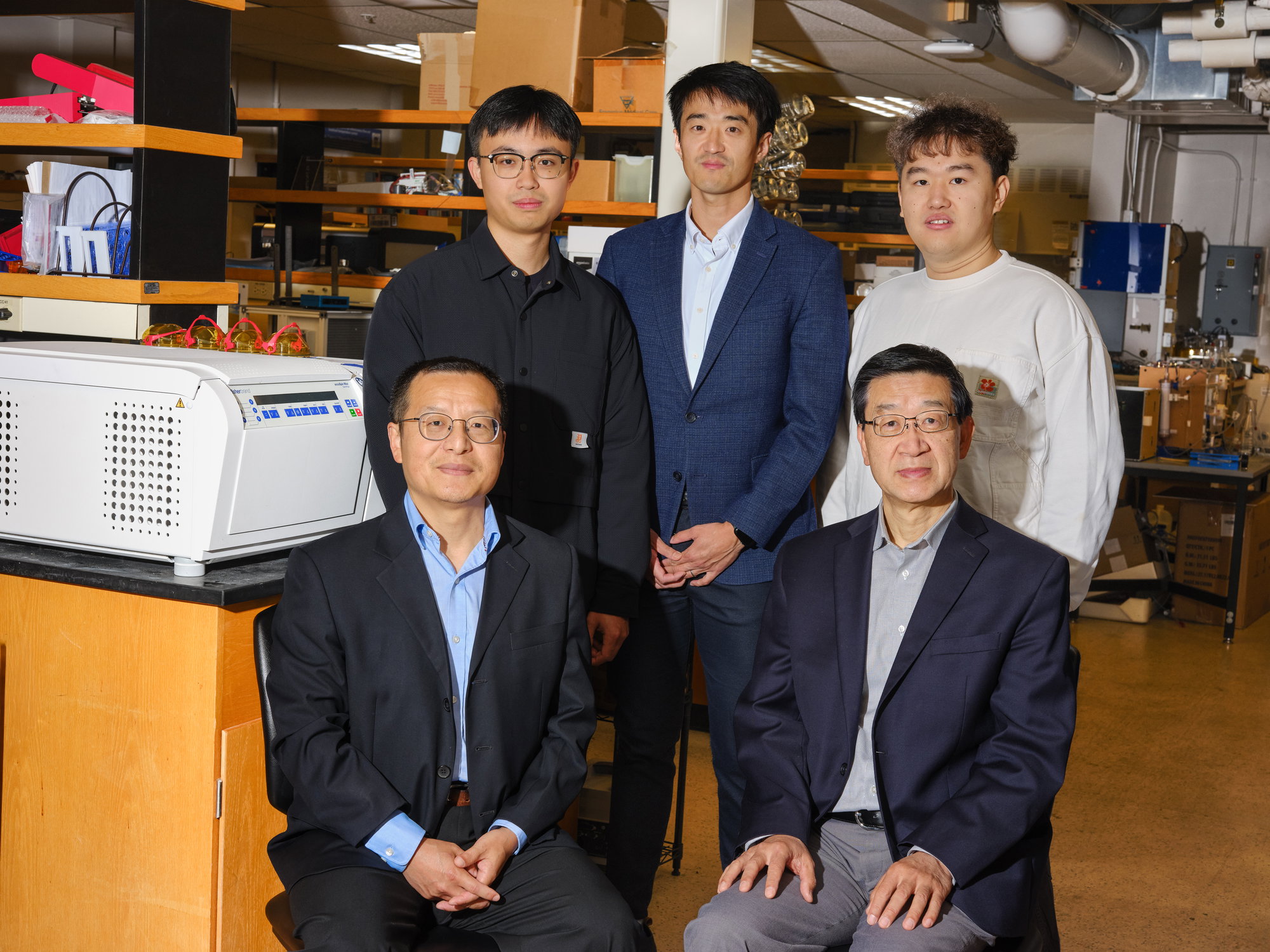
Shu’s research lies in a complex intersection of mechanical engineering and biomedical science—with some mathematics and chemistry thrown in. The field is a top example of convergent science, integrating disparate knowledge from interdisciplinary subjects to address the most challenging problems facing humanity. His lab spaces in Tacoma and Seattle are dedicated to theoretical and physical studies to both develop a novel rewarming approach and design and manufacture the physical equipment needed to do it.
On a daily basis, Shu, along with a handful of PhD and undergraduate students and his mentor Dayong Gao, use numerical simulation software to test out the complex multiphysical phenomena involved in rewarming. Promising approaches are built, tested, and revised.
Their approach is a mouthful: single-mode resonant electromagnetic rewarming. Theoretically, it’s quite similar to a household microwave, but “technically,” Shu says, “it’s quite different.” Any break room microwave uses multimode heating; Shu’s single-mode focus is much more uniform.
It’s exciting progress in something scientists have been working on for decades: a way to bank organs for a long time. In 1990, researchers at the University of Minnesota did use microwaves to rewarm dog kidneys, studying ways to avoid heat damage from uneven heating. A contemporary collaboration among that university, Massachusetts General Hospital, and Harvard Medical School continues to work toward organ preservation and rewarming; another collective from Spain employs ultrasound technology for its own approach to organ rewarming.
All are racing to figure out a way to preserve organs and save lives. Shu imagines a future with organ wait lists—that grow, on average, by one person every eight minutes in the United States—zeroed out. Right now, organs must be transplanted within hours; when a deceased donor is identified, a mad dash ensues to get the organ to a suitable match. “We want to long-term preserve the donated organs, not just for days: it could be for months, for years, even for decades,” Shu says. That kind of stockpile would mean better matches for patients, fewer wasted organs, and transplants without the wait.
At Seattle Children’s Hospital, in the span from 2018 to 2023, only 25 percent of patients waiting on a kidney and 40 percent of lung transplant candidates received one within a year, not including transplants from living donors. With the bank of organs Shu envisions, vulnerable patients like children wouldn’t spend years waiting in limbo.
When exactly that might happen is still up in the air. “Even five years ago, 10 years ago, people asked us, and we were not so optimistic,” Shu says. “Generally we’d say, ‘Oh, that will take us a very long time,’ but now we’ve become more and more optimistic.”
Published in the The Innovation Issue issue of Seattle Met.
|
|
|