


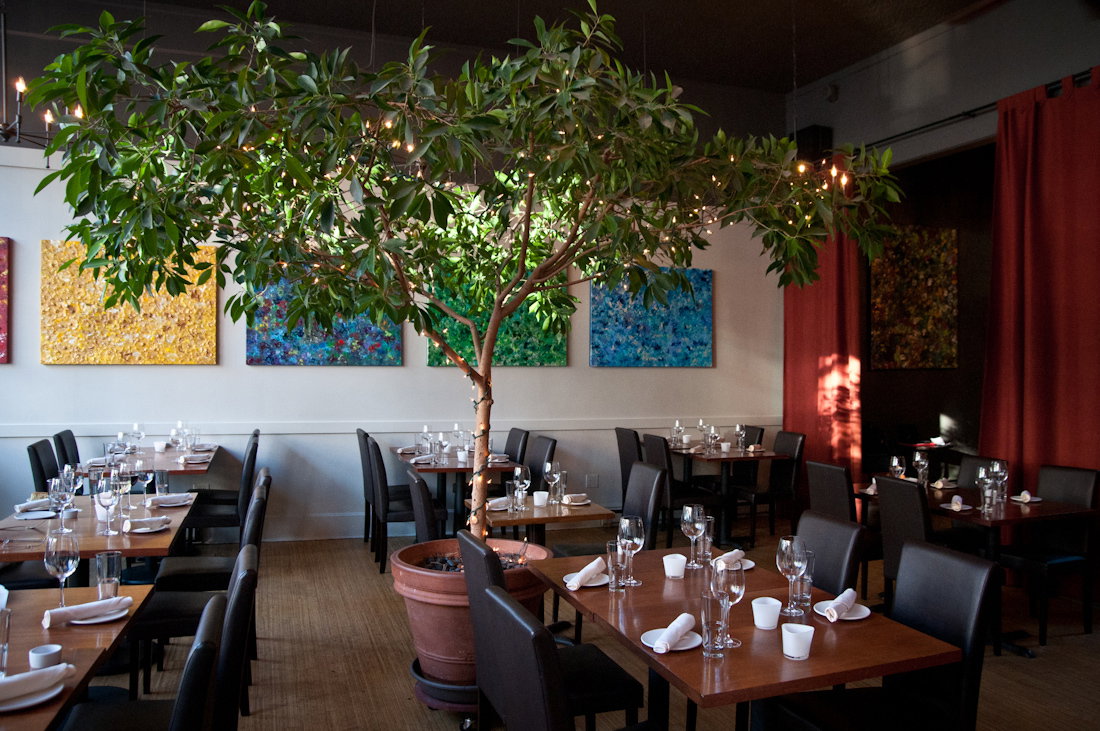
The beautiful ficus of Agrodolce.
Image: Morgen Schuler
Decorative elements vary widely across Seattle restaurants, but one repeating motif, not surprisingly, is the tree. Yes, trees show up in plenty of restaurant names—Tamarind Tree, Sitka and Spruce, Treehouse Lounge, London Plane, Madrona Arms, Cedars—but they also decorate more than a few restaurant interiors.
In one common usage, when restaurants have rollaway walls allowing patios to feel like extensions of the indoors, patio trees effectively become part of the interior decor. I’m thinking now of the leafy tree—a bay laurel? an evergreen magnolia?—holding down the patio of The Whale Wins, lending the place real warmth when those walls are open; or the potted trees where indoors gives way to outdoors at the inimitably lovely Tallulah’s.
Other times the tree is fully committed to the interior, and the effect can be as otherworldly as an indoor forest. Rising from the center of Maria Hines’ beautiful Agrodolce is a leafy ficus that opens like a canopy over tables, lending a soft coziness that twinkles with lights after dark.
Still other times, the tree is art. The mid-room, probably weight-bearing posts at Six-Seven Restaurant at the Edgewater Hotel are clad in “bark,” with “branches” artfully extending. The areas atop the sushi bar and behind the liquor bar at the newish Sushi Kashiba are lined with slim, striking birch trunks. Another sushi bar, Moshi Moshi in Ballard, is anchored by a gargantuan “cherry tree,” its “blossoms” an exuberance of pink LED lights.
Know of others?
|
|
|