Wikispeed’s 100 Mile Per Gallon Car

Image: Michael Clinard
JOE JUSTICE DOES NOT GIVE HIGH FIVES. HE PLANS THEM. Estimates jumping trajectory, calculates arm speed, triangulates a meeting point. For him the high five is a physical manifestation of exuberance multiplied by the sum of satisfaction and happiness. And right now, in late September, as the 32-year-old Lynnwood resident stands outside of a four-stall garage next to his home, dressed in paint-spattered Carhartt cover-alls, he’s very happy. And satisfied and exuberant, no doubt because he just spent the last 90 minutes explaining how—if his numbers are correct—his automotive startup, Wikispeed, will change the car industry and manufacturing in general. So naturally he wants to high-five.
It’s difficult to not get caught up in Justice’s enthusiasm. In May 2010, Wikispeed was one of 27 finalists for the Progressive Insurance Automotive X Prize, a $10 million bounty offered to the three teams that designed mass-producible cars capable of getting 100 miles per gallon. Then in January 2011, Justice went to Detroit to exhibit his prototype, the SGT01, at the North American International Auto Show, the biggest car confab in the world, “the place where Ford unveils its new F150 each year,” he says. And this January, he’ll deliver his first two cars to paying customers.
Rattling off those accomplishments has amped him up, so here comes the high five. “We’re going to jump,” Justice says to me, taking note of his roughly two-inch height advantage, and then presumably plugging numbers into a hastily drawn-up formula in his head. He jabs a finger at a spot about two feet above us. “There. That’s what we’re aiming for, okay?” He bends at the knees and gets ready to leap, then hesitates, straightening up to point to the target again. “Right there. Got it?”
I guess.
“Ready, set, go.” We jump and…the heel of my hand awkwardly bumps his wrist, most likely because his formula incorrectly assumed that my excitement would equal his. (Which isn’t to say that I lacked enthusiasm; it’s just that he was practically springing out of his coveralls.) “That’s okay,” he says. “Let’s go again.” He recalculates. We jump, this time more or less in unison, and our palms meet more or less where he predicted they would.
“Yeah!” he cheers. He smiles, a toothy, open-mouthed, full-on-giddy smile. “Awesome.”
AWESOME POPS UP OFTEN IN CONVERSATIONS with Justice. “You can call me on my cell, which would be awesome,” he wrote in one email. “It is awesome working with you,” he wrote in another. The more than 100 volunteer engineers and mechanics who have joined the Wikispeed team—including Justice’s mother, his five siblings, and a cousin and uncle—are awesome. His response when I pointed out his affinity for the word? “That’s completely awesome.”
There are a couple reasons for Justice’s relentless optimism. First of all, he may actually be onto something with this car thing. Part of what makes the SGT01 so fuel efficient is its weight. The body is made of carbon fiber, the same superlight material used in Formula 1 race cars and Boeing’s 787 Dreamliner. That sits on a chassis made of aluminum (also superlight) that Justice says meets five-star crash-test equivalency ratings from the National Highway Traffic Safety Administration. So despite being just as sturdy and safe as your car, Justice’s prototype weighs 1,104 pounds, a little more than a third the weight of a typical compact. And its low-profile, swoopy design drastically reduces drag. According to him, those attributes get the car to the 80-mile-per-gallon range. Where the other 20 miles per gallon come from, he won’t tell. (He’ll only say that he buys engines from Honda—the same ones used in the Civic—and “tweaks” them.) But add it all up and you’ve got a car that, according to his tests and computer modeling, gets 104 miles per gallon in the city and 114 on the highway.
What makes the SGT01 really intriguing, though—aside from the fact that Justice will sell you one for about 21 grand—is that virtually every system and component can be pulled out and quickly replaced by someone with no automotive experience. Have a sporty body on your Wikispeed car but want something more practical and sophisticated for carpooling with coworkers? Unbolt it from the chassis, lift it off, and drop on your four-door sedan body. (The carbon fiber construction is so light that two people can do the job without breaking a sweat.) The interior in the car you bought last year looking a little dated? Swap it out for the 2013 model. “Let’s say tomorrow Volvo comes out with an amazing new air bag,” Justice says. “You’d have to buy a new Volvo to get that. Even if they wanted to they couldn’t give it to all of their existing customers. Well, when you modularize a car, suddenly that’s not true anymore.
“Think about your email client—maybe you use Outlook or Gmail,” he goes on. “You don’t have to buy a new computer when you change email clients, right? Imagine if you did.” Ah, computers. This idea of interchangeable, plug-and-play components has been around for years in the computer industry, and that’s where Justice got it. He majored in computer science in college, and today he’s a consultant to software engineering teams. He can’t help but make car design geeky because that’s the way his brain is wired.
Modularity doesn’t just benefit the consumer; it lends itself well to another software industry concept Justice has applied to Wikispeed’s manufacturing process, something computer nerds call agile development. Justice and his volunteers pull out the car’s components, tweak them, and test new versions every seven days. Metal shelves in Justice’s garage are lined with plastic bins that hold car parts in various stages of testing. One houses an accelerator pedal attached to a series of wires that can be hooked up to an engine to develop a more fuel-efficient shifting mechanism. “People coming from other disciplines don’t think that way,” he says. “They say, ‘Well, here’s the best idea I have. Let’s try it.’ And it’s not modular, so it costs a lot to change. They kind of have one shot at it. I created a software project because I didn’t know any better. I did tests first and said, ‘Okay, this is the range of parameters that can achieve more than 100 miles per gallon. What’s the cheapest thing I can do with that design?’ ”
There’s one more explanation for Justice’s irrepressibly awesome attitude. It’s his explanation. “Morale is a multiplier for velocity,” he says. “If there is a conscious reason I’ve wholeheartedly embraced positivity, it’s because I saw how little good was accomplished on low-morale days. And I saw that we got to do completely ridiculous, crazy fucking shit on high-morale days. High morale makes the impossible possible, so it doesn’t seem worth spending my time any other way if I can help it.”
Put another way, he just did the math.
{page break}

Image: Michael Clinard
THE STORY OF JOE JUSTICE’S QUEST to build a car that gets 100 miles per gallon is littered with ironies, but let’s start with Nicolas Cage. In the summer of 2000, when Justice was a 20-year-old computer science student at the University of Wyoming in Laramie, he saw Gone in Sixty Seconds, in which a Cage-led gang of thieves attempts to jack 50 high-end cars—think Aston Martin and Bentley—in less than a week. It was an odd ticket for Justice to buy, partly because he’d never cared for any of the twitchy overactor’s roles, but mainly because he had absolutely no interest in cars, high-end or otherwise. And further confounding his analytical mind, when his friends would talk about slippery sports cars like, say, the 1999 Ferrari 550 Maranello, they’d use the word cool. What exactly made that car cool? Was it the shape? Its speed? Its power? He grew so frustrated by the subjectivity of their appraisals that he got defensive when they brought up the subject. Cars made him an outsider among his friends.
Maybe it was the way the Aston Martins and Bentleys were lit in Gone in Sixty Seconds. Maybe it was because they had more pedals than he was used to seeing. Heck, maybe it was because Cage’s character anthropomorphized one of his targets, a 1967 Shelby Mustang, by nicknaming it Eleanor. But the movie had found a way to romanticize cars and flip a switch for Justice. He still didn’t get his friends’ fascination with automobiles, but now he wanted to get it. Buzzing from his epiphany, he went home, sat down at his desk, and got to work trying to understand what made a car cool in the only way he knew how. He made a spreadsheet.
Justice is well aware that trying to quantify coolness with formulas and Microsoft Excel is the polar opposite of cool. But he’s not ashamed of it, because as he poured data into that spreadsheet over the next year, patterns started to emerge, confirming some truths that less mathematically inclined car enthusiasts had long since taken for granted, and illuminating others that few if any gearheads had ever bothered to consider.
Cars that looked good were cool. But if they broke down often, that was not cool. So reliability was cool, but it had to be paired with other characteristics, like off-roading capability or speed or storage room. Big cars with space for lots of people could be cool, but they were inefficient and wasteful, which wasn’t quite so cool. So according to Justice’s calculations, that left reliable, fast cars.
“And I found that of reliable fast cars with some utility, there were two ways to go faster,” he says. “One was that you kept adding power, which meant that the car had to get a little thicker everywhere to hold that power. The wheels had to get thicker. The tires had to get thicker. The suspension parts had to get thicker. So it got heavier, which meant you had to add more power. That’s not very efficient, so the cost to own them goes up.”
The other way to go faster was to drop weight, which had the added benefit—for a college kid on a modest budget—of making the cars less expensive to maintain. Some sporty compact cars fit that profile, like the Mitsubishi Lancer Evolution or the Subaru STi, but weren’t available in the States at the time. Others, like the Honda Civic Si and the Acura Integra Type R, were. “And right then—right as I realized with my spreadsheet that these things were utilitarian, had extremely low cost of ownership, were relatively easy to maintain, and were really fast—the movie The Fast and the Furious came out,” Justice says.
“High morale makes the impossible possible, so it doesn’t seem worth spending my time any other way.”
Vin Diesel’s name was on the poster, but the real stars were a handful of Hondas used by a gang to pull off roadside heists. And thanks to the movie’s success in the summer of 2001, the inexpensive coupes Justice’s spreadsheet had deemed cool were suddenly popular to amateur racing enthusiasts. Not only were the cars fast and reliable, they could also cling to the road through tight turns, making them perfect for mountain racing—which just so happened to be taking off in Laramie at the time.
The college town sits in the shadow of the Medicine Bow Mountains, and students would caravan up from the valley after class in their souped-up Civics to whip through the passes along I-80. Yet despite all his intense research and all the tinkering he’d been doing on the Honda he’d recently acquired, Justice stayed behind. “I wasn’t that interested in driving,” he says. “In fact when I drove really fast, I wasn’t very comfortable with it.” He preferred hanging out under the hood and figuring out how to go fast. There was order to that kind of work, objective causes and effects. Theories led to testing, which produced data, which led to modifications, which increased speed and improved performance.
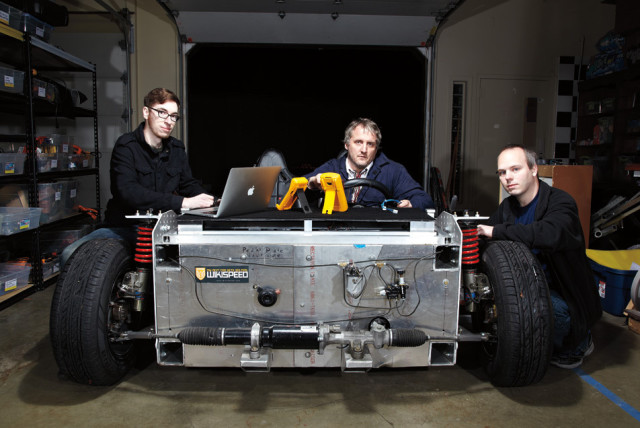
Motor Home Volunteers gather in Justice’s garage to turn wrenches and high-five.
Image: Michael Clinard
About that Honda he was working on. It came from his father, Dr. Dennis Justice. The elder Justice had planned to surprise his son with it as a graduation present, but after being diagnosed with terminal cancer he decided to give it to Joe early. Dr. Justice died in April 2002 at the age of 60, two years before Joe got his degree.
Joe dropped this detail into the Wikispeed narrative matter-of-factly and moved on to the next plot point seamlessly, showing little emotion. It was only later when I pointed out the bittersweet role his father’s death played in the story that he paused to reflect. “I never got to have my dad say, ‘Good job,’ ” Justice said after a long pause. “I guess it depends on how people grew up, but to me that really matters. So I have to, all the time, think, ‘While I don’t have my dad to give me approval, I have myself.’ And I think that might be part of the reason why I’m self-driven to the point that I am. I have to give myself approval.”
BRYAN FORD IS HARDLY A QUITTER, but he knows when he’s beaten. And on May 3, 2010, at a little after 4 in the afternoon, he was beat. A technical inspector from the Automotive X Prize had just found major problems with Wikispeed’s entry into the contest. The team had reams of data demonstrating the strength of the car’s suspension (Justice’s words: “It was mathematically proven to be awesome”), but the inspector informed them that it didn’t meet X Prize specs. They had just 36 hours to strip it out, fabricate new parts to attach the wheels to the car, and put the whole thing back together. Faced with that prospect, Ford was realistic. Not pessimistic. Just realistic. “There were parts that had to be ordered,” he says now. “There was no time. It was a logistical nightmare.”
Ford had officially become a member of Team Wikispeed just 14 hours earlier, at 2 in the morning, when Joe Justice and a half dozen volunteers showed up on his doorstep in Hillsdale, Michigan. Less than two weeks before that, Ford had responded to an ad on Craigslist that was just crazy enough to pique his interest:
“Team Wikispeed is competing in the final rounds of the Progressive Automotive X Prize, and we need a fantastic Honda mechanic to support our team at the Michigan International Speedway the week of May 2–8.… Ideally, the candidate would be willing to work at a reduced rate or gratis, since we’re a small team of volunteers. An appreciation of MacGyver is helpful.”
Oh I gotta check this out, Ford thought when he read that. It had been four years since he’d left the Mercedes-Benz dealership in Bloomfield Hills, Michigan, and moved back to his hometown of Hillsdale, a sleepy rural community just north of the Michigan-Ohio border. (No, he’s no relation to that Ford family.) There he’d turned his garage into a fabrication and mechanic shop, filled it with thousands of dollars’ worth of tools, and started fixing his neighbors’ cars. His specialty was higher-end foreign makes, but he knew he could handle a Honda. And having grown up in garages with a socket wrench in his hand, he couldn’t pass up an opportunity to get onto the track at the speedway. He didn’t even mind working for free because he’d read about the X Prize in Popular Mechanics and, he says, “you never know what kind of doors might open by answering an ad like that.”
{page break}
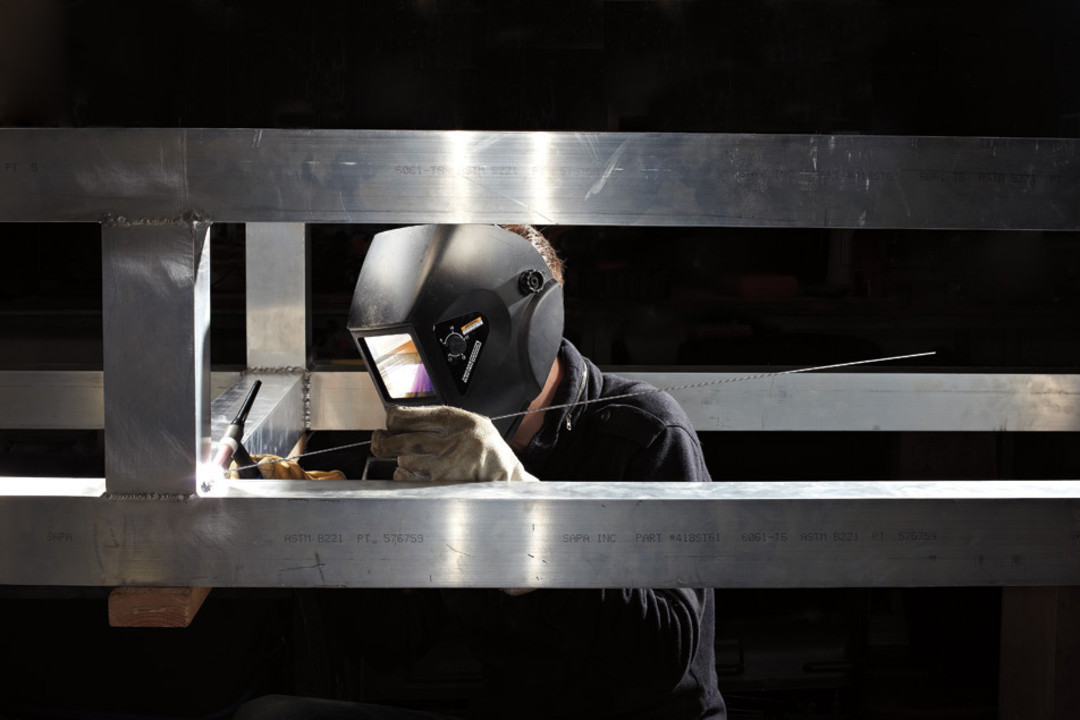
Bright Ideas The SGT01’s aluminum chassis is insanely light but still superstrong.
Image: Michael Clinard
JUSTICE’S PARTICIPATION in the X Prize competition was, if not a happy accident, certainly another ironic twist in the Wikispeed origin story. After graduating from Wyoming in 2004, he’d moved to Denver, where he worked as a software engineer. He was still goosing his Honda to go faster, but it had topped out at 155 miles per hour. That wasn’t fast enough, so he decided to design and build his own ultralight car from the ground up. (Remember, he didn’t actually want to drive fast; he just wanted to prove he could.) A few years went by. He moved to Seattle with his new wife, and his work on the car continued, although slowly. Gas mileage was the furthest thing from his mind, but then in 2008, when the X Prize was announced, he realized his theories on cutting weight could also cause a car to sip gas. He submitted an application that outlined how he’d achieve 100-mile-per-gallon fuel efficiency—what would become the SGT01 was still just a chassis and a set of CAD drawings at this point—and was accepted in November 2008. Of the more than 100 teams that made it that far, 27 advanced to the final rounds at the speedway.
When Justice showed up in Hillsdale in May 2010, Bryan Ford expected to see a vehicle that needed a few last-second tweaks. Justice had, after all, been working feverishly on the SGT01 at night and on weekends for two years. But what rolled off the trailer had, in Justice’s words, “the bare minimum”: a chassis, a body, four wheels, a seat, a steering wheel, and a working engine. The taillights weren’t mounted properly. The rearview mirrors hadn’t been mounted at all. The parking brake needed adjustments. The body, a fiberglass shell that was a precursor to the current carbon fiber version—and what Wikispeed members still affectionately call the “shoebox”—wasn’t even painted. So they worked through the night, and with Ford’s wife bringing them coffee, making them breakfast, and lending a hand when she could, they finished it all and got the car to the speedway on time. Barely. “We were loading it onto the trailer with the paint sticking to our fingers,” Ford says. “It was that close, down to the wire.”
And yet within an hour of unloading, they faced elimination—and the car hadn’t even made it out of the paddock and onto the track. Without even bothering to look at the finite element analysis and computational fluid dynamics Justice had brought as proof of his design’s validity, the inspector rejected the car outright. Justice felt like he’d been slapped in the face. “It was like fireworks going off in my cheeks,” he says. “This is something I’ve had a whole lot of design input into, and this one person is saying, ‘This isn’t good enough.’ ”
Ford expected Justice to put down his tools, thank the group for their efforts, and pack it in. It would have been the logical thing to do. Instead, Justice whipped out a laptop and started plotting how to get the work done. “I’m going to go down the list, and I’m going to start calling out tasks,” he said. “And if you think it’s something you can handle or something you can even do a little bit of, I need you to own it.”
Remember that modularity thing, the computer-industry concept that makes it easy to upgrade individual parts of the car? That’s what saved Justice when he should have had to fold. Rather than spending hours pulling apart the SGT01 to get to the suspension, the team simply unbolted the body, removed the suspension module, and began fabricating a new one. They got it done, too, just in time. The only problem was that as they finished, minutes before the deadline, Justice and another team member cut a wire in the electrical system. The car wouldn’t start, and Wikispeed’s run for the X Prize was done. They finished in a tie for 10th in their division.
Up until the first technical inspection, working alongside Justice and the rest of the Wikispeed team was just a diversion for Ford, an excuse to hang out at the speedway. “But that’s when I started believing in Joe,” he says of the moment when Justice rallied. “He doesn’t say, ‘Is that possible?’ He says, ‘Why isn’t it possible? What’s stopping us?’ He’s young enough, brilliant enough, and enough of a motivator to be able to pull something like this off.” Ford is currently building two Wikispeed cars in his Hillsdale shop.
“CAN I ASK YOU to not make our family the focus of your story?” That’s Mary Michael Justice, Joe’s oldest sister and one of Wikispeed’s lead project managers. Although she’s proud of her family’s involvement, she’s concerned that I’ll overlook the contributions of the team’s more than 100 members. Without question, Wikispeed is hardly just a Justice family project. Volunteers across the country toil in their garages every night after work, testing brake designs, fabricating new bodies, brainstorming ways to make the car just a little more fuel efficient. They dial in to a conference call Thursday nights to report progress and discuss upcoming goals. And after that weekly call the Seattle members converge on Joe’s garage to weld, drink beer, and exchange high fives.
Justice demurred when I suggested the volunteers donate all that time because they believe so strongly in him. “If I was asking all of these people to come over and put a new roof on my house, I wouldn’t have this team,” he said. And, yeah, that may be true, but it’s not a fair comparison. He’s asking them to help him build a car to change the automotive industry, and as the X Prize competition proved, there are plenty of inventors trying to do that. Technically, Wikispeed volunteers could work for any of those start-ups, but they’re inspired by Justice’s ideas, and he’s invested himself so completely in this project that he’s become his ideas. He gets up and shuffles out to the garage in the middle of the night when a solution for improving the car’s drivetrain comes to him. He’s poured $200,000 of his own money into Wikispeed. He travels around the country, extolling the virtues of Wikispeed’s manufacturing methodology at software engineering conferences. It was at one of those conferences in Seattle in January 2011 that Jeff Lopez-Stuit saw Justice speak. “I walked into it thinking, ‘This guy is just dorking around with something in his garage,’ ” Lopez-Stuit says. “By the time Joe’s talk was over, I was practically in tears.” He ran up to Justice afterward, gave him a hug, and joined the team on the spot.
And that may be another reason Justice is so freaking upbeat: He has to be if he wants to shield the rest of the Wikispeed team—and maybe even himself—from the soul-crushing reality that launching an automotive company that can elbow its way into the industry and actually make money is about as easy as changing a tire without a jack. Tesla Motors, the electric-car manufacturer that just opened a showroom in Bellevue last November, launched in 2003 and has yet to be profitable—and that’s after raising nearly half a billion dollars in two stock offerings. So far Wikispeed has raised half a million, and Justice is still looking for about $400,000 in additional funding to begin production on a second Wikispeed model, what he calls the “comfy commuter car.”
Justice isn’t even the first wannabe carmaker in Washington. In 1984 a 27-year-old Western Washington University grad named Craig Henderson built the Avion, an arrowhead-shaped, gas-powered car that two years later set the Guinness World Record for fuel efficiency, at 103.7 miles per gallon. Like Justice, he had orders from two customers and planned to go into production in the fall of ’86, he told a reporter back then. He never finished a second car. “It was too complex of a product to sell,” he says. Today, having fallen well short of revolutionizing the automotive industry, Henderson builds boats to pay the bills. (Those two customers, by the way, were fictitious. Henderson admits now with a laugh that a “PR guy” told him to make them up just to build buzz.) He still has the original Avion and occasionally drives it to the grocery store. “Most products you see on the market today are not very complicated,” he told me as we stood next to the mold for the car’s body, which leans up against a shed on his property in Bellingham and has become a nest for yellow jackets. “But here I decided to build a car, which is the most complicated sort of product you can make. Call it confidence through ignorance.”
Despite the odds stacked against him, Justice remains unbowed. He’s convinced Wikispeed’s nimble nature will make it easier for him to compete without gobs of money. In fact, only once in a month of spending time with him did I see his ironclad positivity show any signs of weakening. It was early November, about a week before he was scheduled to speak about Wikispeed at the TEDx Rainier conference, a local offshoot of the national gathering of innovators and forward thinkers. He’d just finished presenting a dry run of his speech to the event’s curators, and now he was standing on stage listening to their notes.
“This is not TEDx-like,” one said bluntly. And for the next several minutes, he was—politely—eviscerated. The speech was too long. It was too dry. The accompanying slides were wordy and wonky. There was a nugget of a good idea somewhere deep in the presentation, but it needed to be presented with more coherence and verve. Justice stood stoically, taking their criticisms, only occasionally protesting that certain parts they wanted to cut—like how his agile methodology was more cost effective than his competitors’ approach to manufacturing—showed why Wikispeed is so innovative. There is a perfectly logical reason why each of these facts has been included, his eyes seemed to plead. Why don’t you understand?
Instead, he composed himself, clasped his hands, and said, “I love that you have a lot of background in what we’re doing here so you can coach me on what’s missing from my speech.” He thanked them, and then he smiled. Not quite as wide as he was accustomed, but wide nonetheless.