Clam Dips
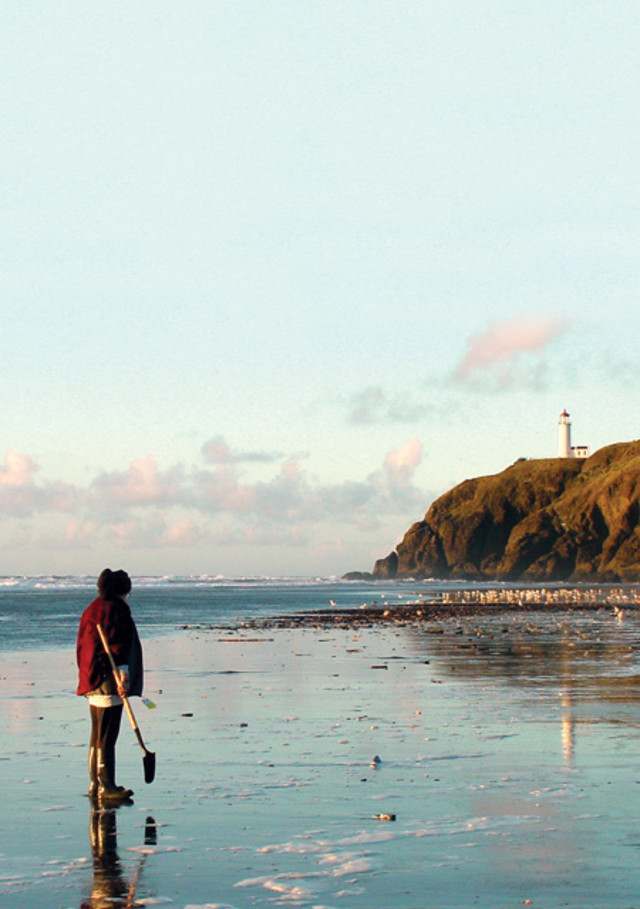
Looking back on the night my husband, Tom, and I duct-taped our rain pants to our duck shoes and our gloves to the flesh of our forearms, it wasn’t the penetrating dark that was the toughest. It wasn’t the cold, which easily slipped through our Gore-Tex, or even the rain, which shifted from insipid drizzle to full-throttle pelt the moment we got out of our car at the beach.
No: It was the wind. Wind you could lean against. Wind that had whipped the ocean into 17-foot swells, hurling the occasional wave so far onto shore that the minus tide we had come for seemed pretty darned plus to us. We were here for the Lantern Tide, when clam-digging enthusiasts do their business at low tide in the dark—and on this particular evening—in the rain and wind besides. The wind caused the waves to so hammer the sand, the razor clams we had come for just dug deeper.
“My God,” my husband concluded. “They’re smarter than we are.”
Not that I had come expecting anything different. We were on the Long Beach Peninsula, where my record has never been auspicious. There was the autumn evening years back where sideways rain and flooded detours turned the four-hour drive from Seattle into an eight-hour odyssey past roadside cafés deep in timber country with signs reading “Tonight’s Special: Spotted Owl Soufflé.” There was my solo getaway a few years later, where I tried to drive on the beach—you can do that here, theoretically—then met some nice tow-truck operators. Last summer there was the camping trip where the rain blew in out of nowhere, right around midnight. A really wet rain.
This time we had come with our seven-year-old daughter, Samantha, for a Northwest experience so shrouded in romance and tradition we figured it had to be worthwhile. The Lantern Tide occurs whenever a minus tide, darkness, and a thumbs-up for razor clam digging from the Washington Department of Fish and Wildlife (who check in advance for toxins) converge—three, maybe five times a year—resulting in a beach studded with clammers digging by the yellow glow of their lanterns, far as the eye can see. So what if we had to research shellfish licenses, purchase clam guns, duct tape our waterproof clothing to our bodies as a sealant against the seawater, then learn entirely new skills under cover of darkness in a driving rain. We’re Northwesterners!
We set off the morning before, plunging into the fir-fringed wilds of the Olympic Peninsula, windshield wipers set to Frenetic. Past tree farms and pulp mills, through vistas of clear-cuts that looked like butch haircuts on the horizon, we wound our way to the ocean. Willapa Bay, an early oystering hub, is the inland water held apart from the Pacific by the slender arm of Long Beach Peninsula. Famous for a lot of things—kite-flying tourists, inordinately good restaurants, retirees, a really long beach—the peninsula’s most recent fanfare was its bicentennial last fall, celebrating the site of Lewis and Clark’s triumphant dead-end.
Though summer crowds the peninsula with folks in search of waffle cones and bingo halls, the region is arguably loveliest when the leaves are still missing from the trees, their limbs starkly elegant against the firs and the oyster sky, draping moss or clad in soft chartreuse lichen. In spring, the wetlands around the bay go juicy with sloughs and streams, and bands of mist mute the receding horizons in successively dimmer pewters and sages, like paint chips on a hardware store rack. The rain, which on our visit often couldn’t decide between falling or hanging, certainly knew when to unleash.
“Oh, it’ll be pouring all weekend,” chirped our innkeeper as she met us at the door of the Moby Dick Hotel, which glowed through the mist like the box someone had packed the sunshine in. Built in the ’20s by a railroad man on the shore of Willapa Bay on the northern third of the peninsula in Nahcotta, the hostelry fell into disrepair until Fritzi Cohen, the owner of the Tabard Inn in Washington, DC, renovated it in 1992.
Now it’s like the hotel put together by your fascinating great uncle—the art history professor who moonlit for the CIA in several equatorial countries—where even the most boardinghouse-ish rooms with baths down the hall might have Warhol prints on the walls and New Yorkers on the nightstand. In the lobby, mismatched couches before a roaring stove, along with vintage lamps and beaming Buddhas, extend the offhand sense of worldliness.
Out the windows, beyond the yoga yurt and the Finnish sauna, beneath the lapping shallows of the bay, lie the oyster beds. In the morning, we enjoyed plates of the bivalves, sautéed lightly with lemon and parsley, as the second-course of a lavish breakfast. (The chef, Jeff McMahon, is from Saucebox in Portland.) “I’m getting more into oysters,” Cohen said, inviting us to a little impromptu tasting that her oyster harvesters were putting together in the shed that afternoon.
{page break}

This is my caption
Until then, we drove back to Cape Disappointment, which holds down the windy northern promontory of the Columbia River Bar, to visit the newly renovated Lewis and Clark Interpretive Center. A masterful retelling of the historic journey featured hands-on activities for kids and grandstand views of the surging sea. We noted with particular interest that we weren’t the only ones who had ever developed a mordant obsession with Long Beach’s weather. Wrote Clark in November of 1805: “Our party has been wet for 8 days and is truly disagreeable. . . .”
Feeling somewhat disagreeable ourselves, we dropped into the Port of Ilwaco, which in recent years has burgeoned with shops and galleries and restaurants for sustenance. At OleBob’s, we sipped chowder out of bread bowls and eavesdropped as several locals talked ominously about that evening’s forecast wind. “Is it even safe to go out there?” I ventured to one weather-beaten old guy in suspenders. “Depends,” he said slowly. “How bad you want a clam?”
He told us to look for round, dime-size holes in the sand, and to pound the shore with our clam guns to reveal them. He told us to use a clam gun, which looked like a big sawed-off piece of pipe with handles, instead of a shovel. And to never, but never, turn our backs to the surf. Bolstered by irrational confidence, we stopped at Dennis Company, a Long Beach outfitter purveying everything from marine supplies to appliances to, fortunately, clam guns. Quite a crowd had amassed in the hip-wader aisle, which was made up almost entirely, to Samantha’s delight, of camouflage. That’s when we realized, toting our massive clam gun to the car, that clamming isn’t sport. It’s war.
And so we dressed and taped ourselves carefully as soldiers, looking like we’d just come off the wreck of the Edmund Fitzgerald as we dropped into the Moby Dick’s oyster shed for one last nosh before the big dig. There, warm and dry, civilized guests slurped oysters and wondered aloud what exactly it was we were thinking. “I prefer oysters, m’self,” reflected one of the oystermen as we headed into the dark rain. “Easier than clams.”
Never having gone oystering, I’m pretty sure he’s right. At the beach all three of us stomped and splashed, pounded and gunned—nothing. Among our clam-digging confreres, we observed that though they were clad in a little of everything—including, let the record show, plenty of duct tape—the really serious ones were decked head-to-foot in camouflage. “Hey, maybe it’s clam-ouflage!” squealed Samantha through the wind gusts. Who knew, maybe stealth was the key! I approached one particularly intense couple in matching his-n-hers clam-o-waders. “Sneaking up on ’em, are you?” I shouted jauntily. For a moment they stopped maniacally pecking the shore with their clam guns, and looked blackly at me.
Turns out they, seasoned locals, hadn’t gotten any either. Looking back, I’m not sure if that’s when we decided to throw in the towel, or if it was later, when Samantha suddenly looked up and couldn’t see our car. “Are we lost?” she asked shakily. “No honey, we’re not lost,” said Tom, flashing our car lights with his keychain. “We’re just losers.”
Stumbling toward the car, I turned for a last look up the beach toward the wild northern tip of the peninsula, and was suddenly seized, most unexpectedly, with a sense of the perfection of this place: The barely discernible line of white froth roaring in at the shore, the raw elements giving life to the air, the glowing lanterns making a starry sky of a very black beach. There is something deeply primal and unyielding about this part of the world; something that, as Lewis and Clark discovered 200 years ago and I seem to discover afresh every time I come back, isn’t at all concerned with the comfort level of its inhabitants. It is what it is. It’s one of those natural places that calls us, simply, to surrender.
Driving out of town, we stopped into the 42nd Street Café in Seaview and enjoyed a splendid breakfast—which to my profound sense of completion included delectable fried razor clams.
Muscular little buggers.