Beacon Hill Unplugged
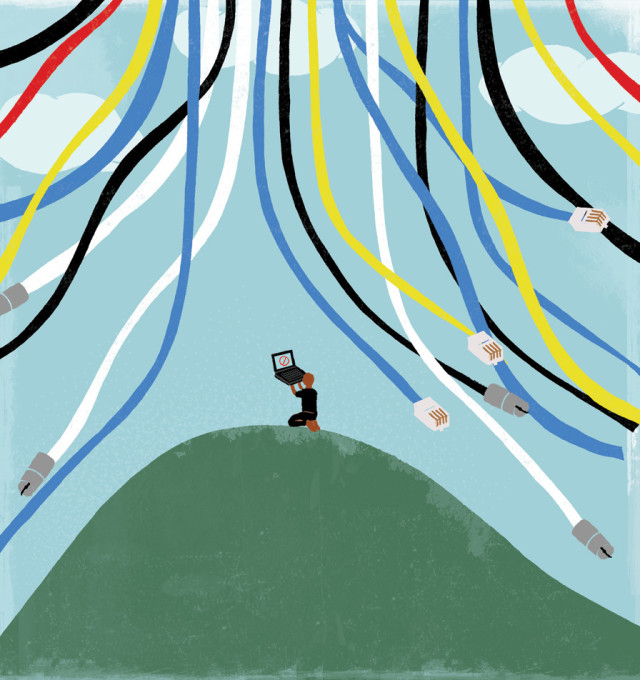
Image: David Senior
WANNA MAKE SOMEONE from Beacon Hill spontaneously combust? Ask about their Internet service. “Oh, I’m pissed,” says Sebastian Kohlmeier, a Microsoft employee who moved into the neighborhood in 2008.
He’s all but given up trying to conduct online conference calls from home because he regularly clocks download speeds south of two megabytes per second, even though he pays for 15—and that’s when he actually has a connection. Last August, he lost service for three and a half weeks. “I would have thought twice about moving here if I’d known what it was going to be like.”
Most web surfers and boob tubers in the city of Seattle can get their cable TV and broadband Internet from the Philadelphia media goliath Comcast—unless, that is, they live in parts of Beacon Hill and the Central District. That hatchet-shaped chunk of the city is what’s called the Central Cable Television Franchise District, an Internet hinterland served by tiny St. Louis–based Broadstripe—which, by the way, filed for bankruptcy in 2009. To hear its customers tell it, Broadstripe’s wires might as well be made out of Silly Putty: The connection goes down when it gets too hot outside. The connection goes down when it gets too cold. The connection goes down when the wind blows too hard.
A group of the incensed Internet users formed UPTUN—Upping Technology for Underserved Neighbors—in early 2009 to goose the city, Broadstripe, and other service providers to beef up broadband in the neighborhoods. And after two and a half years of having their complaints disappear into the Ethernet, they hope to schedule some face time with Mayor McGinn in late May to hash out their ideas for improvement. But they may be able to dig the waterfront tunnel by hand before anyone grants them their wish for wider web access.
For starters, the city can’t force Broadstripe to unclog its Google tubes because the Telecommunications Act of 1996 places all matters Internet under the FCC’s jurisdiction. Then there’s UPTUN’s proposal that the city build out its own municipal fiber-optic network, starting in South Seattle. But that would cost more than $240 million. “That’s not a near-term solution, especially given the current status of city finances,” says Bill Schrier, Seattle’s chief technology officer. And Comcast could, of course, buy out Broadstripe and start rebuilding its dated Internet infrastructure, but a source at the company who isn’t authorized to discuss acquisitions says it may just wait to see if Broadstripe’s financial footing worsens and its price drops. In the meantime, Broadstripe has voluntarily agreed to replace every drop—the length of cable that runs from the utility pole to a customer’s home—in its service area. “We’ve made a lot of progress,” says John Bjorn, Broadstripe’s executive VP of regional operations. “But we have a lot of progress to make.”
The bigger issue, though, may be how any part of Seattle—the home of Amazon and Microsoft—could fall so woefully behind in the broadband-access arms race. And the answer has as much to do with socioeconomic forces as it does with technological savvy. Because its residents were historically lower income, the Central Cable Television Franchise District didn’t attract its first provider—locally owned Vanhu—until 1980. It folded three years later, and for the next two decades a series of second-tier providers tried to serve the area but didn’t make enough money to maintain their cables and connectors. So while the digitally rich got richer, the poor got stuck with the equivalent of crank-powered Internet service. “It’s hard when you hear things like, ‘We’re making investments,’ because you don’t know what they’re investing in,” says Kohlmeier the ’Softie. “I can only laugh about it now.”


