The New School Plan

Image: James Yang
SARAH BOWEN plays a mean violin. For three years at Eckstein Middle School, she was her grade’s concert master, a desirable designation bestowed upon the top violinist in the entire orchestra. In other words, her path to higher learning is paved in half notes and treble clefs. Or it was until she found out last winter that, based on nothing more than her address, she’d been assigned to Nathan Hale High School, which didn’t even have an orchestra program. “We became very active last year in trying to have a reasonable discussion about this with the district,” says Sarah’s dad, Keith Bowen. “And basically we got snubbed each time.”
The neighborhood-school concept is so accepted—and entrenched—in most cities not named Seattle that it’s practically passe: If you live within the boundaries for Clark Kent Middle School, you’re going to Clark Kent Middle School. What that system lacks in options it presumably makes up for by encouraging neighborhood ownership of the school.
On the other hand, Seattle Public Schools’ decades-old open-choice program has given picky parents the power to apply, on their kids’ behalf, to any school in the district. And what that plan lacked in community building, it presumably made up for by encouraging niche curricula: Don’t think the science program at West Seattle High is challenging enough for your overachieving teen? See if you can get her into Ballard High—and the district will pick up the crosstown transportation tab.
At least that’s how it worked until the 2010–11 school year: From now on, all incoming kindergartners and sixth and ninth graders are assigned to their neighborhood school. At its core, it was a change jump-started in 2007 when the U.S. Supreme Court struck down SPS’s method of integrating schools. But the district prefers to focus on the positive, pointing out that the new student assignment plan excises the complexities inherent to the open-choice system, which included tiebreakers for students who fought for spots at in-demand schools. “In the past, you had every choice except predictability,” says SPS enrollment manager Tracy Libros. But Sarah Bowen’s less-than-desirable school-assignment sitch underscores the ways in which the new plan is testing some families’ ability to adapt to change—and the district’s ability to meet every student’s educational needs.

iPad illustration by Benjamen Purvis
Image: Charlie Schuck
In theory, the neighborhood-school plan wouldn’t be a problem if parents believed the educational offerings were comparable at every SPS high school. And although superintendent Maria Goodloe-Johnson says the district is trying to level the academic playing field across the city, it’s a work in progress. In Bowen’s case, it wasn’t until other parents like hers complained that administrators at Nathan Hale tuned up an orchestra there. But faced with the prospect of languishing in a fledgling program, Bowen decided her only choice was to go private and attend Bishop Blanchet.
Now, the neighborhood-school system hasn’t stripped parents and students of all of their options. In fact, this year 10 percent of the seats at each high school were left open for students who live outside their preferred school’s attendance-area boundaries. But unless they had an older sibling already there, they landed in a random lottery. And there’s no guarantee that the district will be that flexible in the future. The new student assignment plan mandates that each high school offer open-choice seats, but it doesn’t specify how many. A subsequent transition plan approved by the school board set the 10 percent target for this year, but even Libros isn’t sure what will happen next year. “The percentage of open-choice seats may decrease and it may increase.”
{page break}
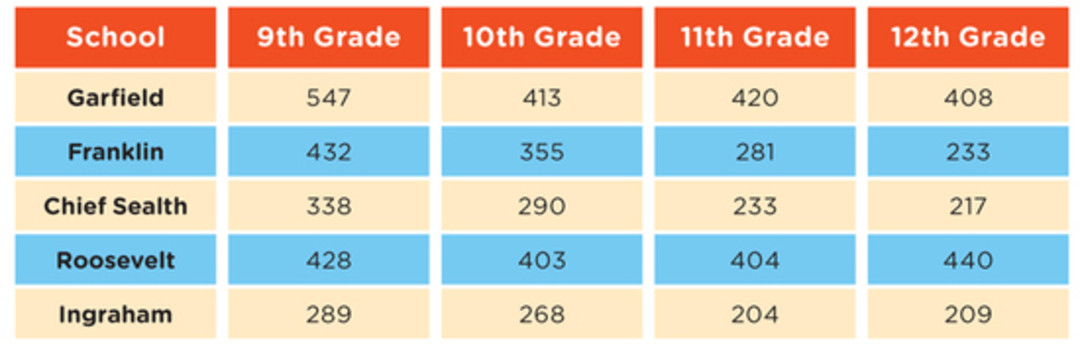
Even more troubling for parents whose kids were assigned to schools they wanted to attend is the potential for overcrowding. Contrary to district projections that enrollment at SPS high schools would drop this year, the incoming freshman class at every high school except Ballard and option school Nova was actually higher than the average enrollment of the other three classes. According to enrollment figures released in mid-October, this year’s sophomore, junior, and senior classes at Garfield each average just over 400 students, while the freshman class has ballooned to nearly 550. The crowding was so extreme earlier this year that students struggled to get through the cafeteria line before their lunch period was over. It’s hard to say for sure why enrollment spiked. The economy may have hit parents’ budgets for private school. But it’s not a stretch to presume that kids who went private in the past are going public now because they’re guaranteed entrance to desirable public schools. The very thing that the district was striving for—namely, predictability—may be what’s choking its schools’ hallways.
Of course, it’s not all bad. In fact, it’s mostly good. School-choice applications at all grade levels dropped from more than 13,000 last year to less than 6,000 this year, which means that instead of spending money busing kids all over the city, the district can devote more funds to classrooms. And those students who applied to schools outside of their ’hood had a considerably less complex system to navigate: After receiving their assignment in February, they could opt for open enrollment, choose their preferred schools, and wait until May to hear if they got into one of them. Even the educational offerings are expanding. For the first time ever, every SPS high school offers some Advanced Placement or International Baccalaureate classes. “And that’s the promise of the new student assignment plan,” says Goodloe-Johnson.
As for violin virtuoso Bowen? She’d requested a seat at Roosevelt, but because it’s an in-demand school she’d resigned herself to attending Blanchet—and her parents had paid the $500 deposit. But then last summer she got a call: She’d been accepted to Roosevelt. “We put in a whole lot of time and energy and money,” says Keith, “and really, the only thing it came down to was that we won the lottery.”
GROWING PAINS
In the first year of the new student assignment plan, the number of entering freshmen in several public high schools grew substantially over prior years, but none more than Garfield.
Total Enrollment by Class