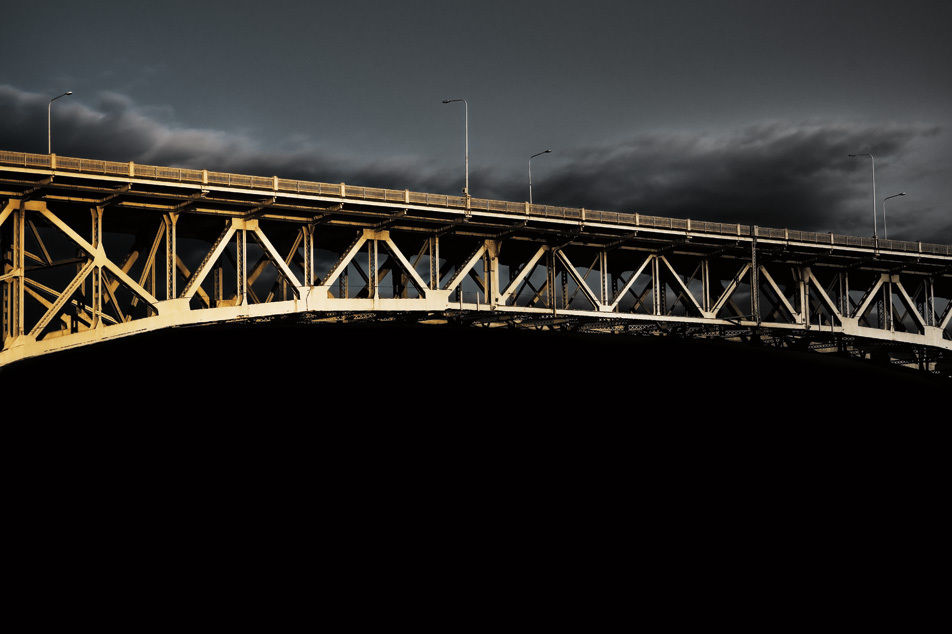
The Girl on the Bridge
THE LAST THING KAY SAID on the phone a little before midnight was unsettling enough—“Bryan, I love you. I got to go. It was nice to know you”—but now she wouldn’t answer her cell. She wasn’t in her Queen Anne apartment. She wasn’t in the park they’d strolled through hand in hand days earlier. He didn’t know where she was, he just knew he had to find her.
Finally around 1:30am, Sunday, January 16, 2011, after pounding on his girlfriend’s door, after multiple calls went straight to voice mail, Bryan Wilson, a 29-year-old sustainable-business consultant, dialed 911.
A Seattle police cruiser met him at the corner of Queen Anne Avenue and Roy minutes later. “Do you have any reason to believe she might hurt herself or others?” asked officer Kurt Alstrin. “Yes,” Bryan said. “She’s severely depressed.”
Soon every police radio in Seattle crackled with the name. Kaylan Rose Campbell, 25 years old. Green eyes. Red or auburn hair. Five feet eight inches tall.
What the radio message couldn’t convey was that few people who knew Kay had ever met anyone more intelligent. Or more beautiful. That she dabbled in six languages and had traveled halfway around the globe by the time she was 20. That she could hear any tune once and play it back on a keyboard. That she laughed so loud you could feel it in your spine.
Nothing in that call to all police units could explain how Kaylan Campbell had been struggling for the past few months, how she had told those closest to her that she hated herself, that she was convinced she was a bad person, that she felt trapped.
“Any idea where she might be?” Officer Alstrin asked.
Bryan recalled the background noise he’d heard during their last phone conversation. Wind. Traffic. He thought of their conversations during the past week.
“Where do you think she is?” the officer pressed.
“I think she’s at the bridge,” Bryan said. “The Aurora Bridge.”
He knew the words were loaded, that they sounded preposterous. Someone’s distressed and I automatically assume she’s going to jump off the Aurora Bridge?
But the cliche exists for a reason. The bridge, site of more than 230 suicides, is second in the U.S. only to San Francisco’s Golden Gate in number of jumpers. So dire had the suicide problem become—especially for the vocal minority who lived and worked below the bridge—that the Washington State Department of Transportation was nearly finished constructing a $5 million suicide fence. The project had been stalled, first by historic preservationists who wanted to keep the nearly 80-year-old bridge looking exactly as it did when it was erected in 1932, and later by engineering setbacks and unforeseen noise complaints.
If Kaylan Campbell was on the span connecting Queen Anne to Fremont, staring into the darkness 15 stories down—at either the Ship Canal or its banks—she had joined hundreds of others who had come to the bridge for the same reason since before it was even completed.
Wednesday, January 20, 1932, H. N. McKeehan, a recently divorced shoe salesman from West Seattle, traveled to the unfinished George Washington Memorial Bridge, drank a jigger of bromide, and jumped. He died instantly on the ground 65 feet below.
THE CROWD POURED DOWN SECOND Avenue on the morning of February 22, 1932, and waved small American flags—a river of red, white, and blue gushing toward the new steel structure on the north end of town. At exactly 10am church bells chimed throughout Seattle, commemorating the moment 200 years earlier when George Washington was born.
By 2pm, the throng of fedoras and ringleted hairdos—nearly 20,000 people—reached the bridge, the dedication of which was to be the national highlight of the bicentennial celebration. The 2,945-foot-long, 70-foot-wide cantilever span—officially named the George Washington Memorial Bridge—soared over Lake Union and was the last link in the Pacific Highway, which ran from the Canadian border to the Mexican border. Dignitaries from Canada and Mexico, the mayor of Seattle, and Washington’s governor gave speeches.
Twelve trumpets sounded. Three thousand miles away in the White House, President Herbert Hoover, two years into presiding over the largest financial crisis in U.S. history, pressed a telegraph key at exactly four minutes before 3pm. The message surged across the continent in seconds, triggering a siren at the bridge, a 21-gun salute, and streams of water from fireboats. An enormous American flag unfurled 500 feet above the crowd.
The excitement of the day may have overshadowed the shoe salesman’s suicide a month earlier, but Seattleites were soon reminded of the bridge’s deadly pull. Within three weeks, police were ordered to stand guard at the bridge to thwart a Fremont woman who had threatened to jump off. A month after that, the span saw its second suicide—a man leapt off the bridge onto the train tracks on 34th Street.
In September 1934, responding to three or four suicides in that year alone, the Seattle Daily Times editorial page pleaded with the city council, asking “that a very high fence with incurved top be built to surmount the guardrails for the full length of the Aurora Bridge.”
The body count mounted. On February 3, 1938, six years after the bridge dedication, 26-year-old Alex Cohen, owner of a sausage casing company, became the 20th person to jump to his death. The next day, the Times again brought up the fence, this time on the front page: “Anti-Suicide Fence Urged on Aurora Bridge.” A poll revealed that a majority of Seattleites supported the creation of a suicide barrier.
The decades ticked by. The death toll reached 105 in 1973. By the 1980s officials had stopped keeping track. This may be because the official count was lost as the duty of recording suicides transferred from agency to agency. But a new attitude about reporting suicides had emerged: Releasing such numbers and the details of the deaths, the theory went, only encourages more suicides. The names of the deceased disappeared from the news stories. Then the stories themselves vanished.

Image: Brett Cheek
WHEN RYAN THURSTON LOOKED out his office window in September 2005 and spotted a man laying face down in the parking lot, he wasn’t sure what he was seeing. A design engineer for Impinj, which specializes in radio-frequency identification technology, Thurston and his coworkers had moved to an office building below the Fremont side of the Aurora Bridge two months earlier.
Employees at Adobe, in the same office park, stood at their windows, too, staring in horror as a pool of blood expanded around the man’s head. Was he a victim of a hit-and-run? Then Thurston craned his gaze upward. Traffic on the bridge had stopped. A handful of people peered over the railing and down at the dead man. A few weeks later Thurston saw another jumper. Then another.
People crawled over the bridge’s three-foot-high guardrail and fell from the sky with such frequency—about one person every three months—that many of Thurston’s coworkers kept their office blinds shut. Some colleagues sought counseling to cope with the carnage. But Thurston couldn’t stop looking. He felt he had to bear witness to the ongoing tragedy. In 2006, he’d had enough. He organized a group of Fremont residents and other office park tenants to see what could be done. They called themselves Seattle FRIENDS (Fremont Individuals and Employees Nonprofit to Decrease Suicides) and their goal was to achieve what no else had in seven decades.
Thurston soon learned why efforts to erect a suicide barrier had failed in the past. He sent an email to Washington State Department of Transportation to plead his case. A WSDOT official snapped back with a reply that outlined the costs of such a fence (an estimated $8 million) as well as the impossibility of collaboration between Washington State and Seattle (the bridge is state property but any decisions regarding it must be approved by the city). The takeaway: Not likely to happen.
Thurston was discouraged but undeterred. He and Seattle FRIENDS regrouped. They spoke to architects about possible fence designs and made appointments with elected officials WSDOT couldn’t ignore.
The bridge, meanwhile, continued to lure people to its edge.
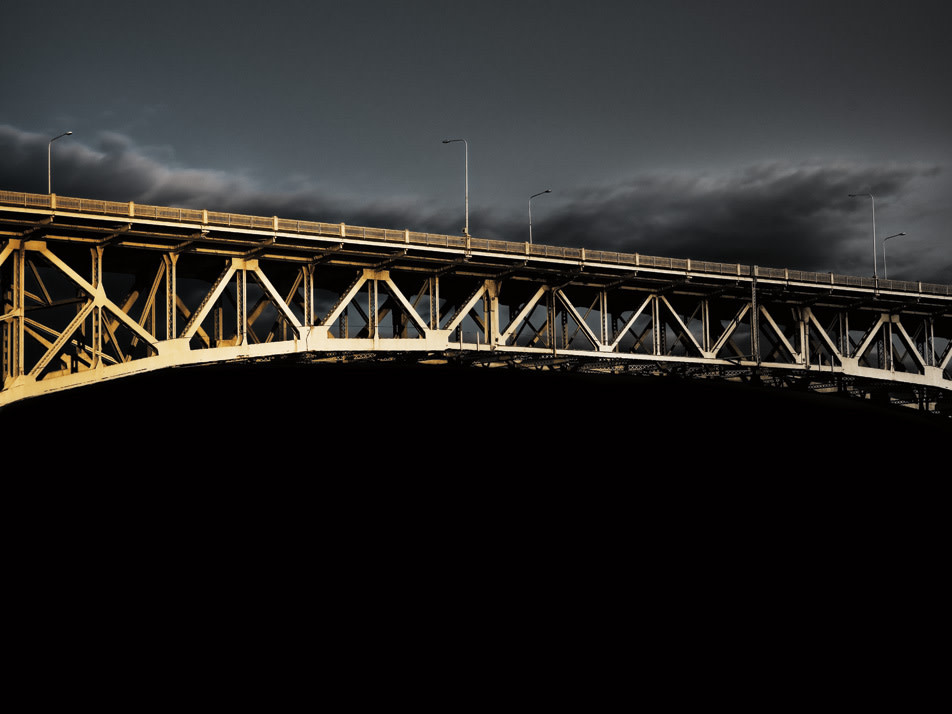
Image: David Bowden
IN THE SPRING AND SUMMER OF 2006, when Ryan Thurston worked the bridge-barrier campaign like it was a second full-time job, Seattle saw some of the most seasonable weather in recent memory. May brought temperatures in the high 60s; June, the low 70s. Clouds were uncharacteristically sparse. The sun lit a bright-blue Elliott Bay. The city’s foliage shined like a wet lime.
Into this postcard rolled Kaylan Rose Campbell, 20, red-headed, tall, runway-model thin. She’d been living in western Colorado, its bald hillsides and parched air a far cry from lush Emerald City. Before that, Auburn, California, where she had watched her father die, slowly, painfully, from hepatitis. Before that…well, stick a pin on a map of Europe and you’ll likely hit something close to one of her former haunts.
See, Kaylan was always on the move. Her mother, Erica Kitzman, lost her in a pine tree when she was three. They were in Rocket Park in Grand Junction, Colorado. The swing sets and monkey bars were shaped like spacecraft. But Kaylan went for the tree. She’d spotted a bird, and followed it up, limb by limb. By the time Erica noticed, her toddler was looking down at her from 25 feet above. The branches were too slender for the adults to climb after her. And so, calmly, they coaxed her down.
Her father worked in telecommunications and the family moved around a lot. But everywhere they went—New York, Nebraska, California—Kaylan’s curiosity and fearlessness were constant. In a field outside Omaha, Erica pointed out a snake in the brush and turned to Kaylan and her brother, William, to explain what it was, but…no Kaylan. Erica spun around. Kaylan was holding the snake. She was five.
In Guatemala, where Kaylan and William studied Spanish as teens, Kaylan overheard a local mention that he was on his way to butcher a pig. She followed the stranger into the jungle—at 4am. Her explanation: She had never butchered a pig before and wanted to see what it was like.
Though the family finally put down roots in California when she was nine, the itinerant lifestyle had settled in her bones; after high school Kaylan split for the Eastern Hemisphere to work for nonprofits that promoted peace and charity in Wales, Germany, France, and Greece.
In Seattle she enrolled in the University of Washington’s linguistics department. Made sense. She spoke Spanish and dabbled in Greek, Japanese, Korean, Russian, and Norwegian. And she read Latin (which she’d taught herself while bedridden with tonsillitis at age nine).
What impressed Kaylan’s Seattle friends most, though, was her ear for music. She didn’t read notation but she composed elaborate piano scores. And if she listened to a tune once she could play it back.
When Brett Cheek heard her play on the porch of a Phinney Ridge pub late in the summer of 2008 he was smitten. He’d just performed onstage and was messing around with his guitar and a little Casio keyboard, which Kaylan spontaneously grabbed and began to noodle away on. He accompanied her on his six-string. They didn’t say a word during the entire jam.
She showed up a week later at his workplace, a bar near Lake Union, and finally spoke. “Hi, I really enjoyed that show,” she said. She wrote down her name in Greek—Kei—and her phone number. Within days they became inseparable.
She moved into his house in Fremont, along with her two cats. She planted strawberry plants in the backyard, and they spent the rest of that summer and fall hiking and road tripping in his red 1990 Audi through the Cascades.
By the winter of 2009, when she wasn’t playing music and hanging out with Brett—or spending time with her mother, who’d recently moved from Colorado to Sequim—she was with Amanda Johns, a recent Western Washington University grad from Spokane. They often hit the dance floor at Nectar in Fremont or the Tractor in Ballard.
“It was always inevitable that some douche bag was going to come up to us,” Amanda recalls. “I felt sorry for the guys, because she would definitely humble them. She’d keep a smile on her face, and she had the sweetest voice, to where if you weren’t listening to the words she was saying you’d think she was singing you a lullaby. Like, ‘Kick rocks, dick,’ and it would sound sweet.”
They commiserated over having lost a parent; Amanda lost her mother when she was 10. Kaylan’s father, with whom she was very close, died in 2005, when she was 19. “I’ve had a lot of time to deal with it, but Kay, with her father,” Amanda explains, “she really hung onto it.”
Over time Brett learned things Kay hid from most people. She struggled with bulimia and anorexia. She also said that, shortly after moving to Seattle, she had been married, to a person her mother Erica describes as “completely inappropriate.” It wasn’t a legal union—they didn’t have a marriage license—and it only lasted a few months.
There was more: Around the time the marriage fizzled, Kay revealed to Brett, she had tried to kill herself by overdosing on her bulimia medication. The ER had to pump her stomach to save her. After her release from the hospital she dropped out of college and sought counseling for depression. She was making progress, Erica says, until “her therapist terminated treatment because he fell in love with her and told her.”
As Brett and Kaylan’s relationship progressed, he would also notice tears in her eyes for no apparent reason. When he asked about it she’d often say she was thinking about her father, about how much she missed him. Other times she’d say she felt intense sadness but couldn’t, or wouldn’t, pinpoint it.
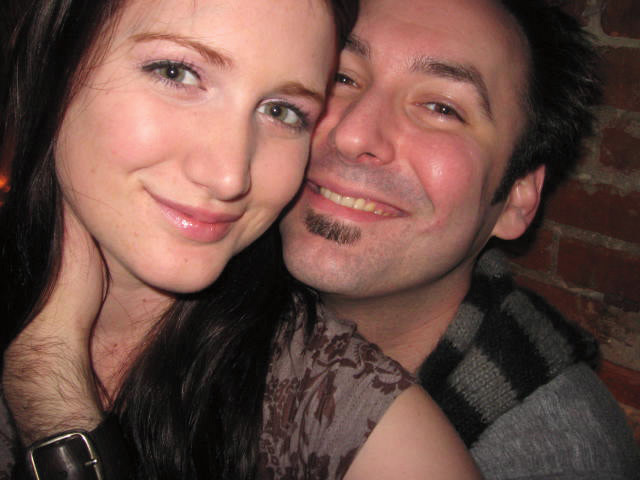
Image: Brett Cheek
RYAN THURSTON KNEW IF HE WAS TO make a case for the barrier he needed to understand the jumpers, to get inside their heads as best he could. He watched The Bridge, the 2006 documentary about Golden Gate suicides. He pored over a 2003 New Yorker article titled “Jumpers,” in which a Golden Gate jump survivor is quoted as saying, “I instantly realized that everything in my life that I’d thought was unfixable was totally fixable—except for having just jumped.”
Thurston requested information from the King County Medical Examiner’s office to once and for all get an exact total of Aurora Bridge suicides. The ME refused. It wasn’t until Ron Sims, then King County executive, joined the cause that Thurston was able to review the records, but those dated back only to 2000. The best estimate he could get puts the number at a little over 230.
The biggest opposition he met was from those who said that a suicide barrier would simply force people to find another means of killing themselves. But he uncovered a 30-year-old study, long lost in the annals of suicide prevention, by a UC Berkeley professor who interviewed 515 people who had been talked out of or physically restrained from jumping off the Golden Gate Bridge. Ninety-four percent never attempted suicide again. The data convinced Thurston that suicide is an impulsive act.
He also studied bridge barriers in other cities—Washington, DC, Augusta, Maine—and found that suicide rates at other potential suicide spots did not increase, nor did general suicide rates in those cities.
Thurston and Seattle FRIENDS took this research to meetings with community leaders, including then mayor Greg Nickels. King County council member Larry Phillips and Pete von Reichbauer were proponents of the suicide fence and wrote letters to Governor Chris Gregoire.
Meanwhile, members of the Queen Anne Community Council fought the barrier. They insisted that the cost—still estimated at nearly $8 million—was too high and that those contemplating suicide would just choose another method, despite Thurston’s research to the contrary. But their chief complaint was that any modification would destroy the bridge’s original design. They fussed over the proportional relationship between the three-foot guardrail and the rest of the structure, with its two supporting cantilevers looking like the flying buttresses of a Gothic cathedral—not to mention the unobstructed eyeshots of Lake Union to the east and Puget Sound and the Olympics to the west.
In April 2009 the council sent a letter to the Seattle Landmarks Preservation Board, citing the structure’s inclusion on the National Register of Historic Places (granted in 1982), arguing that the proposed changes risked the bridge’s historic status. “As an object of monumental beauty and a fine example of period engineering prowess,” they wrote, “any additions to its structural facade would be tragic and unwarranted.”
The preservationists were unable to sway Seattle FRIENDS’ highly placed political allies. In May the state transportation committee approved the 2009–11 transportation budget. “In that budget was the funding for the barrier,” says Thurston. “It was buried way deep. You know, the transportation budget’s like a billion-dollar budget, but it was in there.”
The Washington State Department of Transportation, now on board, drew up plans to build an eight-foot-nine-inch-high fence outside the existing railings, from end to end. The barrier would consist of panels with pencil-thick vertical rods spaced five inches apart—effectively creating a 2,945-foot-long cage on both sides of the span. The cost would be $5 million—$3 million less than previously estimated.
By spring of 2010 WSDOT had hired a contractor. The scheduled completion date: January 1, 2011. There were fatal setbacks from the start.
AT A BAR IN GREENWOOD MEN DRINK alone and drink a lot. They suck down bottle after bottle of Miller High Life and are drunk by three in the afternoon. Their unkempt hair curls out from under sweat-stained baseball caps and they regularly comment on the female bartender’s assets, loudly, as though they were in a strip club.
This is where Kaylan Campbell worked for most of 2009 and all of 2010; she’d found the job on Craigslist a few months after she and Brett started dating, and bartended during the day shift, 11 to 5.
“All these dirty old guys hitting on her,” says Brett, “and just treating her like she was a bar wench. Not being polite, not tipping her. She actually brought home the logbook so that we could read through it for entertainment. Scary stories. There’d be like ‘Russian guy came in again last night with a knife.’ Flip another page, and there’s like part of a crack pipe taped into the logbook, and it says ‘Found this piece of a pipe in the bathroom.’”
Amanda and Brett both say that the bar and its clientele made Kay sad. All those ruined lives, they were like an undertow that sucked her down. She said she hated it, but she didn’t look for another job.
Brett was also increasingly alarmed by how much Kay was drinking. He would pick her up from work and she’d already be well on her way to blackout drunk, which by mid-2010 had become an almost nightly occurrence.
The situation became impossible to ignore in October 2010, two years into their relationship, when Kay was drinking with a coworker at the house in Fremont after a shift. Around midnight she offered to drive the coworker home. They hopped into Brett’s Audi. Kay took the first corner at 30 miles per hour and whacked into the back of a parked Toyota Scion, which then smacked into a parked Chrysler. Instead of stopping, Kay wheeled back around the block and parked across the street from her house.
The cops, responding to a 911 call, showed up within minutes. Kay called one of the cops “a dick” and told another, when asked if she wanted to know the results of her Breathalyzer test, “No, I don’t give a shit.” She had blown a .265—more than three times the legal driving limit.
A month later, Brett says, he gave her an ultimatum. Stop drinking or move out.
Kaylan found an ad on Craigslist seeking a roommate in Queen Anne. She and one of her cats (the other stayed with Brett) moved into a two-bedroom with a guy from Morocco.
Amanda didn’t see her for weeks. Then one night in early December, Kaylan called: “I need to come over. Two minutes later she arrived in a taxi at Amanda’s Greenwood apartment. “So she comes up to my front porch and she starts bawling.” She told Amanda about the DUI and said she was a bad person and that she hated herself. And one more thing: “She said, ‘I walked to the bridge the other night.’ ” Kaylan said the only reason she didn’t jump is because she didn’t want to hurt her family.
“When I look back, it kills me,” Amanda says. “I mean, that’s her telling me she’s had thoughts of jumping off of the Aurora Bridge.”
THE BRIDGE WAS IN WORSE SHAPE than WSDOT had realized. Twenty-three steel beams—upon which the fence posts were to be fastened—were corroded beyond use. Steel supports had to be fabricated and attached to them.
Worse, when the original bridge builders poured the concrete pedestrian sidewalks, cement bled to the bridge’s underbelly. So as the contractor began removing the bridge’s old rivets the vibrations from the rivet buster shook loose the excess concrete. Fearing that cars or pedestrians below might be hit by the fist-size chunks, WSDOT project engineer Aleta Borschowa ordered construction to stop while crews removed the overflow. That delayed them at least two weeks.
But they met their biggest challenge in early spring. Again, the culprit was the rivet buster. The device sounds like someone firing a .357 magnum—30 times a minute. The crew had planned to remove the 1,272 rivets during weeknights, so as not to stall daytime traffic on Aurora Avenue. But almost immediately WSDOT was flooded with calls from angry neighbors who couldn’t sleep. “Working over water and near the water seemed to amplify the noise,” explains Borschowa. One irate resident left a voice mail describing the sound as a “monster woodpecker.”
“So we changed the whole timing and did the rivet removal during weekend days when traffic was minimal.” That meant working 16-hour days, Saturdays and Sundays, for the remainder of the summer. “We had to get off the road for two hours on game days to let Mariners traffic through.”
Kaylan said, “I walked to the bridge the other night.”
In September a 23-year-old Renton woman jumped off the bridge to her death. The crew doubled its efforts to install the fence panels—682 in all—racing to meet the January 1 deadline. And when it became obvious that they wouldn’t, they raced to complete the fence before anyone else jumped.
With all the setbacks, says Borschowa, “We added 45 days to the project.” The lead contractor postponed his honeymoon to speed progress. “He was married in November but he made the decision to wait.” By mid-January 2011, the fence was nearly complete, save for a handful of gaps.
“I THINK I’M IN LOVE.” That was Kaylan Campbell, much to the surprise of her friend Amanda. After Kay had scared her with talk of the bridge, Amanda didn’t expect to see a smile on her face. But there it was, just a few weeks later.
She had met Bryan Wilson, a sustainable-business consultant. “She was the happiest I had seen her in months,” Amanda says. “She liked her new place and Bryan just made her so incredibly happy.”
The three met at a bar in early January. Bryan showed up late and said, “I don’t want to disturb you ladies. I’m going to go grab a pool table.” When he walked off Kay “just had this look in her eye, like, I don’t know, just the cutest little faint smile and just completely dreaming,” Amanda says. “Everybody wants someone to look at them that way.”
As for what happened next, she says, “I’ll never understand. I never will.”
For Bryan there were two red flags. The first was when Kaylan mentioned the film The Bridge—the same documentary about the Golden Gate that Ryan Thurston had watched to understand the mindset of jumpers. Kaylan told Bryan she was obsessed with it, that she wondered what those people were thinking as they were falling, and whether it’s the fall that kills them, or the impact.
The other, much more alarming revelation came on Wednesday, January 12, 2011. They were hanging out at her apartment when she told him, apropos of nothing, that she was having a strange day. “What do you mean strange?” After some prodding, Kay confessed that ever since she was a little girl she’d had a sadness that she couldn’t explain and a drive to hurt herself, that she used to cut herself and burn herself with cigarettes. She admitted that she had begun to cut herself again that week. She also told him for the first time that she was bulimic. Finally, she said she couldn’t stop thinking about death and dying.
“I asked her, ‘Is this something where you’re just fascinated by the idea, or is it something bigger? Is it something you’re considering for yourself personally?’” Bryan says. “She basically appeased me somehow and got me to think that she was all right.”
Now it was Saturday, three days later. Kaylan had spent the previous night at Bryan’s house and lay awake most of the time with a cough. When she got to work, she was exhausted. Worse, the bar crowd was in rare form. She phoned Bryan to vent. “Just people being impatient and rude and disrespectful,” he recalls. “You know, she’s got 30 degenerates calling for her attention and they’re just fucking relentless.”
Hours later she texted: “I’m off now. Going to have one beer, go home, and chill out.” Bryan thought of going to meet her, but instead he stuck with his plan for the evening and met up with an old college buddy at a bar in Ballard and shot pool.
Kaylan called around midnight. She said she was at home but that she’d been at Peso’s, the Mexican cantina in Queen Anne. She sounded inebriated. “I’m sorry that I’m not going to see you tomorrow,” she said.
He reminded her that they had plans to watch the Seahawks game at his dad’s house. And that she was scheduled to work the next day. “I said, ‘Sweetheart, you’re tired, just go to bed, have sweet dreams, take it easy tonight, and I’ll see you in the morning.’”
They hung up, and he immediately regretted it. “This is where I fucked up,” Bryan recalls. “I didn’t realize what she was talking about, even though I should have.” He called her back. No answer. He kept trying until she finally picked up. “I’m coming to your house,” he announced. She told him she’d already left the apartment.”
“I love you,” she said, “I got to go. It was nice to know you.”
He drove to her apartment to make sure she wasn’t there. Her roommate wouldn’t let him in. “Hey bro,” the roommate said, “It’s too late, bro.” Bryan tried explaining the situation but the roommate was unfazed. After pounding on the door some more, Bryan sat on the sidewalk in front of the building and left a voice mail for Kay: “I’m going to call the police.”
After talking to Officer Alstrin, Bryan kept searching. He wasn’t sure the cops were taking him seriously. (SPD units did search the Aurora Bridge, up top and down below, for Kaylan.) “I was fucking maniacal,” Bryan says. “I was running down the deserted streets, screaming out her name, hoping that she was just sleeping it off, or passed out somewhere.”
Drained, he returned to his car in front of her apartment and dozed for about two hours. Around 6am as the sun was coming up, he muscled a Dumpster over to her second-story bedroom window and climbed up to peek inside. He couldn’t get a good look. But he heard music.
Kay’s cat had likely leapt onto her keyboard and played a few notes.
Sunday, January 16, 2011, Kaylan Rose Campbell, 25, jumped off the southeast side of the Aurora Bridge at around 5:30am. A jogger came across her on a hillside hours later. On the bridge railing above, police discovered a black purse, which included her ID, sitting next to one of the very last gaps in the suicide barrier.
BRETT CHEEK COULDN’T SLEEP. He kept hearing things. Seeing things—shapes in his periphery that disappeared the second he tried to bring them into focus.
Kaylan, his ex-girlfriend, his best friend, had died two or three days earlier. He’d lost track. A buddy had called him that Sunday afternoon to tell him the news, and he lost it. Just collapsed on the floor and sobbed.
He wasn’t any better now, there in the house they’d shared for two years. He called a friend. “I’ve never been so scared in my life,” Brett says. “I’m shaking and I didn’t want to get off the phone with her. She’s like, ‘Just stay on the phone with me, put on your shoes, put on your jacket, get outside, get out of your place, and call a cab.’”
The taxi arrived around 4am. Brett opened the car door. “I see Kay in the backseat of the car! Her body in the backseat. Her eyes are open, like she’s staring at me. I shake my head. Of course, I know that I’m hallucinating.”
It got worse. He gave the driver his friend’s address in Ballard, but the driver inexplicably went in the opposite direction, toward the Aurora Bridge—the last place he wanted to go. “I start yelling, ‘You’re going the wrong way, you’re going the wrong way!’” They drove within two blocks of the bridge before the driver finally changed course.
A couple days later he floated an idea past Bryan Wilson, Kay’s last boyfriend, who he’d met briefly at a survivors of suicide counseling session earlier in the week. “What if we put on a benefit concert in Kay’s honor?” Both men were intimately tied to the Fremont music scene, Brett as a performer, Bryan as a fan.
On April 6, three months later, a crowd descended on Nectar—one of Kay’s favorite places to dance—for the Kaylan Rose Campbell Benefit for Life concert. Brett, Bryan, and Amanda had discussed where the proceeds should go; Erica, Kaylan’s mother, sold them on the Seattle Chapter of the National Alliance on Mental Illness, to help prevent tragedies like Kay’s in the future.
Onstage: Joseph Brett Cheek and the Clean Slate, Marmalade (a band that had played on the nights that Kaylan first spoke to both Brett and Bryan), and Michael Shrieve, a friend of Kay’s who also happened to be Santana’s former drummer and the youngest person onstage at Woodstock.
KRC4L raised $2,700 for NAMI. Brett and Bryan plan to hold more benefit concerts and expand KRC4L into a nonprofit foundation centered on suicide and mental health issues.
Erica Kitzman couldn’t attend. She was in the midst of moving back to Colorado. After Kay died she couldn’t bear to be in the region anymore. “I told family that I moved to Sequim for the weather,” she recently confessed, “that it would be better for my health. But the truth was that I was terrified about Kaylan. I wanted to be near her because I knew she was sick and getting worse. Who knows, maybe me being here kept her alive for a few more years.”
ONE MORE KEY PERSON WAS NOT at the benefit concert. A few weeks after Kay’s death, as her friends and family were reeling from the loss, an article in The Seattle Times made an oblique, inaccurate, and insensitive reference. The last panel of the fence had been set in place on February 15, exactly one month after Kaylan’s death. The newspaper—which had covered Aurora Bridge suicides since the very first leap in 1932—identified the last victim, Kay, as a teenager. And the WSDOT spokesperson it quoted said the death on the popular suicide bridge “wasn’t a surprise.” Erica phoned the Times, rebuked the reporter until the reporter cried, and got a correction printed. Brett called the WSDOT spokesperson, who apologized. But Brett persisted, demanding to know why the barrier wasn’t up in time to stop Kaylan.
He was passed on to Aleta Borschowa, the project engineer. She explained the history. The engineering setbacks. The contractor who sacrificed his honeymoon to finish the barrier. By the time the phone call ended Brett had calmed down; he was even satisfied with the answers.
But he wasn’t prepared for what came next. No one was. A donation check arrived for the Kaylan Rose Campbell for Life benefit. It was signed Aleta Borschowa.
If you or anyone you know is contemplating suicide, call the 24-Hour Crisis Line—Crisis Connections—at 206-461-3222 or 866-427-4747.

True Detective
The True Tale of Seattle's Sherlock Holmes
Feature
A Midsummer Nightmare

Year in Review
