A Red Light History of Seattle
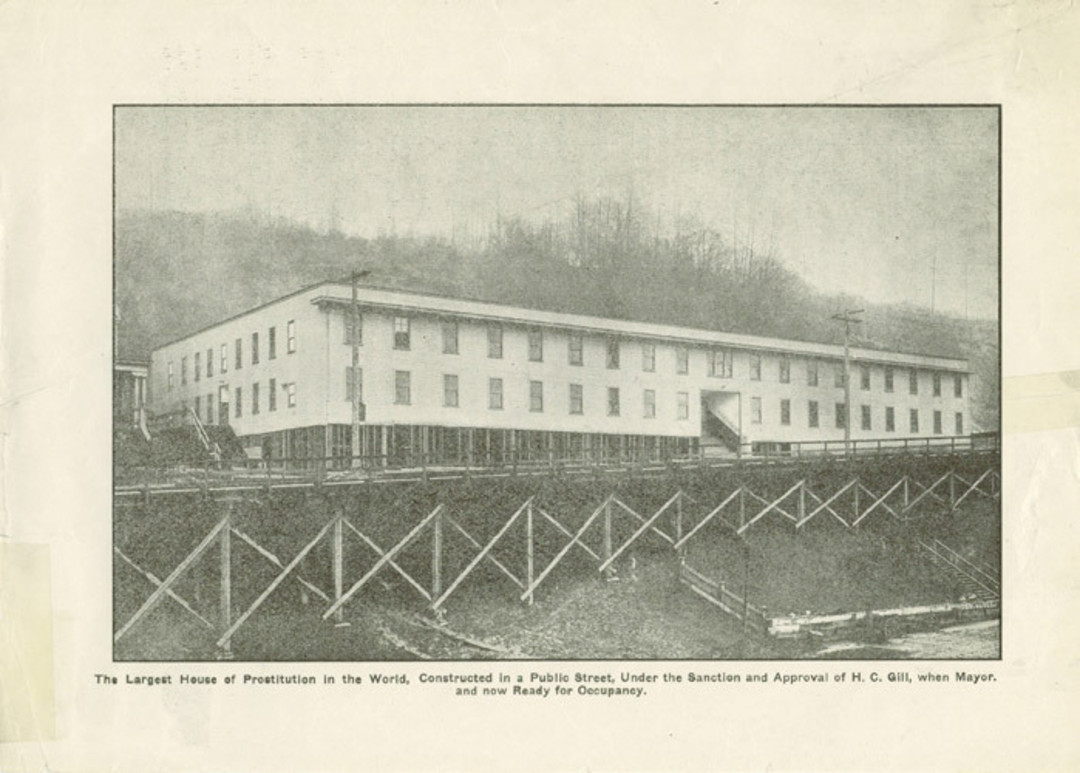
Image: Seattle Public Library
Long before Seattle made jets, software, or coffee, it built crib houses, box houses, and brothels—lots of them, including the world’s biggest. Prostitution runs as deep as rain through Seattle’s history. This is the chronicle of a city built on sin.
1853 Young Mary Conklin washes up in Seattle after her whaling-captain husband maroons her at Port Townsend. She manages the Felker House at First and Main, the infant town’s first inn and, when required, courthouse. Her lavish profanity in six languages earns her the sobriquet “Mother Damnable.” By some accounts she later adds a brothel upstairs and becomes “Madame Damnable.”
1861 San Francisco brothel operator John Pinnell (aka Pennell), opens Seattle’s first rough-hewn bawdy house on sawdust fill just below Mill Street (now Yesler Way). He names it Illahee—Chinook for “home place”—but locals call it the Mad House and the Sawdust Pile. Native women staff the Illahee at first, but after Asa Mercer imports marriageable maidens from Massachusetts, Pinnell recruits unemployed dancehall girls from San Francisco’s Barbary Coast.
1861–1916 The Tenderloin, by some reports the nation’s most monumental concentration of vice, sprouts in the “lava bed” south of Mill Street—“below the line.” Some of its “crib houses” have 100 cubicles (cribs) waiting to welcome loggers, sailors, and especially Alaskan miners loaded with gold. One census rec0rds more than 500 women working in them. Related industries—gambling, robbery, brewing—also flourish.
1884 Washington women become the first in the United States to win the vote, launching an epic political battle between reform and morality advocates (many of them women) and boosters of “business,” including the vice business. One of the latter wins the mayor’s race, and business booms.
1884 A new ordinance bans “soliciting prostitution upon any of the public streets,” and the mere presence of “dissolute Indian women” after dark. Its effect is to favor the brothels and “box houses”—low-end theaters whose actresses hustle drinks and sexual services—staffed by white and Asian women.
February 1888 Madam Lou Graham arrives on the steamer Pacific Pride. She proceeds to build a lavish, genteel bordello above the line, opposite Father Prefontaine’s Church of Our Lady of Good Help at Third and Washington. To entice customers, she and other “parlor house” proprietors parade new girls around town by carriage.
1890s and early 1900s Teetotaling, devoutly Catholic John Considine, “Boss Sport” and “the king of the box houses,” rises to become a top national vaudeville promoter.
1891 City Hall tries to clamp down by raiding Whitechapel, the Lava Bed’s French quarter. The raids spare white and target Asian women, who seem to have replaced Indians as targets of outrage.
1894 Reformers finally gain a majority on the City Council and ban liquor sales in theaters, killing the box houses.
1903 Lou Graham dies at 42 of syphilis. Contrary to legend, she leaves her fortune to relatives in Germany, not to local schools.
1897–99 The Alaska-Yukon gold rushes and Spanish-American War spark pell-mell growth and a new vice boom. Parlor houses continue, but the trade comes to be dominated by “crib houses,” homes broken into small, sparsely furnished rooms used only for sex transactions.
1900–1916 City politics becomes a battleground between progressives upholding clean government and vice enforcement, and an “open town” faction, spearheaded by Seattle Times publisher Alden Blethen, advocating tolerance and regulation of vice. The battle recurs in various forms to the present day.
1902 The Tenderloin is relocated several blocks south, in an effort to open up valuable downtown land for other business and insulate respectable citizens from the vice trade.
March 1903 U.S. and Japanese officials announce a campaign to break up the burgeoning trade in “white slaves”—young women imported for the sex trade by procurers posing as husbands with new brides—from Japan. They estimate that 500 are kept as sex slaves in Washington alone.
May 13, 1909 After Mayor John F. Miller orders the “disorderly houses” in Seattle’s vice districts closed, police raid five houses, confiscate their liquor, and arrest those found within. Miller endorses “the purpose of segregating vice and the establishing of a thoroughly regulated district as the best practicable means at hand of dealing with the social evil.”
December 1909 Customs officials announce a “deplorable state of affairs” in the sex-slave trade, with girls being sold in Seattle for service in Chicago and New York for $400, with quantity discounts.
1910 City Councilman Hiram Gill, an open-town advocate with financial ties in the Tenderloin, runs for mayor. The Seattle Star denounces him as a would be “red light mayor” who will unleash “a carnival of vice and crime.” Gill is elected anyway, and vice and corruption thrive.
1911 Mayor Gill and Police Chief Charles “Wappy” Wappenstein are caught conspiring in the construction of a 500-room brothel—supposedly the largest in the world—in two sprawling buildings on city property on Beacon Hill’s west slope. Wappy goes to prison and Gill loses a recall vote, triggering an exodus from the Tenderloin.
1914 Hi Gill switches sides and is elected mayor as a law-and-order candidate. He cracks down on vice operations but keeps his hand in the till,
Late 1920s Nellie Curtis, another madam of legendary business acumen, launches her first brothel in the Camp Hotel on First Avenue. She runs a string of houses and amasses a small fortune.
1942 Nellie Curtis takes over the LaSalle Hotel at the southwest corner of the Pike Place Market when its Japanese proprietors are uprooted by wartime internment. She makes it the city’s leading brothel, bathed in a telltale red glow from the “Public Market Center” sign on Pike. Stairs down to Western Avenue for sailors streaming up from the harbor. Many brace themselves with a drink at the adjacent Lotus Inn. Curtis somehow escapes a military-instigated brothel shutdown and operates the LaSalle until 1951.
1950s To discourage dozens of would-be customers who still show up each day, the LaSalle Hotel’s new owners hang a sign outside the door reading “No Girls.” The Lotus Inn is renamed Place Pigalle, after Paris’s red-light district. Place Pigalle (aka “Pig Alley”) continues as a seedy tavern with an Edith Piaf soundtrack until 1982, when it becomes an upscale restaurant.
1951 An errant B-50 bomber taking off from Boeing Field demolishes the Lester Apartments on Beacon Hill—formerly world’s largest brothel.
1973 Cinderella Liberty, starring Marsha Mason as a whore with a heart of what might be fool’s gold and James Caan as her sailor swain, shows the world a sad, seamy, sexy Seattle a mile and a universe away from the gleaming world’s fair grounds. And it records a now largely vanished First Avenue of dive bars, pool halls, and peep shows.
June 1974 The Association of Seattle Prostitutes, a chapter of the national union COYOTE, is inaugurated. Its motto: “At the Breast of the Queen City.”
June 14, 1974 The Association of Seattle Prostitutes pickets the Roosevelt Hotel for “giving free rooms to the vice squad for entrapment purposes while raking in dollars from business generated by working women.”
Feb 20, 1975 The American Civil Liberties Union of Washington and the Association of Seattle Prostitutes sue to overturn Seattle’s anti-prostitution law on grounds it violates First Amendment rights and discriminates against women.
March 1975 Using unpaid volunteers posing as prostitutes, the Seattle Police Department arrests a Spokane school principal, a 15-year-old boy, and 21 other alleged patrons. A police spokesman calls the volunteers “typical working girls.”
May 1975 SPD begins deploying female officers as prostitution decoys and says it will phase out the use of volunteers.
July 29, 1975 King County Superior Court Judge Donald Horowitz overturns the 1974 prostitution convictions of two Seattle women on discrimination grounds, because police failed to arrest male customers as well. Police have since begun snaring using volunteer female decoys to snare customers.
August 1977 Police and outreach workers report an unprecedented number of young male street prostitutes in Seattle. Police make their first arrest for pimping underage boys.
September 1977 The Dorian Group and other gay organizations condemn a weeklong P-I series on young male street prostitutes as “yellow journalism,” a “double standard,” and “scandalous attacks on gay people.”
November 1977 Residents around 19th and Yesler report “car tricking”—downtown businessmen driving up for lunchtime trysts—plus shootings, stabbings, and fights between pimps.
Dec 7, 1977 Seattle vice detective Cal Rowley, renowned for more than 2,600 prostitution arrests, uses an “expert lip reader” observing conversations through binoculars from 50 yards away to arrest women for prostitution. A judge later admits the lip reader’s testimony, but pronounces it insufficient by itself for conviction after the hearing-impaired lip reader fails to understand some questions on the witness stand.
May 9, 1978 King County Council members adopt a graphically detailed anti-prostitution law that, unlike its predecessor, is not limited to acts “performed by a woman.”
May 5, 1978 In an apparently unprecedented application of a 1913 public nuisance law, a King County judge shuts down Skandia massage parlors in downtown Seattle, Federal Way, and Mercer Island.
July 1978 Police report that prostitution is at its highest level in nearly a decade, and that streetwalkers have fanned out from their longtime hub at Sixth and Pike to the International District and Pike Place Market. Some officials and civic boosters worry about pimps, prostitutes, and muggers preying on tourists coming to see the Treasures of King Tut exhibit.
November 27, 1978 The Venusian Church, which stages live sex acts for peep-show patrons to communicate “the principles and philosophies of the church” at its Temple of Venus on First Avenue, sues the city and SPD for trying to shut it down.
December 1978 The Exotica Dance Studio at 718 Pike fortifies its sidewalk picture windows, in which women dance, flash bikinis under their dresses, and beckon men to come inside (and pay $25), after disappointed patrons put bricks, feet, and fists through the glass.
July 1980 The city attorney proposes new regulations for tease operations like Exotica, requiring notification that no nudity or sexual activity is offered inside.
March 1981 Phinney Ridge and Ballard residents complain that the oldest profession has invaded their quiet neighborhoods, via Barbie’s Counseling Service on Phinney Avenue and the Riviera Sun Center (with just one tanning bed) on 8th NW.
April 1981 The Venusian Church moves from a West Seattle house to a motel room near Sea-Tac.
Feb 1982 A federally funded study in Seattle finds an emerging “new breed” of young male prostitutes who feel good about themselves and their gay identity and enjoy work as “sexual entertainers.”
September 1982 SPD proposes an ordinance barring doors on peep-show booths. Lawmakers, officials, and operators spar over it for months. It finally passes.
September 1982 Prosecutors charge the Fred Astaire Dance Studios of Seattle and Bellevue with using sex to extract tens of thousands of dollars from lonely, elderly, and widowed dance students.
February 1984 An admitted prostitute says she was gang-raped and another reports she was assaulted by seven prospective NFL recruits in the Sheraton Hotel. Prosecutors charge the Texas-based sports agent who hosted the event with promoting prostitution.
May 1984 Sea-Tac neighbors picket motels that offer special short-term rates or otherwise seem to cater to prostitution. The King County Council considers banning room rentals of less than four hours.
Mid-1980s According to local strip-club lore, the Texas couch dance, later known as the lap dance, is actually invented in Seattle.
September 30, 1985 In an effort to catch johns, Seattle bans driving around in circles and beckoning to pedestrians.
May 1986 The deputy director of the National Association for Missing and Exploited Children charges Seattle has the most rampant juvenile prostitution in the country. “It’s got to be officially sanctioned,” he argues.
Autumn 1986 Snohomish County police arrest 55 prospective escorts in a costly, controversial sting operation: advertising for workers for a bogus escort service. Aurora Avenue merchants post “Prostitution Watch Area. License Numbers Are Being Recorded” signs.
December 31, 1986 Seattle police finish the year with more than 2,000 prostitution arrests, an all-time record.
June 1987 Sea-Tac area residents and merchants complain that the anti-prostitution campaign on Aurora Avenue has driven streetwalkers into their neighborhood.
May 2007 Seattle’s tradition of innovation in vice continues, in more wholesome form. Mercedes Yaeger, the daughter of Pike Place Market artist/merchants and creator of the popular Market Ghost Tours, launches a Seattle Lust Tour, apparently the first tour anywhere guiding tourists and locals to historic sites of vice and debauchery.
February 2009 Yaeger is invited to Iceland to speak on ghost and lust touring to an international tourism conference.