


Image: Naomi Tomky
The side-swept tuft of light hair at the top of a Highland cow’s head wouldn’t be out of place on a K-pop star or boy band heartthrob, and the glamour shots that invaded my social media feed proved it. Some cows hung out in glamping resorts with stylish yurts near Bellingham, others nuzzled gently at children at an Oregon wedding venue. All of them—for a price—could be my new best friend, and I could not resist their fuzzy-headed charms.
Among this new crop of niche petting zoos, Luckie Farms won me over with proximity (just outside Everett), price ($30 per person for an hour), and blatant appeal to what I wanted most from the cows (to cuddle them). The unpredictable nature of I-5 traffic meant my daughters and I arrived at our cow cuddling appointment a touch early, giving us plenty of time to peruse the gift shop—think “Live, Laugh, Love,” but make it bovine.
Though I resisted my children’s begging for one of the more than a dozen different Highland cow stuffies (and earrings, socks, pens, stickers, key chains, magnets, pill cases, purses, and scrunchies), I couldn’t help but agree with the farm’s founder, Tara Luckie, when I asked her later why people love the breed so much: “They’re really cute; I mean, they’re really adorable looking.”
The thick, double-layer coats that served to keep them warm in Scotland now serve looks in Lake Stevens, and the animals help out around the farm, too. They eat like goats, part of their adaptation to harsh environments, and clear fields of thistle and weeds, leaving behind lush green grass. “They’re extremely hardy,” says Luckie. “They’re very friendly and very intelligent; they’re really easy to train.”
Most importantly, they’re highly social. “They like attention from humans just as much as we like to give them attention,” she says. “They’re kind of like big dogs, because they really just like to be in your presence and to get scratches and attention.”

Image: Naomi Tomky
We have plenty to give them, as the three of us and two other groups of about the same size followed our guide, Danielle, a few hundred feet down the path, pausing briefly to admire a baby reindeer Bambi-ing about on unsteady hooves. The reindeer were the original focal point when Luckie began offering farm tours—mostly educational field trips—but she quickly realized people were really into the Highland cow.
She started inviting family and friends to come over. “It was like Disneyland to them; the joy I saw in their eyes,” she says. She decided to open it up to the public last year, putting out some signs on the side of the road. “One blew up on a community social media profile that was like, ‘Is this for real?’” It was, and it is—Luckie Farms now gets about 1,000 visitors each week.
After a quick safety briefing, we grabbed hairbrushes from the bucket by the gate and wandered into the pen, a tennis court-sized grassy field, where a dozen or so cows hung out. The alpacas looked over at us curiously from a neighboring pen, and at the far end, a batch of piglets, barely bigger than a potato, wandered in their mother’s rather large orbit.
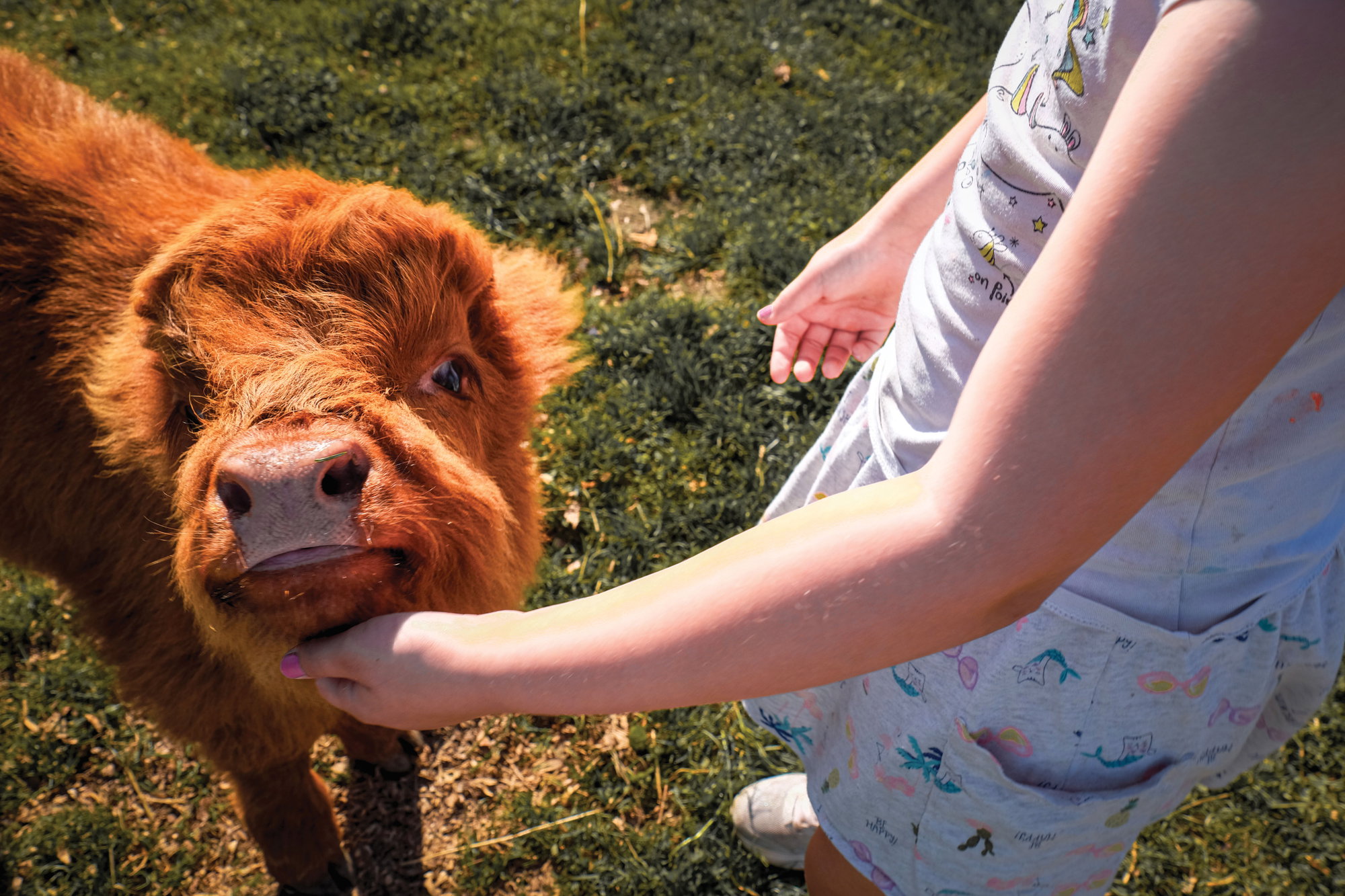
We started by brushing a trio of small cows, an innately calming activity. One of the farm staff monitoring—and taking photos, offering to answer questions—came over to introduce us: Mine was Pumpkin, the other two were Spice and Petunia, and all three were about a month old.
The cuddling also has a farm purpose, especially key for the babies like scraggle-haired Petunia: “It gives them that positive association with people; it allows them to build trust with people,” says Luckie. That keeps Luckie and anyone else working on the farm safe when the animals are full-grown—1,800 pounds, some with horns.

Image: Naomi Tomky
Even so, the larger cows occasionally scared my 8-year-old, who needed reminding from the short safety briefing Danielle had given us: The cows are friendly but don’t realize they have horns when they try to play. A problem easily fixed by making sure to stand to their side, she explained, rather than in front of them. Mostly, we just stayed with the smaller, gentler cows, letting them nudge us in search of scratches and lay their comically large heads on our thighs.
“I really think that people are surprised at the level of joy they experience,” says Luckie. “Just being in the present moment, like calm and peace when they’re with them.” I can pinpoint that exact moment in our time there: At the end of our hour, just as the girls’ interest had started to wane, we began testing a new technique, combing a cow named Gideon’s short, red fur with two brushes at the same time. He lifted his stubby nose and rewarded us with a smile showing his neat rows of white chiclet teeth, punctuated with glimpses of his little pink tongue. In the words of my 10-year-old, “I stepped in cow poop, but it was very amazing.”
Published in the The Innovation Issue issue of Seattle Met.
|
|
|