


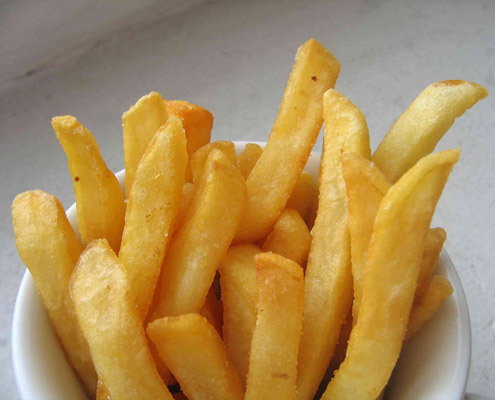
Fries are good. Fries fried in meat fat are better.
Among the many really fine small plates I sampled recently at the new Pioneer Square gastropub Damn the Weather—a supple zucchini carbonara, an improbably successful Caesar sandwich, glorious grilled peaches offset with blue cheese and rhubarb—the most addictive was a cone of beef fat fries: more flimsy than crispy, but so flawless in the flavor department as to shame every other fry in my recent memory.
“They taste,” I wrote in my notes, “like a burger and fries got married.”
Thank you, beef fat. Or tallow, its rendered version; the stuff that made MacDonald’s fries taste so full-bodied and sumptuous before the company bowed to pressure to switch to vegetable oil in 1990. I wasn’t the only one who adored those wicked things—so, reportedly, did both James Beard and Julia Child—and the reason is simple: The flavor of a fry derives mostly from the oil it’s cooked in. (Okay, it’s about the potato variety too—but mostly it’s the oil.)
Duck fat fries, for instance, are insane, flavorful and uberrich, like the great ones at RN74. Rendered pork fat fries—aka bacon fries—are as ridiculous as they sound, especially tossed with salt, garlic, and chives at West Seattle’s Swinery Courtyard.
In related savories, we got fries beautifully drizzled with smoked olive oil (Spur Gastropub), and truffle oil (BOKA, Baguette Box, Canlis of course). Lately I’ve been hearing rumors of fries topped with, gawd, foie gras (Le Zinc and Quinn’s, reportedly). Can this be true?
But fried in meat fat is another thing altogether. I’m guessing a whole lot more places fry their potatoes in meat fats. Know of good ones? Comment please.
|
|
|