


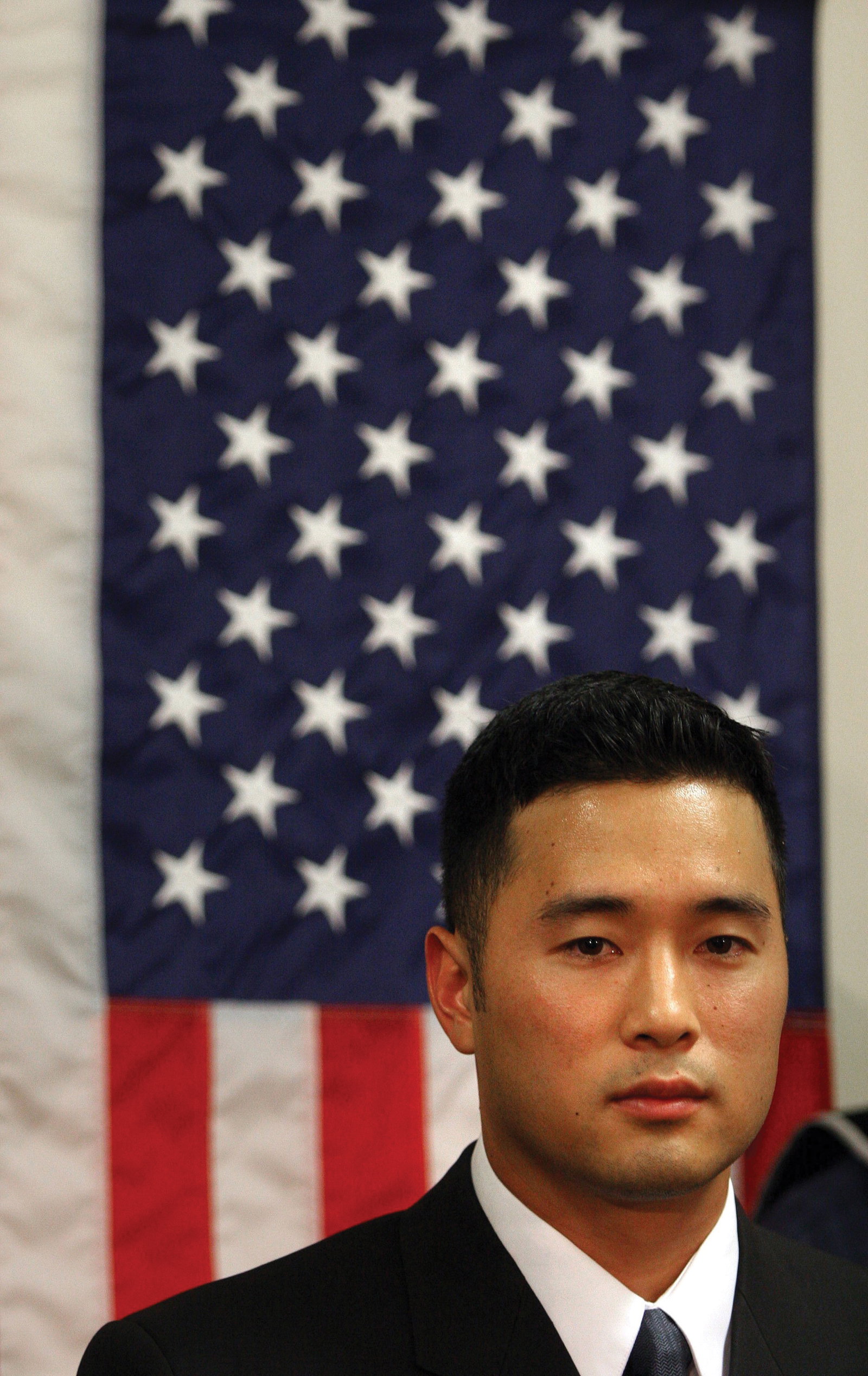
Photo: John Lok / MCT / Newscom
He was 28 years old, with the dashing good looks and dignified bearing of one typically cast in the role of the hero, not the rebel. Instead Ehren Watada out of Fort Lewis became the first commissioned officer in the nation to publicly refuse deployment to Iraq, and one of the first in history to challenge, in military court, the very legality of a war.
Nothing about the quiet lieutenant presaged his defiance. He had signed on to the army in a surge of post-9/11 patriotism and served with distinction for three years, taking up research on the Iraq War only after his upcoming deployment there led a commanding officer to recommend it. Watada was leveled by what he found: that the war was not sanctioned by the UN, and that it had been Congressionally approved on the basis of a claim, regarding weapons of mass destruction, found fraudulent.
“I didn’t consider myself a rabble-rouser or dissident,” Watada, who now runs a family business in Nevada, recently wrote via email. “I considered myself a good patriot, a team player, and someone who in good conscience committed himself to arms. What I found unconscionable was the Bush administration’s lie to the American people to take them into war and invade another country.” He numbered the consequences: The deaths of (then) over 3,000 service members. The traumatic brain injuries, posttraumatic stress disorders, and maiming of tens of thousands of others. The deaths of what will probably be over a million Iraqis. The fanning of the flames of Islamic extremism, leading to the birth of ISIS.
Watada’s crusade, which cast Fort Lewis and its very public I-5 overpasses as a locus of the protest movement, ended with a whimper. His court-martial culminated in a mistrial in 2007 and a quiet discharge from the army in 2009. He did not get jail time—but he also never got official acknowledgement that the United States’ involvement in the war was fundamentally unlawful.
Still, Watada tallies the wins—not least for integrity. “I truly believe now as I did then, that obedience and complicity in the face of what you know to be wrong is the true prison,” he says. “My greatest triumph was seeing I was not alone and that my actions created the seeds of doubt and perhaps hope for some.” Yes he got hate mail, but Watada says he also received a significant show of support—most meaningfully from within the ranks of the enlisted.
From this vantage point 10 years on, that’s not a surprise. If there’s one theme Americans have not been able to stop chewing on the last decade, it’s the intersection of government authority and individual conscience. That’s where we’re struggling to make sense of everything from Guantanamo Bay to the Patriot Act, from Edward Snowden to Bowe Bergdahl. Say what you will about his act of defiance: In a world where jihadists increasingly reveal the grim outcomes of blind obedience to authority, Ehren Watada tried simply to expose blind obedience as conduct unbecoming the U.S. military.
2006
February 5
The Seahawks make their first Super Bowl appearance, losing to the Pittsburgh Steelers, 21 to 10.

Image: Matt Lutton
February 28
The March 2006 issue of Seattle Metropolitan hits newsstands.
March 25
Kyle Huff shoots eight people then commits suicide at a Capitol Hill rave after-party in the worst local mass shooting in more than 30 years.
July 28
Gunfire at the Jewish Federation building leaves five injured and one person dead; the shooting is deemed an anti-Semitic hate crime.
December 14
The Hanukkah Eve Wind Storm leaves 14 dead and millions of Washington residents without power for days.
Published in the 10 Years That Changed a City issue of Seattle Met.
|
|
|