


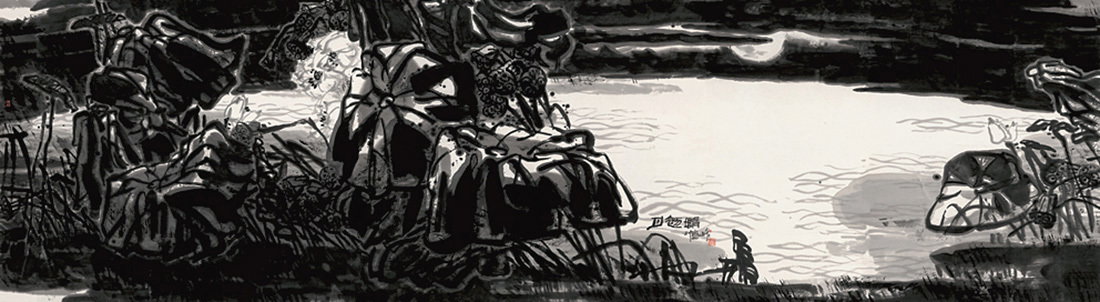
Pan Gongkai, Withered Lotus Cast in Iron, 2014, ink on paper, 180 x 1,500 cm.
Image: Courtesy Frye Art Museum
Despite most of the works on display being painted this year, the Frye Art Museum’s new Pan Gongkai: Withered Lotus Cast in Iron is almost as much an art history lesson as an exhibit. Pan is one of China’s leading artistic scholars, serving as president of the prodigious Central Academy of Fine Arts in Beijing. If there’s one person to provide an education in Chinese brush painting, it’s Pan. And with Withered Lotus Cast in Iron, he’s here to show us what we’re getting wrong about his country’s signature style. It’s an exercise of refined flow and simplicity over self.
One of the main pushes of Withered Lotus Cast in Iron is to emphasize the separation that exists between the 3,000-year-old Eastern art tradition and our Western ideas and expectations about art. Pan has been vocal about how he thinks recent Museum of Modern Art displays of Chinese brush painting have misrepresented its true, pure form and led to confusion about the medium. Pan’s paintings stress the two-dimensionality of the image, as opposed to striving for the artificial sense of three-dimensional realism of a large portion of Western work. But more to the point, the lineage of Chinese brush painting doesn’t emphasize a sense of the artist’s self. There aren’t human forms to be found in Pan’s pieces, instead focusing on impressions of reality. They’re not expressions of one’s self; they’re expressions beyond one’s self. It’s both the crucial point Pan is trying to convey and what can leave things feeling a bit dry and distant for Western eyes; it almost seems like too much of a lesson at times.
The improvisational aspects of Pan’s classic technique keep things interesting. Complying with tradition, all of the paintings must be finished in a single take, even the works (like the titular Withered Lotus Cast in Iron) that stretch nearly 50 feet long and over 5 feet tall. There’s no room to go back and edit or repaint trouble spots. The free flowing nature of each piece’s creation can be discerned when looked at up close. The dip points where Pan started a stroke begin to stand out more, and the tonal changes of the ink speak even further to the process. The grayer tones indicate the initial movements when the brush was still partially wet, mildly deluding the ink. In fact the ink itself seems to have some level of control in the style, as randomness the way it bleeds onto the thin canvas in varying saturation level can sometimes lead the painter in unexpected directions.
The seventeen Pan paintings on display depict the natural existence outside of his own control: blossoming and withering flowers, atmosphere, shadows, dusk, and autumn. But they’re very quiet works. With the notable exception of Moon Fall—which possesses a unique lushness with its rich, dark swampy (almost Dagobah-esque) scene—nothing feels instantly gripping. Instead, the paintings require a visitor to take the time fully examine them, study them. Which is just what Pan Gongkai wants.
Pan Gongkai: Withered Lotus Cast in Iron
Thru Jan 18, Frye Art Museum, Free
Pan Gongkai, Moon Fall, 2005, ink on paper, 180 x 617 cm.
Image: Courtesy Frye Art Museum
|
|
|