This Cold House
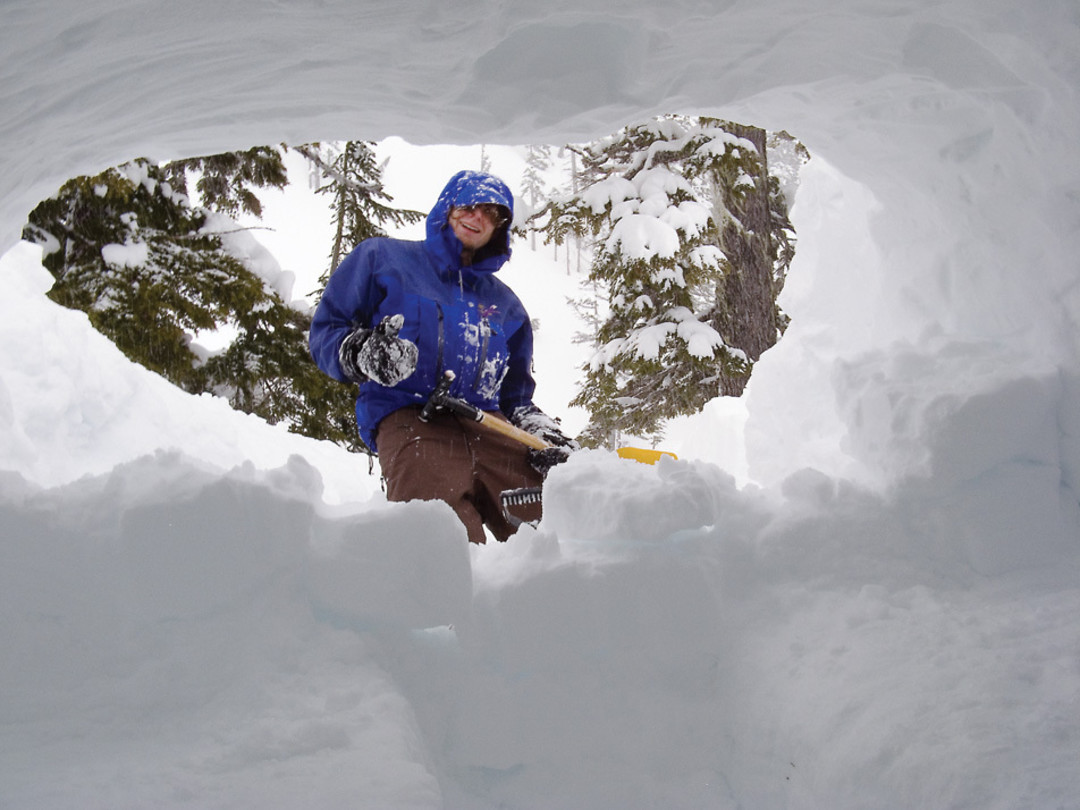
Image: Paul Milbourn
Snow caving brings back great memories for me: trudging through a godforsaken ice-locked hinterland (I swear we took the back way to Narnia) at a tender stage of adolescence with the Boy Scouts, only to spend a night freezing my hind end off in a sorry excuse for a hole I’d clawed into the side of a snowdrift like some desperate rodent. To top it all off, my boots were frozen solid in the morning because I’d left them near my cave’s opening all night, so I had to spend the morning cloistered in shame while they thawed by the fire pit. Ah, snow caving…
Turns out, like most teenagers, I just didn’t know what I was doing. Snow caving, which is exactly what it sounds like—making a cave in a mound of snow to use as a shelter for winter camping—can actually be an enjoyable recreational activity for just about anybody who can wield a shovel.
My first mistake, says John D. Erickson, was digging into the first lump of snow I could find at the edge of the Boy Scouts’ campground; instead, the ex-Spokanite and snow caving guru of OutdoorsWithDave.com says I should have looked for a drift at least four feet high and 10 feet across. (The alternative method involves making a pile of snow big enough to sleep in, then waiting for it to settle so it regains the density of naturally packed snow, and then burrowing into it—all of which takes more time and energy than you’re bound to have on a subfreezing day in February.) Cliff Hodges, a snow caving guide in Santa Cruz, California, suggests waiting until the snowpack—the amount of snow that’s piled up in a given location that year—is at least six feet.

Go dig a hole: Budget at least half a day to clear your cave.
Image: Paul Milbourn
It’s crucial to make sure there’s nothing hidden within the drift you’re hollowing out. Otherwise you could spend hours unearthing a boulder instead of fashioning a humble abode. Hodges recommends using an avalanche probe—a collapsible metal pole used to find people buried beneath an avalanche—to test the depth of a drift and make sure it’s all snow. Tad McCrea, a UW student and frequent snow caver—he’s kind of a bizarre mixture of Ken Kesey and Bear Grylls—learned that one the hard way the last time he tried to build a cave at the Hyak Sno-Park near Snoqualmie Pass and hit a rock wall beneath the snow before he’d dug very far. Since it was already dark and he didn’t have time to look for a better spot, he was forced to dig straight down, along the slope of the wall, putting the chamber of his cave below the entrance and allowing any heat generated within to escape. He’s immortal, so it didn’t matter; but for you and me, a good cave design is key.

Put on your coat and stay a while: It’s not as hard to get comfy as you might think.
Image: Paul Milbourn
Give yourself at least half a day of sunlight, to allow for mishaps, and get burrowing. If possible, it’s best to start out digging up at an angle before leveling off, so the chamber of the cave will be above the entrance tunnel and trap the heat. The size of the chamber is up to you—the floor should be big enough around for you to lie down—but it’s important that you keep the walls of your snow cave between a foot and 18 inches thick and arched for stability. Naturally packed snow holds together well, but never walk on top of your cave—and make sure you mark it with flags so an unexpected, middle-aged, rediscovering-youth-by-cross-country-skiing guest doesn’t (literally) drop in on you. And don’t be alarmed by melt—as the temperature drops when day turns to night, the water will refreeze and strengthen the walls of your cave. You can also dig drainage gutters along the base of the walls to divert excess runoff away from your sleeping area.
On my one failed trip into the snow, I marveled at how some of my fellow Scouts’ caves could go so right—icy palaces with sculpted benches and tables, little shelves cut into the walls, smoothed ceilings—but McCrea says that comfort has more to do with bringing the right gear than fancy interior decorating. Some things, like fat- and protein-rich foods, are obvious, but others might not be: “Bring synthetic fabrics—don’t bring down—and if you have a down sleeping bag, bring a bivy sack to stay dry,” he says. “It can get pretty wet in the cave, depending on how warm it is.” And remember, snow is an excellent insulator, so you’ll stay warmer than you might think.
Most important, though, always let someone know where you’ll be camping and have an emergency plan, even if it is running back to your car and blasting the heater.
Taking a shot at snow caving is well worth it, not only for the sense of accomplishment, but because of the chance it provides to get the hell out of Dodge. “I love being far out into the wilderness and being able to take care of myself and be comfortable,” Hodges says. “I also love the solitude. Winter camping has a quiet and serene aspect to it that is extremely different from other camping.”