Roam, If You Want To
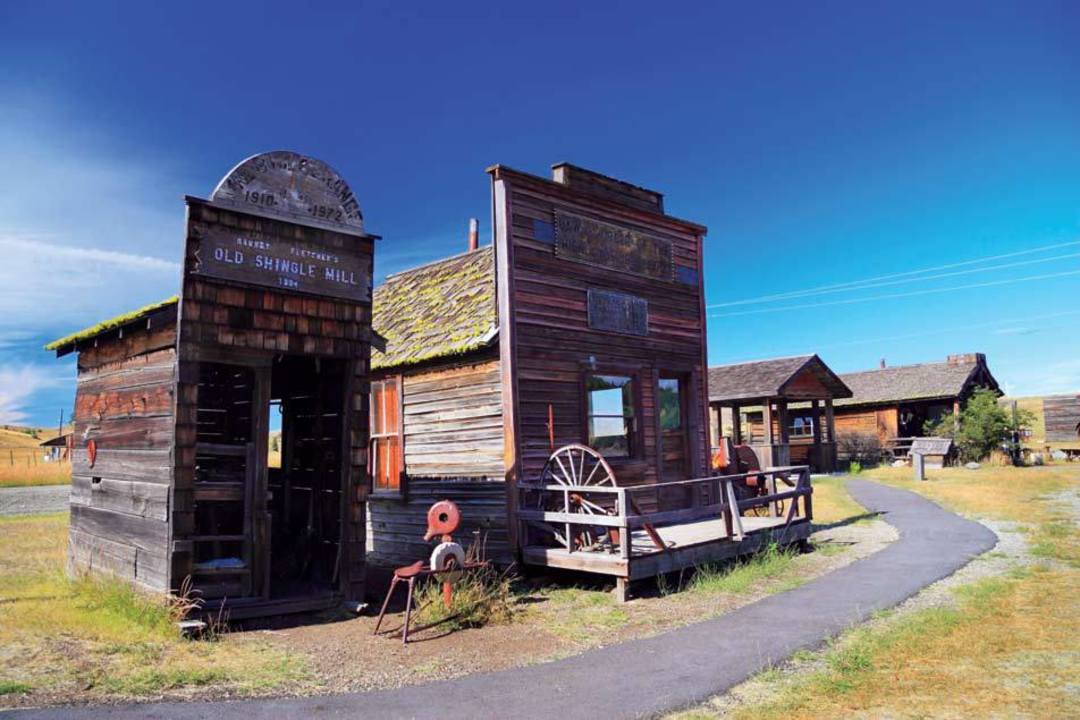
Ghostland observatory Molson is just one of several ghost towns dotting Okanogan County.
Image: Jon Feider
WHEN I FIRST started crossing the North Cascades highway to spend time in Okanogan County more than 20 years ago, the town of Winthrop struck me as heaven with a false front. The kitschy cowboy overlay was forgivable because the fantastically varied beauty of the Methow Valley lay spread out all around—Cascade foothills coming to rest in solemn pastures, fir trees speckling the seams of dry hills, rolling sagebrush to the east, and a pretty little river running through it all. Never mind the tourists browsing on the wooden sidewalks or the ever growing herd of second homes cropping up on river- and hillside, this was God’s country.
When You Go

Image: Richard Stringfellow
SLEEP
Canaan Guest Ranch
474 Cape LaBelle Rd,
Tonasket, 509-486-1191;
canaanguestranch.com
EAT
Breadline Café
102 Ash St, Omak,
509-826-5836;
breadlinecafe.com
Cinnamon Twisp Bakery
116 N Glove St, Twisp,
509-997-5030;
cinnamontwisp.com
Tonasket Saloon
302 S Whitcomb Ave
Tonasket, 509-486-2459;
tonasket_tavern.tripod.com
Twisp River Pub
201 N Highway 20
Twisp, 209-997-6822;
methowbrewing.com
DO
Bernard Hosey Sculpture Studio
Twisp-Winthrop Eastside Rd
Twisp, 509-997-1313;
bernardhosey.com
Lost Lake Campground
509-486-2186; recreation.gov
Molson School Museum
509-485-3292;
ghosttownsusa.com/molson.htm
Okanogan County Historical Society
1410 Second Ave N
Okanogan, 509-422-4272;
okanoganhistory.org
Then one visit I kept pushing east and north, and I realized that God had actually been living somewhere else all along. I left the Methow behind and, in the next valley over, picked up the Okanogan River and followed it north past white Grange halls and blue ridges, into shady cottonwood groves and out to the dazzle of grassland tanning in the sun. Around the funky little burg of Tonasket (venerable organic food co-op, vibrant community center, welcoming Tonasket Saloon) is where it starts getting really pretty. This is a country of big vistas, small lakes, and even smaller towns—so small, as you get up near the Canadian border, that some of them have shrunk down to memories. The term ghost town seems especially fitting in outposts like Molson and Chesaw—so lovely and sad in the spring sunshine that they’ll haunt you forever.
Twisp, nine miles past Winthrop, sets the mood for the dreamy hinterlands beyond. Just outside town is the studio and sculpture garden of local metal sculptor Bernard Hosey. “Most small rural communities have a monoculture,” he told me, “but here we’ve got a mix of ranchers, artists, hikers, and farmers with deep roots.” Hosey steered me toward his favorite hangout, the Twisp River Pub (good grub, live music on weekends, and nine different kinds of Methow Valley Brewing Company beer), suggested a day hike up to Twisp Pass at the upper end of the Twisp River Valley, and advised me to stock up on sweet rolls and scones at the Cinnamon Twisp Bakery the next morning. Not much in the gourmet way from here on.
My first couple of times in Okanogan, I beelined straight to Omak through the glary utilitarian strip along Route 97. But on a recent visit, I pulled off at the Okanogan County Historical Society in the north end of town to take in the wonderful Frank Matsura photo collection. Matsura, born in Tokyo, relocated to Okanogan County in 1903 and spent the next decade taking a series of vividly textured black-and-white photos. Fruit orchards in tender spring bloom, sad-eyed Native Americans on horseback, kids swimming in the river, men carving mines and roads into the gorgeous hills, grinning bachelors perched like crows on a rail—Matsura snapped the beautiful, transient, historic, festive, and odd. The 2,500-plus images held by the historical society (some on display, most preserved in binders) cover the county so thoroughly that you could easily plot your trip by browsing through them and making lists of what appeals.
Plotting is a good idea, because north of Omak (worth a stop for the Breadline Café) the possibilities abound. If I were a birder or a fisher, I would head out to Lost Lake, an amethyst teardrop deep in the woods east of Tonasket (follow the forest service roads north from Bonaparte Lake). Those with keener eyes than mine have spotted common loons, black terns, and Williamson’s sapsuckers. Anglers assure me that eastern brook trout abound. Absolute serenity is guaranteed.
But I’m more of a history and landscape guy, so I usually stay on the 97 north out of Tonasket and scour the lonely hills for the remains of old homesteads, mines, and pioneer towns from days gone by.
To me, this austere upcountry yields its deepest secrets along the paved but dinky Loomis-Oroville Road that loops west off 97 just past Tonasket and rejoins the highway 17 miles north at the lakeside town of Oroville. The Okanogan Highland, as this high semidesert is known, is a region of ancient mountains worn smooth by time and planted by nature with prairie grass, wildflowers, and scatterings of ponderosa and lodgepole pine.
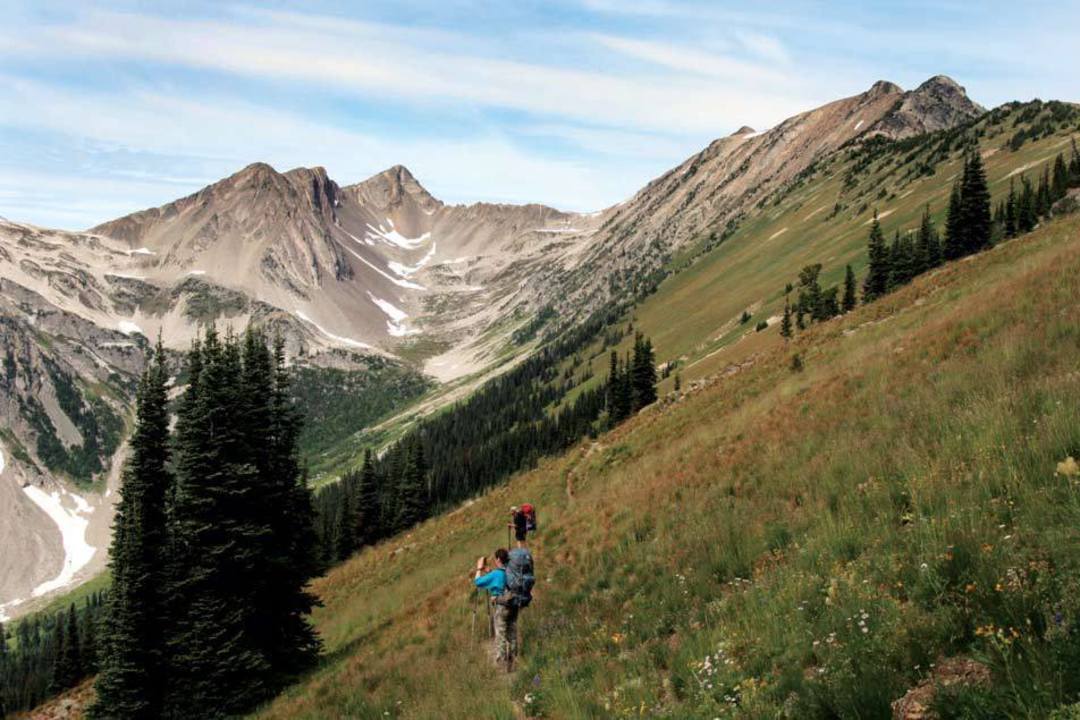
High life Hiking in the Pasayten Wilderness.
Image: Andy Porter
History, at least white history, is brief and fading fast. Back in the 1880s, miners in search of silver, gold, and copper flocked here, set up shop in towns with the lilting names of Loomis and Nighthawk, built, extracted, and roared for a while—then gave up and moved on. Today you can still follow their wagon tracks into the hills and muse by the faint rectangular depressions where their cabins once stood. There’s good camping and decent fishing on Spectacle Lake just east of Loomis; in spring the orchards along the Similkameen River, which parallels the road, fill with clouds of pink and white. West of Loomis, Toats Coulee Road makes a convenient jumping off point for treks into the half million untouched acres of the spectacular Pasayten Wilderness, which buffers the Okanogan Highland to the east and the Cascades to the west.
Molson, 28 miles due east of Nighthawk on the other side of the Okanogan River, is worth the detour for the breathtaking backroads drive alone. The town site is now an outdoor museum with a collection of weathered buildings and rusting tools—but the most evocative spot is the old schoolhouse half a mile away. The three-story, circa 1914 brick building commands a rise with the most stunningly mournful panorama of any school I’ve seen.
On my first visit a kindly docent regaled me with statistics on ferocious winter cold and dwindling population as I poked around the classrooms and library. But my mind and eyes kept wandering to those tall windows and the vistas they framed of rippling grass, radiant sky, and nary an inhabited dwelling for miles and miles.


