All Washed Up
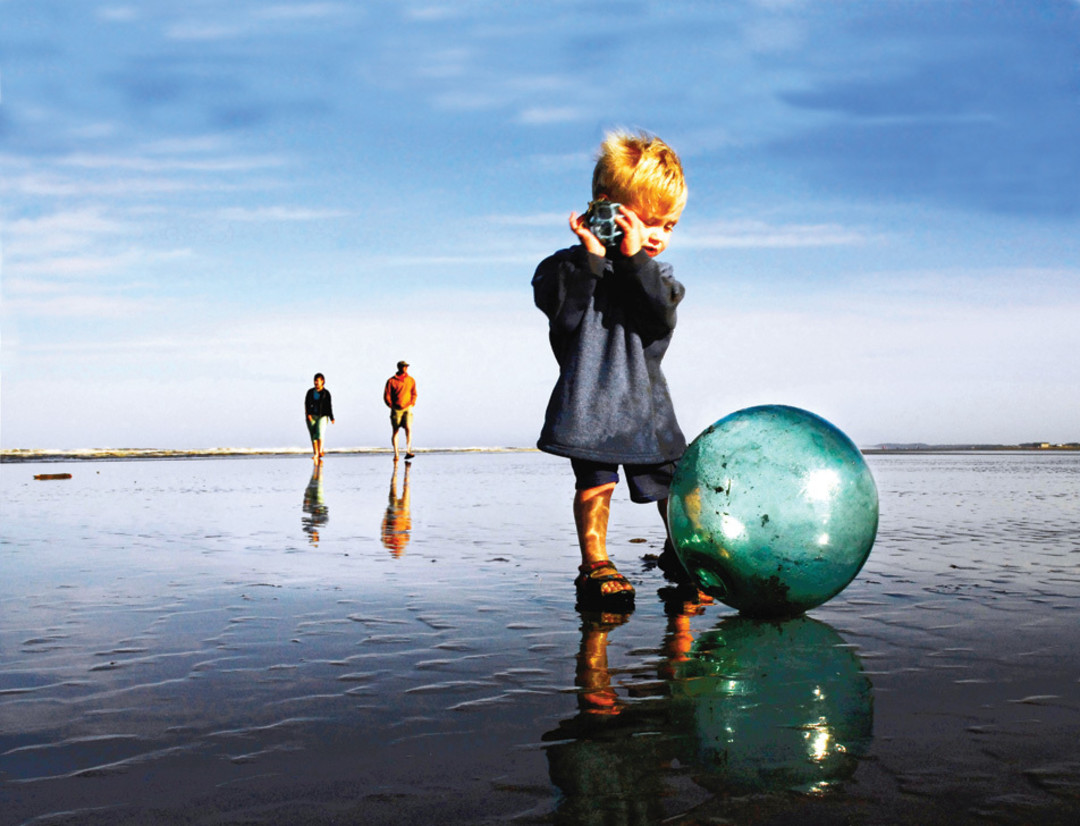
Image: Deby Dixon
Two years ago, at the annual Beachcombers’ Fun Fair in Ocean Shores, I met a garbage-truck mechanic from Sumner named Andrae Hart and his wife, Kimberly, and mother, Priscilla. Thirteen years earlier Andrae had suffered a severe head injury, courtesy of a drunk driver, and fallen into a coma. For years after he awakened, his mother told me, “he didn’t find anything he could enjoy or get involved in. Then we took him beachcombing.” Somehow tramping the sands, scanning for a message in a bottle or whatever else the sea felt like spitting up, reconnected him to the world. “Now he does it all the time,” Priscilla says. “He gets up at four in the morning so he can go scour the beaches. His life just revolves around this.” The three Harts followed the storms and flotsam the way Deadheads once followed the Magic Bus. They even talked of selling their house, buying a camper, and becoming full-time beachcombers.
Beachcombing appeals to a raft of instincts and inclinations: to the detective, archaeologist, naturalist, treasure hunter, collector, and, especially, hunter-gatherer in all of us. It is a meditative exercise that will upend your worldview and teach you to savor the foul weather and biting wind that bring big waves and flotsam bonanzas. And so it suits Washington’s coast, which is notoriously deficient in the things people usually go to beaches for: The water’s too cold to swim in without a wet suit, beachfront bars are unheard of, and you’re more likely to get wind-whipped than sunburned.
Beachcombing appeals to the detective, archaeologist, naturalist, treasure hunter, collector, and hunter-gatherer in all of us.
This outwardly quirky pursuit is a draw for many of the 4 million tourists and day-trippers Ocean Shores hosts each year. About 2,000 of the more ardent combers gather early each March for the Fun Fair, the renaissance weekend of beachcombing. This year they’ll hear talks on crows and other beach birds, marine ecosystems, and driftwood and how to tell what tree species and area it came from. They’ll view and perhaps erect astonishing assemblages of fishing floats, floating sneakers, and other gaudy sea wrack, all competing like prize steers for one of the show’s blue ribbons. They’ll walk the tideline with a marine ecologist, learning to read the language of sand and surf. And they’ll scatter along the shoreline for the fair’s high point, the Dash for Trash, a littoral scavenger hunt that doubles as beach cleanup.
{page break}
In past years, attendees have seen a slide show on beach glass—bottle shards worn to a biomorphic roundness and elegant frosted finish by the waves and sand. An entire collecting culture, grading scale, and trading market have built up around this glass, which can be jewel-like in its refinement and price. Some colors—orange glass tinted with metallic gold, glowing glass laced with uranium—are rare and lucrative discoveries for those who make a business of beachcombing.
The local champs at that trade are Dean Christensen and his 14-year-old son Andy, who live by the beach in Bellingham. In 1992, Christensen lost his boat off the San Juans; since then he and Andy have found pieces of it washed up on 30 islands. They’ve also found bumpers, fenders, monogrammed life rings, and other doodads from hundreds of boats, which they sell at the local marine exchange, plus 10,000 fishing lures and enough sea glass to keep Chihuly stocked. “Sometimes we’ll sell a boat bumper, then find it washed up again a few weeks later,” says Dean Christensen. Flotsam’s been very good to him and his son: “We’ve made well over $30,000 at this.” I asked the secret of their success (you never know when you’ll need to know these things), but there was no secret: “We cover a lot of ground. And Andy has 20/10 eyesight.”
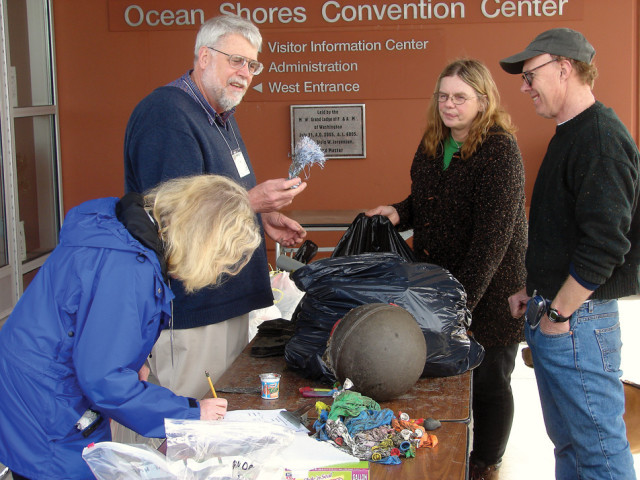
Ebbesmeyer sorts through two flotsamologists’ colorful haul.
The Christensens regularly win the Dash for Trash prize, but the event’s founder and officiator, oceanographer Curtis Ebbesmeyer, sees it as more than a contest: It’s a hands-on venue for “flotsamology,” teaching folks about the sea, the currents that move it, and the debris that increasingly litters it. (Disclosure: I’ve written a forthcoming book with Ebbesmeyer.) He rummages through the beach gleanings the trash dashers present, holding up cryptic pieces of plastic and explaining their origins and impacts: This serrated plastic cone is the gate to a hagfish trap. This is from a squirt gun; the yellow parts float and the red ones sink. This is a chemical light stick, used to illuminate fishing nets; tens of millions of these are lost each year. This weird rock is volcanic pumice, possibly from Mount St. Helens. This plastic bag can kill a seabird or turtle, and one shipping container holds 5 to 10 million bags. This canister looks like a thermos, but it held a toxic fumigant for killing rodents in grain ships.
“Beachcombing,” Ebbesmeyer likes to say, “leads to everything.” The world’s history, and maybe its fate, are written in the stuff floating on its waves. Beachcombing also leads people to wider horizons. When I spoke to Kimberly Hart again this year, she said she was planning to sign on with the Sea Shepherd Conservation Society—moving from the beach to the sea itself, and the fight to save it.


