A Little Crab Will Do You

WHILE WE ZIPPED along the two-lane Yaquina Bay Bridge in Oregon’s seaside town of Newport, my car mates exchanged wisdom about hunting Dungeness: “Bring an extra gauge to measure crabs,” “talk to the locals,” “prepare to smell the worst stench of your life.” They couldn’t stress that last point enough. The crab bait stinks because the crab bait is mink carcass. As we rolled closer to the bay I practiced holding my breath.
Another bit of wisdom: Catching fresh Dungeness for dinner year-round is an invaluable benefit of living in the Pacific Northwest. And despite chilly, overcast weather, right now is the best time to go. Early spring is when adult male crabs migrate from deep to shallow water. My friends, who’ve crabbed up and down Washington and Oregon’s coastlines, swear Yaquina Bay is the most consistent catching spot, which is why I joined them on the 300-mile drive down Interstate 5 and through the Willamette Valley wine region to Newport.
Shellfish licenses are a few bucks cheaper in Oregon than in Washington, and Oregon’s legal size for Dungeness is five and three-quarter inches, measured across the back from end to end on the widest part of the shell; Washington makes you toss back anything smaller than six inches. A crab gauge, a plastic tool with notched markings and the silhouette of a shell, helps make those crucial measurements. Extra gauges come in handy when an absentminded friend assesses an undersized crustacean and mistakenly tosses the gauge, instead of the crab, into the water.
Although oysters put Newport on the map in 1852, the town is now a haven for crabbing and fishing enthusiasts hunting Dungeness, rock crab, salmon, sturgeon, and steelhead.
But five hours on the road had us thinking more about lounging than crabbing. Beach houses are the way to go in Newport. Rentals along the shore sleep up to 12 people, and several sport a utilitarian arrangement—wood-paneled structures perched on cliffs or sprawled across the beach, with spacious decks and no-nonsense kitchens, perfect for stumbling into throughout the day and storing your quarry. Some visitors will want to consider the Embarcadero Resort Hotel and Marina, which includes more upscale one-room and town-house suites.
Nearly every accommodation offers a perfect view of Yaquina Bay, which bobs with small colored buoys marking crab traps. Although oysters put Newport on the map in 1852, when a shipwrecked crew discovered an abundance of tiny, sweet-tasting oysters, the town is now a haven for crabbing and fishing enthusiasts hunting Dungeness, rock crab, salmon, sturgeon, and steelhead.
The city gained international attention again in 1996, when Keiko, the orca who starred in Free Willy, briefly lived at the Oregon Coast Aquarium, which boasts four acres of aquatic and wetlands exhibits and the largest walk-in seabird aviary in the country. Newport, population 10,000, is also home to Oregon’s last remaining wooden lighthouse, located in Yaquina Bay State Park. Built in 1871, the two-story structure was inhabited by a lighthouse keeper and family of eight until 1874, when it was decommissioned in favor of the nearby Yaquina Head lighthouse. Both lighthouses can be toured free of charge.
{page break}

In the heart of Newport is the Old Town Bayfront District, home to one of the region’s top dining spots, Mo’s Annex, a 40-year-old seafood diner famous for its clam chowder. But unless the crab traps are coming up empty, the only time one needs to visit Mo’s is for dinner the first night in town. After that, as I soon discovered, the trip is a weekend-long crab feast.
The next day, on the mouth of the bay, where the gang has been crabbing for the past seven years, we hit up the Newport Marina Store and Charter to rent a 14-foot aluminum boat and four ring nets, and to procure several frozen, skinned minks, most likely byproducts of fur coats. Bait is a controversial topic in the crabbing community. Some experts say clams and fresh salmon carcasses and entrails are the best lures. Others claim spoiled chicken does the trick—and a few load their traps with cat food. This is where it pays to talk to the locals working at the marina. A few years ago, the guy behind the counter at the Newport Marina Store and Charter (which also sells crabbing licenses) suggested switching from rancid chicken meat to mink. The result was a record catch, making mink my friends’ bait of choice. On this recent trip, the man selling us mink meat said the crabs were hanging around buoys 12, 12A, and 14, so that’s where we headed.
Once in the boat we packed the bait into each ring net (essentially two wire rings that form a collapsible wire-mesh basket) and tossed them overboard. To make sure our prey didn’t eat and run we checked the traps every 15 minutes. Every time we hauled the baskets up to the edge of the boat, the stench of mink meat was overwhelming. At the time, the idea of eating crabs that have been nibbling on rotting flesh and who knows what else wasn’t so appetizing. So we broke away from work at lunchtime and stunk up Rogue Ales’ brewpub Brewers on the Bay, where we washed down burgers with Rogue Imperial Stout and strategized about how to end the day with the maximum number of crabs (12 for each person in the boat).
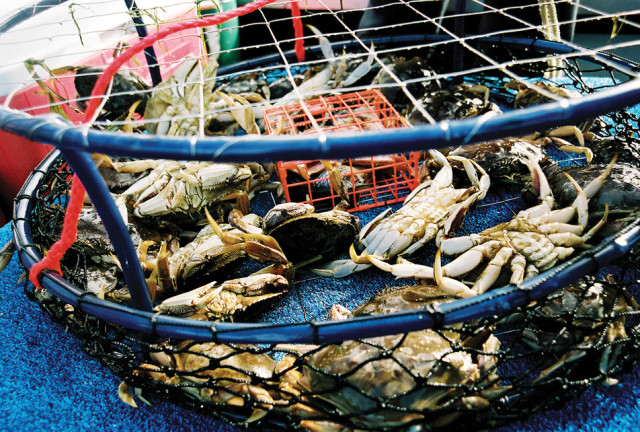
The six of us finished our day with a record 63 Dungeness, which took four hours to cook and shell back at the beach house. Toward the end of the marathon crab-cracking session, we ran out of containers and started filling even the smallest cups and bowls. The subsequent feast was worth all the work. We gorged ourselves on crab pizza, crab dip, and just plain crab with butter and lemon juice—and held cold beer bottles to our sore shoulders.
More wisdom: The messy preparation of crabmeat makes renting a spacious, well-ventilated beach house instead of a hotel room a smart choice. Also, the extra $85 cleaning fee is money well spent.