Suburban Like Me
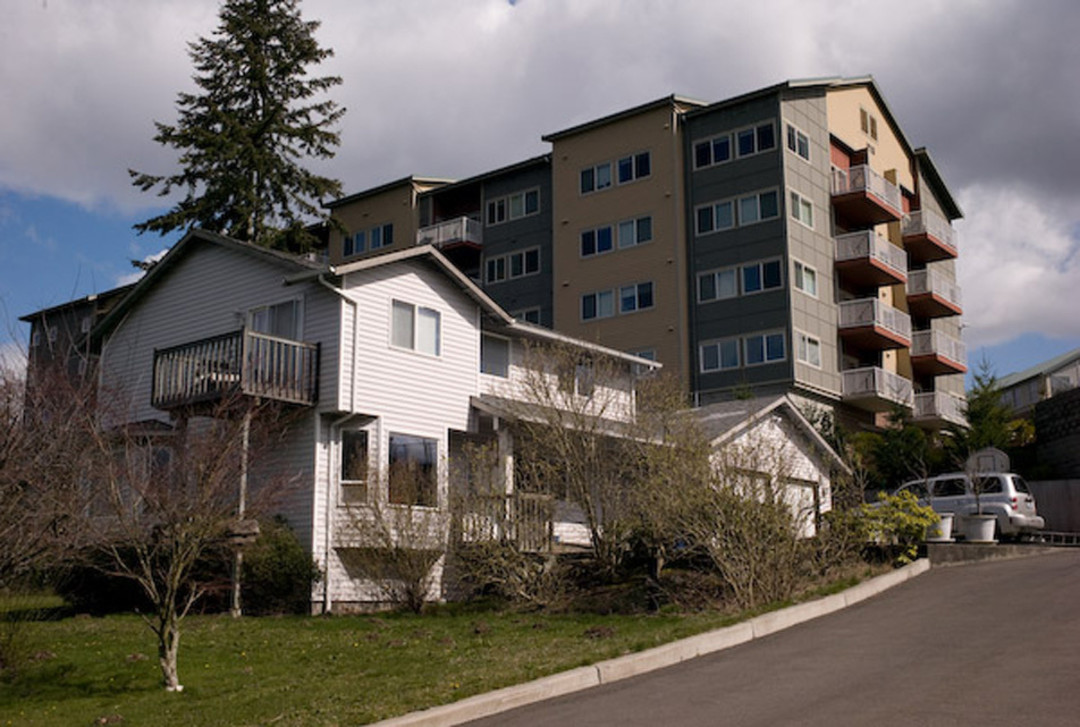
Image: Charles Peterson
THE VIEW FROM TERRY QUICK’S front door is not what it used to be. Once he saw fir trees, hummingbirds, and an occasional bald eagle. Now he gets an eyeful of a four-story apartment building, completed in 2004 after Snohomish County rezoned his low-rise neighborhood just outside the Lynnwood city limits for high-density, mixed-use redevelopment. The new zoning allows up to 50 housing units per acre—as many as in Seattle’s densest neighborhoods. Where ranch houses laze under tall trees, eight-story buildings may now legally rise.
The reactions of those who live the suburban life in these would-be urban villages range from gloom to anxiety to screaming terror. Quick, and it seems everyone else in South Snohomish County, worries about suburban decay—about noise, light pollution, and the loss of trees and green spaces, not to mention eight-story buildings erupting in their backyards. Some have gone so far as to suggest that Snohomish County change its logo, which shows three trees, to three stumps. County officials insist that the long-range vision is worth the upheaval: If we replace far-flung subdivisions with compact development that gets people out of their cars and onto transit, the population explosion can be accommodated without horrific traffic jams or the wholesale loss of open space. Smart-growth advocates argue that allowing suburban depredations to continue would degrade the environment, worsen traffic, kill inner cities, and deaden our souls. They say that sprawl must be eradicated, and Terry Quick and his neighbors are sprawl.
I should say at the outset that I, too, am sprawl. I grew up in suburbs, and I now live just a few miles from Terry Quick in a neighborhood not unlike his. Sub-urbanity has bookended my life; in between I lived in cities, and that has informed the writing I’ve done about architecture and the built environment. Until now, I’ve taken as gospel that mixed-use, pedestrian-scaled human habitats should be our ideal. And those are what county and municipal governments propose to create: As the region grows and Snohomish County’s population swells (it’s expected to reach nearly a million by 2025), close-in suburbs like Lynnwood, Edmonds, and Mountlake Terrace must comply with the state Growth Management Act and grow up, not out.
Image: Charles Peterson
Newberry Square, the complex now looming beside Quick’s house, has brought some welcome urban amenities to this unassuming landscape of subdivisions, strip malls, fast food, and Wal-Mart: an organic butcher, a high-end pet-supply store, a sleek café with free Wi-Fi. Newberry Square broadcasts its aspirations, or pretensions, in the names of its various apartment models: the Fremont, the Leschi, the Madison Park. It charges rents to match, starting at $820 for a studio. On the other side of the freeway, Newberry’s developer, Sundquist Homes, markets its DiModa subdivision as "urban style, suburban price"—starting in the mid-$300,000s. This is an urbanism that’s at least as much about style as substance—but fine, though I’m not interested in hip condos, I do like handmade sausage.
Still, after seeing the real anguish of people like Quick—and experiencing a little density angst of my own—I’ve begun to doubt the "can’t make an omelet without breaking a few eggs" avidity with which these suburban renewal projects are being pursued. And to wonder whom, exactly, they will benefit. Even as housing prices rise for newcomers, the area’s home-owning middle class shudders at the specter of sinking property values. Quick says prices for single-family houses have already started eroding on his block, now that the likeliest buyers are developers who only want the land beneath them. "You’d never want to buy this as a private residence now," he says, pointing to the house across the street from his, over which the apartment complex looms 60 feet. "And the builders won’t pay what the property is worth." County tax rolls show that property values in the subdivision have generally risen over the past three years. But the way Quick sees it, developers have the neighborhood over a barrel. "They’ve been paying, on average, $17 a square foot for land," he says. "A $550,000 house becomes a $250,000 house." Last year Quick convinced most of his neighbors to band together to sell their property as a package, rather than waiting to be picked off one by one. Their hope—as yet unrealized—is that a large builder with deep pockets will pay top dollar for the chance to raze and master plan the entire subdivision. But already, the first dominos are threatening to fall: Applications to build infill on two parcels are on file with the County. If these projects go forward, Quick’s plan could be doomed.
You can rail about cultureless wastelands, but that fails to describe what’s really going on in Lynnwood, Renton, even Bellevue.
When I was a kid, if someone had built a condo tower in our cookie-cutter development, I would have cheered out of sheer spite. I grew up in deepest, darkest suburbia: Kirkland and Bellevue in the 1970s and ‘80s, before the arrival of such neo-urban amenities as pedestrian corridors, transit centers, and street-oriented boutiques. My parents, scrabbling for a foothold in the middle class, found affordable housing and decent schools there. Sometimes, on dull Sundays before I could drive, my mom would convince me to walk the two miles to Bellevue Square with her. We’d edge along gravel shoulders with traffic whizzing by, get an Orange Julius, and then trudge home. In my high school years I was drawn into the orbit of the city, slipping away to spend weekend nights at two of Seattle’s first punk clubs, the Monastery and Metropolis. It was exhilarating, though there was always the risk of missing the 12:50am bus home and getting stuck in Pioneer Square all night.
{page break}

Image: Charles Peterson
When I left for college, I vowed never again to live in such a soul-sucking environment as Bellevue. I settled in a string of real cities: Manhattan, New Haven, New Orleans, Miami. Last year, after two decades away, I came back to find that Seattle had gotten rich and glamorous, and I had gotten priced out of urbanity. I was shocked to find that even Lake City and Shoreline—places that were just as sprawling and uncool as Bellevue, but cheaper—were out of our league. So we lit out for the territory, South Snohomish County, and I wound up living near Lynnwood in a 1970 split-level on a third of an acre. It’s very much like the house I grew up in, only it cost five times as much. Call it "suburban style, urban price."
While I was away the suburbs came under heightened attack, and not just from restless teenagers; environmentalists, social critics, and smart-growth boosters have all piled on. Lately the derision has taken a personal turn: Not only is sprawl bad for the environment and social justice, it also makes us fat, depressed, and more prone to Columbine-style massacres. Suburban building patterns make life "seem less satisfying to most Americans," Andres Duany and Elizabeth Plater-Zyberk, two pioneers of the New Urbanist movement, charge in their influential 2000 book, Suburban Nation: The Rise of Sprawl and the Decline of the American Dream. The typical suburb is "depressing, brutal, ugly, unhealthy, and spiritually degrading," James Howard Kunstler writes in a book whose title says it all: The Geography of Nowhere. Not only couldn’t I afford to be environmentally and socially conscious in my housing choices, it seemed I couldn’t afford to be spiritually fulfilled.
Primed by antisuburban ideology, I half expected to find myself trapped in a South Snohomish version of American Beauty. But, to my surprise, I didn’t feel isolated or depressed; I felt pretty content, and so did the rest of the family. We finally had room for all our stuff (I know, first-world consumerism, yada yada yada), and I rather like driving into my two-car garage when it’s pouring out. My street has a more rural and less uniform feel than the Eastside of my youth: mature woods, lots of wildlife, and a wide array of houses, from humble to haute bourgeois. The large lots and semicountrified, mind-your-own-beeswax ethos partly mask the socioeconomic differences. Goats graze in a little pasture at the end of the street, and in summer a crowing rooster wakes me at six. The human variety is likewise richer than you might imagine out here on the fringes of supposedly homogeneous Lynnwood. Yes, we have black people, including some of the neighbors on my street—and Asians. About a mile from my house, an ornate Buddhist temple, with a beautiful statue of Guan Yin out front, peeks from a wooded hillside; across the Lynnwood city line is an Islamic center. There’s also strip mall after strip mall, which upon close examination reveal an incredible array of ethnic goods and services: the Khemara Market, Mis Potrillos Western Wear, Pal-Do World supermarket, the (Eastern) European Food Store. Driving through town, I see folks in Suburbans zipping in and out of Alderwood Mall and folks in turbans walking their kids home from school.
The only negative feelings I had about winding up here were shame at the unfabulousness of my new zip code and guilt at the thought that I might be destroying the earth. But according to the most apocalyptic antisprawl scenarios, I will soon be punished for my bourgeois crimes when energy shortages make the burbs go down the tubes or up in flames. I try not to think about that too much. Besides, I’m not convinced that a 30-story condo tower is going to be such a great place to be after peak oil, either. At least I can open my windows.

Image: Charles Peterson
These days, antisprawl ideals are widely embraced, especially in the Northwest. But like all pieties, they have their contradictions. Density will relieve congestion? Actually, transit ridership doesn’t increase as fast as density, so upward growth typically makes traffic worse; look at Manhattan. Suburbs suck inner cities dry? Then why have neighborhoods like Belltown, downtown, and the Central District boomed even as the shadow of sprawl stretches out past Sammamish? Growth management has also been charged with making real estate prices skyrocket and imposing undemocratic controls on our lives. I’ve always been a good progressive on matters like transit and sprawl, but now that my middle-class income no longer buys a place in the ranks of smug urbanites, I find the claims of the anti-antisprawl movement harder to dismiss.
Of course the smart-growth advocates have answers. They contend that in-city gentrification results from market demand and lifestyle choices, not growth management. They acknowledge that density will increase congestion in the short run but insist it will improve matters long-term by enabling (or forcing) more people to take mass transit. Our rush-hour agonies are small change anyway, they say; more density means fewer miles driven, which means fewer greenhouse gases produced. And that’s the movement’s trump card. Who’s for more greenhouse gases?
According to the most apocalyptic scenarios, I will soon be punished for my bourgeois crimes, when the burbs go down the tubes or up in flames.
Certainly not I. But Robert Bruegmann, the author of Sprawl: A Compact History and a prominent questioner of smart-growth assumptions, told me that changing people’s habits has proven much harder than density hawks like to suggest. "Outside the very densest cores of cities like New York and Chicago, it is much faster to go by car than to take transit," he says. "As people become more affluent and value their time more, they are very unlikely to take transit unless it can compete with the auto in speed and comfort." Indeed, my stepfather, who lives in a downtown condo with about the same square footage as my house (and floor-to-ceiling glass that obliges him to turn on the air-conditioning when the sun comes out), now reverse commutes across the 520 bridge every day. He can afford the gas, even if it goes up to $5 a gallon. Granted he’s just one man, and it may be that once we’re all living in compact communities (this means you too, Magnolia and Laurelhurst), we’ll stop driving so damn much. But what if high-rise condos replace sprawl and we stay wedded to our cars, with my stepdad’s story replicated a million times over? Then we’ll really see some traffic.
Still, the environmental critique is valuable, even if sprawl’s a more complex problem than some critics are willing to admit. It’s harder to uphold the familiar cultural attacks on the suburbs. Sure, you can rail about cultureless wastelands whose bored inhabitants have nothing to do but drive around, eat at chain restaurants, and shop at the Gap. But if you take an honest look, you’ll see how such language fails to describe what’s really going in Lynnwood, Renton, even Bellevue. The boundaries between suburb and city are eroding. Seattleites may still sneer at "white-bread" Bellevue, but according to the latest census data, both cities have roughly the same share of nonwhite residents. "Ugly" strip malls may assault sophisticated sensibilities, but urban chowhounds now make ethnic-food pilgrimages past the city limits, to where Mexican lonchera trucks bump up against Korean soft-tofu palaces. The Gap in downtown Seattle is just like the Gap in Lynnwood. And sometimes, after visiting friends in, say, Phinney Ridge, where everyone seems to be whitish, 40-ish, pushing an expensive stroller, and foraging for local microgreens and artisan cheeses, I’m relieved to come home, let my hair down, and shop for factory-farmed cabbages alongside the Korean grannies at Pal-Do World.
{page break}
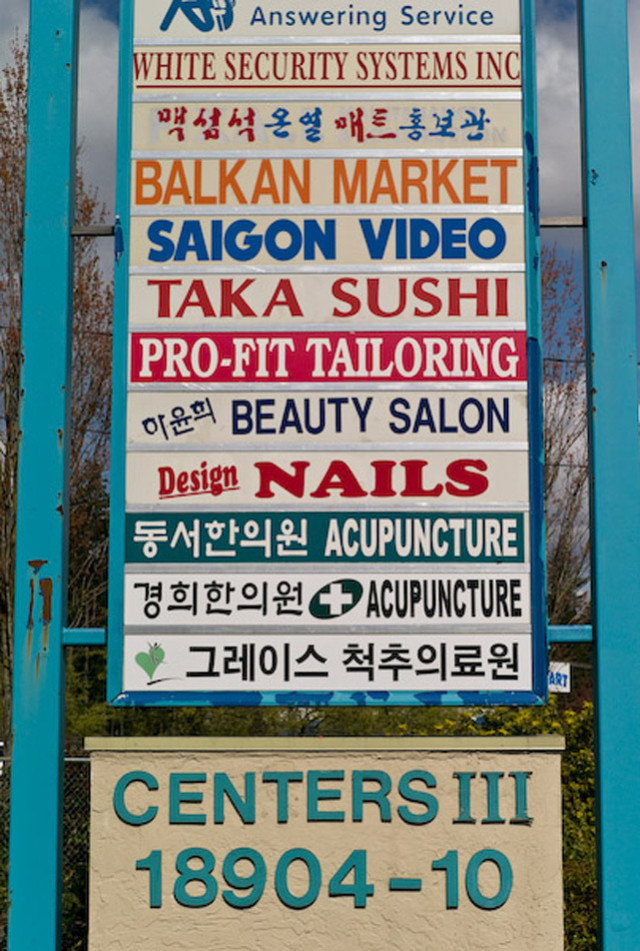
Image: Charles Peterson
If Lynnwood isn’t a suburb, though, it sure doesn’t feel like a city in the traditional sense of the word. So what is it? Academics have strained to devise new labels for communities like this. Rutgers University’s James Hughes calls them "horizontal cities," with just as much life and commerce as the vertical variety. The influential German planner and author Thomas Sieverts would probably consider Lynnwood a zwischenstadt, an "in-between city" unmoored from the old concentric hierarchies of city, suburb, and countryside.
Lynnwood for its part doesn’t seem to realize how intriguingly cosmopolitan—how cool, in a sense—it already is. With eyes fixed on the prize of Real City status, it’s under-going a full-on identity crisis as it tries to decide how to emerge from the Brady Bunch era. Small wonder: The place is under a lot of pressure. State growth-management policies demand that Lynnwood densify, and the public clamors for lively "towne centres" instead of drab strip malls. Real estate economics complicate matters further: Those unfashionable commercial districts slated for the bulldozer host paying tenants who will be swept aside by redevelopment. The new buildings that rise in their place must generate enough income to compensate property owners for those lost rents, plus the costs of demolition and construction. The usual solution to this dilemma: Build higher.
Lynnwood is not the only South Snohomish municipality jumping on the citification bandwagon: Mill Creek has a new mixed-use town center, and Mountlake Terrace has rezoned a swath of its core, such as it is, for more density. But it is the most ambitious. Over the next 20 years, Lynnwood’s City Center redevelopment plan, passed in 2005 and zoned into place last July, aims to transform a 300-acre chunk of downtown Lynnwood into a commercial and residential mecca. Though today’s tallest building stands just six stories high, skyscrapers may rise now up to 34 stories, with shops, cultural attractions, and parks to rival downtown Bellevue. "It’s an exciting time to be working in Lynnwood," says city planning manager Kevin Garrett.
I have a vision of myself at age 80, a hunched old lady trapped in a decrepit split-level ranch, hemmed in on all sides by towering skyscrapers.
I, too, am excited at the prospect of living in a Real City once more, even if it may not be finished until I’m 60 and ready to retire to a condo in Belltown. At the same time, I wonder if Lynnwood will be able pull off such a wrenching transformation without losing the unique brand of class- and ethnicity-mixing urbanism it already has. And I’m not sure antisprawl folks are ready to address this question.
When I asked the Canadian smart-growth guru Gordon Price, director of the City Program at Simon Fraser University, what might happen to ethnic vitality when the place is lousy with skyscrapers and bistros, he got kind of annoyed. "People get very dismissive of yuppies and gentrification and categorize this stuff as for the rich," he says. "If it’s a tower full of condos at 600 square feet, that’s not gentrification—that’s workforce housing. If you dismiss that because they displaced someone else, you are left with no alternatives." Maybe, but no one I interviewed said anything about building 600-square-foot condos around here.
So I asked Lynnwood City Council member Ted Hikel if the City Center plan included any provisions for affordable housing. He told me that "the City is not in the housing business." If Bellevue’s any guide, mom-and-pop businesses and low-to-middle-income families will be forced to move farther out as Lynnwood urbanizes. Flipping through current real estate listings for condos built in downtown Bellevue since the late 1990s, I couldn’t find one smaller than 1,400 square feet or cheaper than $600,000. Some developers are making an effort to incorporate smaller, lower-priced units into new projects: Bellevue Towers, twin 42-story towers set to be completed in 2009, offered a handful of studios priced in the mid-$300,000s during the preconstruction phase. Now, the lowest-priced unit is a 943-square-foot one-bedroom for $479,000. I suppose it might be possible to live there with two kids, a dog, and a cat. But I’d rather not find out.
Right now, with the real estate market in crisis, no one is exactly lining up for condo tower building permits in downtown Lynn-wood. "We’re hoping to catch the next wave," says Garrett, the city’s planning manager. "And we think we’re well positioned to do so." I decided to head over to Bellevue to see where that wave might wash us up 20 years down the road, if we do manage to catch it.
My first stop was the home of Renay Bennett, just south of downtown in the Bellecrest neighborhood. Bennett’s house sits at the end of a long driveway and has a private backyard with an expansive deck and mountain views. It’s no McMansion—it’s an older house that’s been tastefully updated and carefully maintained—but the setup seemed pretty sweet. If I were selling real estate, I’d call it "Suburban Seclusion, Steps from Downtown!"
Bennett, who’s president of her neighborhood association, has fought to keep it that way. Downtown’s growth has brought traffic, parking problems, and attempts to rezone the neighborhood for density despite the city government’s avowed commitment to preserving single-family communities. Bennett was part of a group that successfully sued the City of Bellevue to stop it from exempting neighborhood strip malls from traffic concurrency rules, which require that transportation infrastructure keep pace with new development. She also participated in a failed effort to block a multifamily development near her neighborhood. "I don’t know that density is necessarily what people here want," she says. "People in the suburbs move to the suburbs because it’s the suburbs. And we like it."
{page break}
Image: Charles Peterson
The emergence of a small metropolis half a mile from her house hasn’t altered Bennett’s lifestyle much. "I think some people [in the neighborhood] walk downtown, go to dinner, go to the movies," she says. "We don’t, really." Instead she now drives more to get her daily business done: The City has promoted downtown development, but downtown has grown at the expense of neighborhood strip malls, many of which are dying or trying to reinvent themselves in the face of neighborhood opposition. Driving downtown to go grocery shopping is a hassle, she says, but with a family to shop for, walking or taking the bus is out of the question. It would be an okay walk, now that sidewalks line the entire route, but not pushing a grocery cart.
After meeting with Bennett, I drove the 1.2 miles from her house to Bellevue Square to check out the new urbanity. I hadn’t spent much time in Bellevue since my parents got their Seattle condo, and a lot has changed, at least on the surface. It was a nice day, and Bellevue Way was full of people walking purposefully, people strolling idly, people glad to be out with their raincoats off. My unscientific poll revealed that many were office workers running errands on their lunch breaks, joined by a few condo dwellers and tourists from Idaho. All seemed enthusiastic about the convenience and liveliness of the new downtown. It was hard not to be, out there on the bustling sidewalk, in the sunshine.
After walking up and down Bellevue Way a couple times, though, I wasn’t sure what to do with myself. The sidewalks a few blocks east of the mall were empty and uninviting. I wandered through Crate and Barrel and the Container Store. I peered into P. F. Chang’s, which was packed with a business-lunch crowd. And I found myself drawn inexorably into Bellevue Square: Although it’s been turned inside out to offer storefronts on Bellevue Way, the mall is still the real focus of downtown life. Before I knew it, I was inside shopping, not outside mixing it up with other pedestrians.
Needless to say, there were no Khmer groceries anywhere in sight. For that sort of thing, you have to head out of the vertical and into the horizontal city, which in Bellevue means Crossroads, the once-failed shopping mall that visionary developer Ron Sher remodeled as a "third place" community hangout, with touches inspired by the area’s polyglot population. I drove there and got a bowl of bibimbap in the food court. The friendly Korean-American girl who served me showed me the Spanish-English dictionary she was studying. As I ate, I watched men from India, Iran, the Philippines, Russia, and Mexico slurp noodles and play chess and grannies of many nations push strollers around. Cheap strollers. To a born-again zwischenstadter like me, it felt like home.
Yeah, yeah, I know: Smart growth isn’t about authentic Asian delicacies or Bengalis playing board games with Chileans. It’s about saving the planet. But if I have to give up my bibimbap, I want to be sure I actually get transit and walkability in return, something many South Snohomish County residents doubt will ever happen. After all, even Bellevue still has a ways to go on that stuff. If higher density in relatively undeveloped parts of Snohomish County is not accompanied by the services (super-markets, banks, fire stations), infrastructure (roads, sidewalks, bus routes), and amenities (parks, community centers) that would make it workable, we could end up worse off than in the bad old days of stupid growth.
The County in particular has tended to zone first and plan later (if at all). That tendency alarms the municipal governments that will eventually annex a lot of county land, plus the headaches that come with it. Last year Snohomish cities asked the County for a moratorium on "air condos," the densely-built single-family developments that have sprouted on unincorporated land like mushrooms after a spring rain, until services and infrastructure can be planned to support them. The County refused.
"They are still following the old suburban model of having each developer responsible only for his own piece of street frontage," says Keith Maw, a Lynnwood city planner who liaises with the County on density projects. Without better planning, Maw says, the County’s urbanization initiatives are in danger of devolving into isolated town-house complexes with no pedestrian circulation—i.e., more sprawl.
I live in an unincorporated area, and I recently discovered that the County plans a new "Urban Village" less than a mile from my house. This could be a boon, if it attracts some decent stores. But something else is coming to the neighborhood—to the end of my currently dead-end street, in fact: 146 single—family homes, zoned the same as mine but much more densely packed, thanks to a trick called lot-size averaging that lets developers include common open areas and buffer zones in their calculations. Since many of the surrounding roads have no sidewalks or through connections (my street will have to be widened to accommodate the added traffic, but county code doesn’t require a sidewalk), I expect the 300 or so newly minted suburbanites living there will drive to the Urban Village and everyplace else they go. Contemplating such perverse outcomes, Kristin Kelly, Snohomish-Skagit program director for the smart-growth group Futurewise, shakes her head: "I just don’t think [smart growth] has really been actualized in this county. And it may not be for years and years."
Neighborhood activists say they’ve uncovered shortcomings in the plan: environmental, traffic, drainage, and so on. (Full disclosure: I have attended meetings of the Gravenstein Neighborhood Group, the nonprofit some of my neighbors founded to fight the development. I have also e-mailed county officials on the issue and donated $200 to the group’s operating fund.) Smart-growth skeptic Robert Bruegmann would call this group an "incumbents’ club," intent on protecting their slice of the land-use pie and denying others the right to build. "The only thing people hate more than sprawl is density near them," he snorts. He may be right: I do sense a bout of nimby angst coming on at the thought of all those new houses, cars, and people. What if all the other neighbors with more than an acre sell out to developers and those on smaller lots, like me, are left behind? I have a vision of myself at age 80, a hunched old lady trapped in a decrepit split-level ranch, hemmed in on all sides by towering skyscrapers.
{page break}
But my anxiety is chased with despair. Old-fashioned, uncontrolled sprawl like that in South Snohomish gobbled up lots of wildland, but it also left untouched pockets where building would be difficult and costly. Now many of those pockets fall within urban growth boundaries, and smart growth targets them too. The new subdivision will replace 80 acres of mature wetland forest blanketing the hillside above an ecologically sensitive floodplain and a county park. It’s the prospective loss of that open space, more than "density near [me]," that has prompted me to get involved in the antidevelopment struggle. Neighbors say there’s a black bear living there, and a heron rookery.
Streams running through it feed North Creek, where chinook salmon come to spawn. If the developers win, pretty soon I’ll have to watch that forest cut down and trucked past my doorstep. If that happens—and we don’t get the sidewalks and lampposts and street trees that are supposed to offer consolation—I might as well be living in Bellevue circa 1983.
Then I remember that this isn’t the first time I’ve caught a nasty case of Subdivision Affective Disorder. When I was a kid, living in a brand-new development at the top of Kirkland’s Finn Hill, I used to pass a row of horse pastures on my way to school. For years, my dad would take my brother and me on late-night walks there, up a narrow path between the fenced-off fields and over the crest of the hill to where we could see the moonlight shimmering on Lake Washington. In the late 1980s developers started carving up the pastures into cul-de-sacs, and I railed against the paving-over of such bucolic beauty. My father quickly shamed me out of my youthful self-righteousness. "Ten years ago," he said, "there was a horse pasture where our house is too."