Get Rich Slow

Make sure your money manager is qualified.
Image: Johnny Ryan
OH, IT GOT UGLY. In the dark days of March 2009, no one knew, from an economic standpoint, what would happen next. And it’s not like that’s all over. “We’re not out of the woods yet” is the message the media relays day after day, spooking us with talk of a double-dip recession and unemployment rates that just won’t budge.
But what does it mean for your money? Talk to leading wealth managers, and they’ll say smart financial practice is the same as it ever was: to diversify stocks, think long-term, pay down debt, revisit your portfolio every quarter. But history shows that when a financial bust or boom hits, common sense is often the first thing to go. To get you thinking like a pro, we wrangled 15 tips from three local financial advisors: Ken Smith, a wealth manager with a proof-in-the-pudding philosophy; Therese Govern, a retirement guru who preps clients for the golden years; and Dennis Daugs, a plain-talking moneyman who handles some of our city’s biggest portfolios.
1 Forget the double dip.
We might fall into another recession; we might not. Bottom line: You will never benefit from investment decisions made using short-term, fear-based thinking. The market rises and falls, says Ken Smith, CEO of Seattle-based Empirical Wealth Management, but wise investors think in terms of lifetimes.
2 While you're at it, forget the last crisis, too.
Smith says he’s seen a slew of new financial products from Wall Street that would have solved the subprime mortgage crisis. But solutions to yesterday’s problems can’t help now. “After the tech bubble burst [in 2000] it was hedge funds,” says Smith. “Those haven’t done well either.” Don’t fall victim to investment “opportunities” that prey on recency syndrome, our tendency to project current (and often temporary) financial realities into the future.
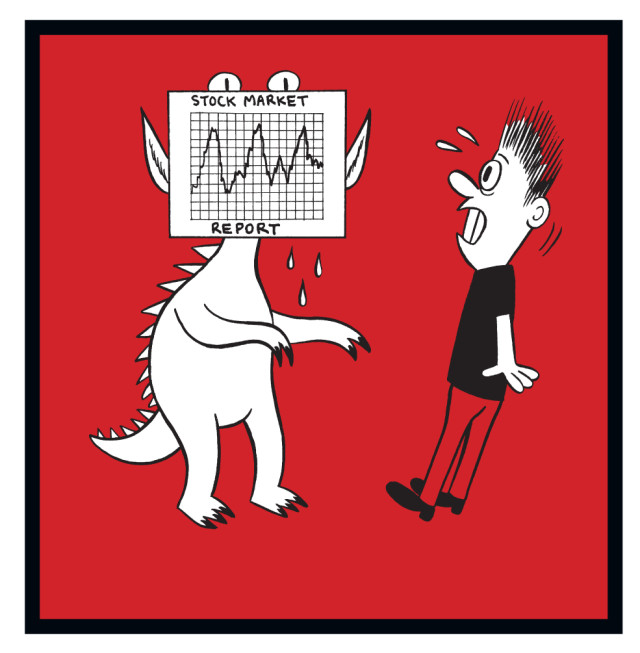
Don't panic during dips.
Image: Johnny Ryan
3 Accept unpredictability.
Therese Govern, a personal finance advisor at TrueNorth Financial Services in Seattle, has seen colleagues turn to tactical allocation, really another name for market timing—strategically buying or selling stocks based on market predictions—and it’s the sort of thing clients like to hear about after they’ve lost money in the market. “I understand why advisors are attracted to that idea, but it’s hard to pull off,” says Govern. If you don’t let a psychic make your personal decisions, think twice before you trust a market diviner to handle your financial ones.
4 Know your financial advisor.
Is your financial advisor fee only, or does she get a kickback when she sells you something? Is your go-to guy a certified financial planner (CFP)? Has he taken a fiduciary oath? If you’re working with someone who is claiming a niche—she specializes in advising doctors, say—what makes her an expert in that industry? People often find their money managers by word of mouth from wealthy friends, but remember, cautions Smith, that’s how Bernie Madoff ended up with so many clients.
5 Know yourself, too. And insist that your financial advisor know you.
Financial advisors think about risk in two ways: capacity and tolerance. Risk capacity relates directly to your financial situation. Bill Gates, for instance, could lose 50 to 60 percent of his net worth and still live comfortably. He has a high risk capacity. Risk tolerance, on the other hand, is about how much risk you can handle. Maybe Gates gets depressed and loses sleep when his stocks plummet. So even though his risk capacity is high, his tolerance is low. It’s easy for your financial planner to calculate your capacity, but she should know tolerance, too, and help you put together a portfolio that won’t have you tossing and turning.
6 Remember that you are human.
In boom times people take unnecessary risks with their money and spend too much; in bad times they are gun-shy and lose out on potential profits. We are human—that’s how we roll. But it shouldn’t be how we invest. To guard against emotional decisions (Buy! Sell! Run! Hide!), write an investment policy statement that details your long-term goals and expectations, and revisit it during quarterly reviews with your FP.
7 Be accountable.
When investments go belly-up, says Dennis Daugs of Lakeside Capital Management in Seattle, people tend to point the finger. Yes, subprime lenders got greedy, yes people borrowed irresponsibly, yes we all paid the price. But at the end of the day, your money is your responsibility. Financial advisors say they often caution clients about overspending for years, but their warnings fall upon deaf ears. Then the market collapses and the client wonders what went wrong. The sooner you start frankly assessing your own financial decisions (including mistakes), the sooner you’ll make better ones.
{page break}

Don’t forget your investment policy statement.
Image: Johnny Ryan
8 Learn from history.
Old money people tend to do all right during downturns, says Daugs. It’s a been there, done that sort of a thing. If you’re new to wealth or aspiring to it, you have to level the playing field by studying economic history. Read The Wall Street Journal, read The Economist, and if you’re working with an FP, ask him to suggest some books to help you bone up on your econ. (If he doesn’t know any, run.) “If you want to treat the market like a casino, be on the side of the house,” Smith says. “Knowing the odds is how you cross the line from speculation to investment.”
9 If you're young, save.
Govern says that by the time people reach their early 30s, they should be socking away 10 to 15 percent of their income regardless of their economic situation. And while you don’t have to iron out the minute details of retirement quite yet, make sure you’re taking full advantage of 401(k)s and employer-matching opportunities. There’s little reason for people in their 30s to worry about recent tales of 401(k) losses, says Govern. When the investment horizon is long, stay in stocks.
10 If you're old, keep working.
Govern is a big proponent of setting up some sort of income after retirement. “Even if you’re not making what you did,” she says, part-time work can keep you from dipping into your savings too early, and give your portfolio more time to recover after a dip.
11 Don't reach for higher-yield bonds.
“In the ’80s,” says Daugs, “everyone had 9 percent bonds. Then the interest rate went down to seven, but people still wanted nine, so they bought risky bonds. Now people say ‘find me seven.’ ” But those high-yield bonds are too risky, says Daugs. Look for short-term, quality bonds, even at 3 to 5 percent, and “know that the product you’re buying is safe.”
12 Gold probably can't save you.
Gold is attracting investors like crazy these days—the price of the precious metal hit a high of more than $1,250 an ounce at the end of this summer. Since it retains its value over time, gold may seem like a hedge against inflation and volatile markets, but it’s been one of the worst-performing assets throughout history, according to Smith. And in the short term, its value tends to fluctuate wildly. If you’re one of those gold buyers who is preparing for the Armageddon, think it through. “So the end of the world is coming,” says Smith. “What good will it do you? We’re going to be scrounging for food, not exchanging gold bars.”
13 Think globally.
A properly diversified stock portfolio doesn’t just spread the wealth over a variety of industries, says Smith, it includes stocks from all over the globe. Money managers tend to invest heavily in the region where they live. (Atlanta advisors are overinvested in Coca-Cola, Northwest planners buy too much tech), so make sure your FP isn’t thinking too close to home. “Don’t put all your eggs in one country either,” cautions Smith.
14 Don't follow the herd.
In finance, says Smith, “whatever is doing well at the moment, you’ll see a bunch of new products. But by the time investors buy them, they’ve usually already peaked out.”
15 Embrace the new order.
College kids who maxed out credit cards; entrepreneurs who budgeted $600,000 in discretionary funds and spent a million; young couples who bought too-pricey condos and ended up in foreclosure: Across the spectrum, we spent the last few decades spending too much. That era is over. “For the first time, our generation understands the way our grandparents acted during the Great Depression,” says Daugs, and we need to get used to it. “Learn how to cook instead of eating in expensive restaurants, buy a 15-year-old Mercedes, no one is going to hassle you about that car and you can get it for $4,000. When you own a property, work on it, make it better, and create value.”