Paris on 12th Avenue
TWENTY-FIVE YEARS AGO as a student in Paris I was sitting in a breezy riverside café in the midafternoon, chewing idly on a baguette, wondering about my friends back home—when it occurred to me that none of them was likely to be sitting in a café in the midafternoon, chewing idly or otherwise. Americans didn’t sit in cafés in the midafternoon. It was the epiphany all expats in France inevitably experience: French people eat differently than we do. But this time it wasn’t centered on the usual observations that they eat superior food, less of it, and slower. No, this time I was struck by the fact that they gathered in third places as a natural part of their day, often over a café au lait or, in the French parlance for snack, a casse-croûte. Cafés were vital community spaces where conversations lively or intimate could flourish, places providing public stage sets for the commingling of private lives. Remember Seattle circa 1982? Not so many places like that around here back then.
Intervening years ushered in the coffeehouse rage and a new informality in the way we began to regard restaurants. Gradually they were becoming less like destinations and more like stops on the journey. Along came spots like Le Pichet, an informal French restaurant on a leafy stretch of First Avenue where an all-day menu encouraged the kind of drop-in noshing familiar to Europeans. It quickly became the little black dress of Seattle restaurants—simple, classy, as right for a solo baguette and coffee as for a big date dinner.
And now, seven years on, Le Pichet’s owners Jim Drohman and Joanne Herron have created their chaser. Café Presse is Pichet’s kid cousin, less little black dress than little French T-shirt. It’s the latest of the many new-generation joints on the stretch of 12th that connects Capitol Hill and First Hill (Licorous, Osteria La Spiga, Café Stellina), this one enlivening the piece between Madison Street and Seattle University.
And if you didn’t know it was next to a college, you might guess it anyway. A rack of international broadsheets and magazines greets you at the door. (Hence Café Presse.) Just don’t come expecting something hushed and academic. At any given moment within any one of Café Presse’s epic 19-hour days, a visitor will undoubtedly spy the laptops of those who’ve taken to using the café as study hall with caffeine drip. (As we went to press, Drohman had hired contractors to install more power outlets.) Interspersed among the students on one visit was a romancing couple with matched piercings who canoodled over plates of salade niçoise and steak tartare. At the bar a gaggle of French soccer fans watching a game shouted over plates of olives and pints of Alsatian lager. On a slow swivel I spied a group of graduate students in flip-flops engaging the tattooed bartender; an elderly German tourist pronouncing the rillettes de porc the best he’d ever had; and a young family of five, Daddy manfully attempting to keep Junior from planting his stubby toddler finger into the next table’s chicken liver terrine.
One big happy world family, their voices swelled to one big happy urban roar under the high-timbered ceiling of an old, raw-beamed, brick-walled building reinforced with girders and lit with soaring windows. I sat in the front room, with its long bar, its game on TV, its skylights leaking cloud glow, its most casual of casual diners. Down a hall the place opens up to the more restaurant-y of the rooms, with olive-green tables, bench seats, baguettes sprouting out of baskets, and ancient long-limbed trees out the windows. This is the room a diner can reserve in—though not every table. For Drohman and Herron, drop-in-ability was essential to their vision for Presse.
{page break}

Drop in anytime The owners will welcome you to their casual hangout.
Sitting solo at the bar in want of something French and lemony, I placed myself in Mr. Tattoo’s hands. Moments later he brought forth a Corpse Reviver No. 2, a transporting alchemy of Lillet Blanc and Cointreau and gin, breathing a float of Pernod. Mr. Learned Tattoo then regaled me with the history of the cocktail (it won World’s Best in 1896), the mysteries of bitters, the kitchen’s way with steak frites. There at the bar I crunched a crumple-leafed bibb-lettuce salad, strewn with halved hazelnuts and drizzled with a sweetly savory sherry-hazelnut vinaigrette, and I tried that steak frites—a rustic composition of natural hanger steak, crisped at the edges and blushing within, served in a richly shalloty reduction shimmering with butter, sweet with Madeira, magnificent with frites. The bill came to $30.08.
Café Presse is Le Pichet’s kid cousin, less little black dress than little french t-shirt.
And so I returned, often, with friends, at all times of day, for more simple, affordable, luscious food. Often the table wasn’t exactly large enough for what we required. Like the evening we took inventory, and discovered to our shame that we were eating a smooth brick of chicken-liver terrine with a seam of sea salt, tart cherry compote, mustards, and cornichons on the side; a croque monsieur, bubbling with Gruyère and béchamel; a daily special of fresh green beans with pine nuts and sherry vinegar; a bowl of bright, briskly refreshing tomato soup with a floating chèvre crouton; and that German fellow’s beloved rillettes, a coarse version heady with cinnamon, clove, and juniper, decadent over a tear of baguette. Oh yes, and the baguette—made at Grand Central Bakery according to Presse’s secret recipe. And two scoops of perfect nectarine sorbet, housemade.
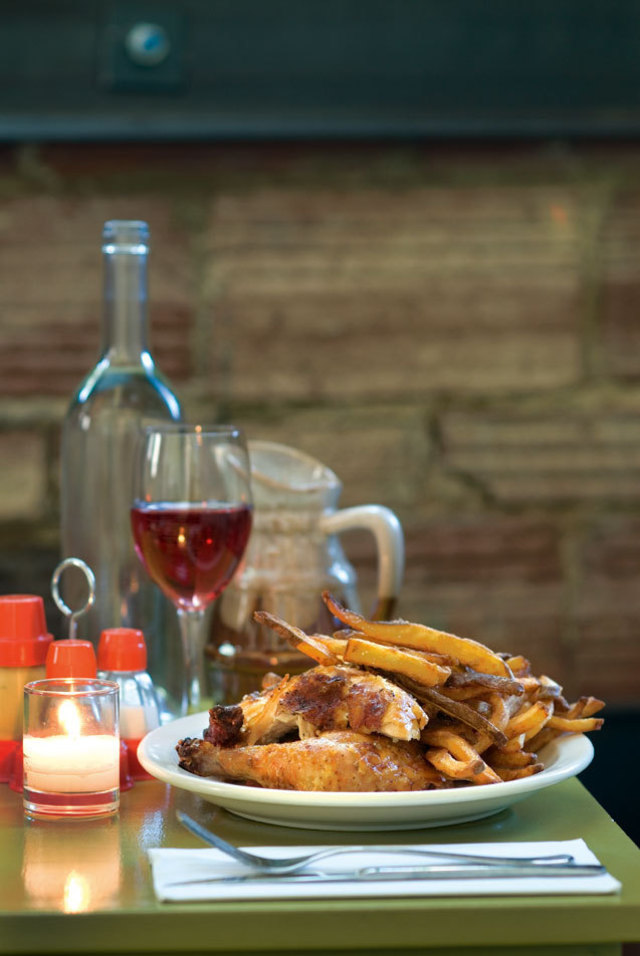
The owners had the good sense to import Pichet’s roast chicken, a civic treasure that takes an hour to cook and is worth twice the wait, for the flavor-drenched crackle of its skin and the succulence of its flesh. It’s one of several dishes Presse has in common with Pichet—egg dishes, cheese plates, charcuterie, and other nibbles off the casse-croûte list—but apart from these Presse’s food is commoner, dailier. That shrewd decision fits the neighborhood, enables the price point, and accommodates a kitchen that’s hot from 7am to 2am. It also explains the waiters, many of whom were lovely humans but a couple of whom may have missed a day or two of charm school. “C’est la vie, sweets,” I told my affronted companion. “You’re in France now.”
And that’s the thing: In this city of food sophisticates and Euro-palates Café Presse is without doubt the Frenchest joint in town. On one late-night visit during a break in the ambient roar we heard a snippet of David Bowie’s “Young Americans” wafting out of the speakers, and somehow that sealed it. French restaurants in the States play Edith Piaf. But restaurants in France play David Bowie.
READ MORE RESTAURANT REVIEWS.