Divided It Stands

Image: Brian Stauffer
IT WAS SUPPOSED TO BE A DAY supposed to be a day for community celebration. In front of the old Colman School on South Massachusetts Street, bunches of balloons dotted the vast field. Singers and percussionists swathed in African textiles readied themselves to perform. About a thousand jubilant spectators gathered under blue awnings, awaiting speeches by dignitaries like Mayor Greg Nickels, King County Executive Ron Sims, Governor Chris Gregoire, and Reverend Samuel McKinney of Mount Zion Baptist Church. A yellow ribbon stretched across the lovingly restored red brick of the 100-year-old building’s arched entry, and above, a sign read “NAAM” in bold, stylized letters, white on red.
The grand opening of the Northwest African American Museum this past March had been a long time in coming—nearly 30 years. More than a few of the assembled well-wishers on that overcast afternoon had gone to grade school at Colman before I-90 slashed the Central District in half in 1985, precipitating the school’s closure. Others had taken part in the decades of lobbying, politicking, demonstrating, fundraising, and civil disobedience aimed at creating a black history museum in Seattle. And some had just walked past the boarded-up pile for years, watching it crumble. Now, all were there to witness its return to life.
Not everybody present, though, had come to celebrate. Before the official speeches began, Wyking Kwame Garrett, an African American community activist, stepped up to the lectern, raised his fist, and called out the NAAM leadership. “This is a disgrace!” he yelled. “It’s not what we sacrificed our lives for.” The event’s organizers had prepared for protest; the Seattle Police Department was on hand. Garrett was booed and, after refusing requests to leave the podium, arrested. Out in the crowd, a lone supporter of Garrett’s held up a sign that read, “Not in Our Name.”
Though the fracas made the papers, it didn’t come as much of a surprise to anyone who’d been paying attention to the NAAM saga. At 31, Wyking Kwame Garrett was too young to have been a student at Colman, but he had more or less grown up in the building: He was eight in 1985 when his father, Omari Tahir-Garrett, and four other activists occupied the shuttered school to pressure the city into funding a black culture center there.
Two years earlier, Central Area residents had petitioned then-Mayor Charles Royer to start a black culture center. The mayor backed the formation of the African American Heritage Museum Task Force, which recommended Colman School as the best site for the museum. But in the fall of 1985, amid rumors that the school district planned to sell the building to the state, museum supporters broke in, planning to stay the weeks or months it took to get the city genuinely invested in the project. No one in city government wanted the bad publicity that the forcible removal of the activists would unleash. The occupation lasted eight years.
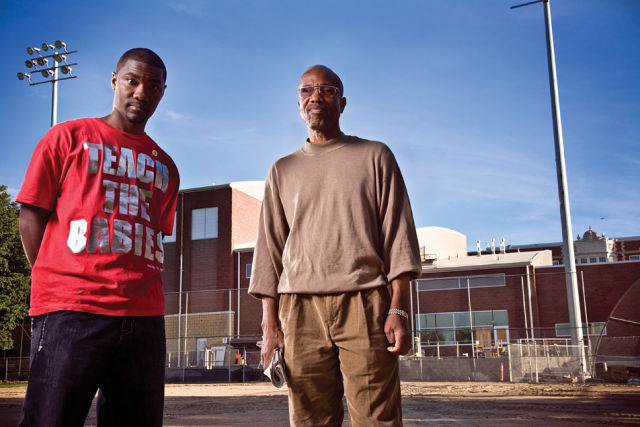
Image: Melissa O’Hearn
Wyking Garrett remembers playing basketball in Colman School’s gym, seeing black history exhibits the occupiers put together on the fly, and watching his father fight for a dream in a city that didn’t seem to care. “It’s been the best education I could possibly get,” he says. “I learned how our society really functions—for the worse, in a lot of ways.”
While the younger Garrett got lessons in realpolitik, the city dragged its feet, spending nearly a decade and more than $350,000 on feasibility studies. It took Norm Rice, the city’s first black mayor, to take the decisive action necessary to end the occupation: In 1993, he created a museum committee that teamed the occupiers with a multiracial group of business and civic leaders, with the idea of injecting the money and structure to make their vision a brick-and-mortar reality. The city pledged funds but by the mid-’90s, the museum board had split into two factions. The new business-class members were battling the old-guard activists for control of the endeavor—and the latter was voted off the board one by one. After nearly a decade of missed deadlines and bitter recriminations, the black community confronted the appalling possibility that their museum might never get built at all. Then, in 2003, the Urban League of Metropolitan Seattle, under the leadership of its president, James Kelly, stepped in to buy the building from the Seattle School District for $800,000 and shepherd the project that eventually got built: a museum on the ground floor and 36 affordable apartments on the second and third stories, all designed by local black-owned architecture firm DKA (Donald King Architects).
At the project’s June 2006 groundbreaking, Tahir-Garrett (who’d served prison time for attacking then-Mayor Paul Schell with a megaphone five years earlier) stood on the sidewalk outside the property, barred from entry due to alleged threats he’d made against NAAM board members. Depending on whom you ask, Tahir-Garrett and the other original activists either had been elbowed aside by powerful downtown interests or were so belligerent and disorganized that they had to be removed before anyone with any credibility or resources would get on board.
{page break}

Image: Jack Storms
To this day, the Garretts say the building was illegally wrested from them and vow to reclaim ownership. They hope to operate, under the Rice-era moniker “African American Heritage Museum and Cultural Center,” an institution that would incorporate social services targeting the needs of black youth. “We would have a low-watt recording studio, a low-watt TV studio, a clinic,” Tahir-Garrett says. “Whatever problem you have as a black person, you [wouldn’t] have to leave the building.” He and his son dismiss the existing institution as by the moneyed, for the moneyed. “If you look at the board of directors, the committees, there’s a class thing going on, and it’s very elitist,” Wyking Garrett says. “Many of the people don’t live in the community, haven’t lived in the community, haven’t been very active in the development, growth, and preservation of the black community here in Seattle.” Most of all, the Garretts condemn the decision to devote two floors of the building to apartments, a move they view as part and parcel of a larger program of gentrification. “There has been a series of institutional, systematic destructions of black-controlled community institutions in Seattle,” Wyking claims. “All of that is in context of the ethnic cleansing of the Central Area.”
The Garretts are not alone in their belief that NAAM has strayed too far from its roots, although others frame their critiques in less incendiary terms. “Some in the community would like to have seen it used for more than just a museum, with more community and youth-oriented programming and resources,” says Aaron Dixon, a founder of the Seattle Black Panthers and a longtime activist. “This is my opinion, and I’ve heard it from others, too.” Soon after the opening, Charlie James, who had participated in the Colman occupation, wrote an op-ed for The Seattle Times in which he vowed never to set foot inside the museum (but he did recommend that others go check it out). Michael Greenwood, another of the occupiers, went to see the museum in July, and says he was “devastated and crushed” that there was not more mention of the activists’ role in the displays (he and his comrades are commemorated on a timeline in the lobby).
“You had a bunch of guys that committed their heart and soul to this effort,” explains Rico Quirindongo, DKA’s lead architect on the project. “And it was, and still is, very precious to that group.” Quirindongo first got involved with NAAM as a UW architecture student in the mid-1990s, sitting at the table with Tahir-Garrett and his supporters, and returned at Donald King’s request from an architecture job in San Francisco to take charge of the Urban League’s design process. He says that he, too, had to let go of some of his aspirations for the project, including a grand rotunda he designed for the entrance, which had to be scrapped for cost and practical museum-design considerations. “None of us had ever built a museum before,” he says. “At some point, there’s a concession that has to be made: I need some help from someone who’s done this before. That was not a concession that [the occupiers] were willing to make. The dream was too precious when weighed against the reality.”
The Garretts say the building was illegally wrested from them and vow to reclaim ownership.
When James Kelly came west for graduate school in the mid-1970s, he swapped the rich, blues-inflected cultural ferment of the Chicago area for a home with his cousin on Mercer Island. “We had culture shock until we discovered I-90 and Seattle,” he remembers. “We were going back and forth to the Midwest, catching a flight every other month to get the music, art, and culture.” Once Kelly discovered the Central District, though, the homesickness eased. He plugged into black society, joined Mount Zion Baptist Church, and worked in education and community service until being tapped to head the Urban League in 1999. He had followed the battle for an African American museum since the ’80s, recognizing the profound need for some local repository for black memory, culture, and shared hopes. -“People wanted a vibrant gathering place in which we could honor the past and articulate the future,” he says. “We had a wonderful, rich history stored in basements.”
Kelly’s biggest challenge when he took on the museum project was not to convince people of its worthiness or even to get them to agree on what it should look like. It was to create a self-sustaining institution. “There was a lot of research that said African American museums were struggling across the country,” he says. “For me it was paramount not to be in a position where you start something and you lose it, and some other entity has to be responsible for it.” A built-in revenue stream was needed. But Kelly views the 36 apartments known as Urban League Village as a bulwark against Central District gentrification, not its handmaiden. Tenants can earn no more than 60 percent of the Seattle area’s median income, and the residents are about 50 percent African American.

Image: Melissa O'Hearn
Sitting in his light-filled living room above the museum, Nathaniel Wilburn exults in the good fortune to have found such a nice place to live. Wilburn, a retired nurse, gets by on Social Security and Section 8 housing vouchers. His apartment boasts exposed brick, soaring ceilings, a handicapped-accessible bathroom installed specially for him, and a million—dollar view of downtown. “I fell in love with that view,” he says. As a Central District native, Wilburn appreciates the chance to spend time in NAAM getting back in touch with his roots, and has encountered some familiar faces in the exhibits—including his own. The alum picked himself out in a photo on display of Garfield High School’s graduating class of 1956. Also in that photo: NAAM’s first executive director, Carver Gayton. “He’s in there, he found himself, too,” Wilburn says.
Carver Gayton, the scion of one of Seattle’s oldest black families, has been a Husky Hall of Famer, an FBI agent, a college professor, a Boeing executive, and a political appointee, among other roles. But his first job after graduating from the University of Washington brought him back to the Central District to teach U.S. history at Garfield High. During his two years at his alma mater, he tried to inject the lessons about African American accomplishments he’d learned from his mother, who’d attended Howard University, into the curriculum. He also taught and coached a young Garfield quarterback named James Garrett, who would one day change his name to Omari Tahir. Now, nearly 50 years after that early encounter, Gayton and Tahir-Garrett use almost identical language to explain the need for an African American museum, and both refer back to those long-ago Garfield days when their forebears were left out of the history books. “If they had anything about African Americans in the history books,” Gayton says, “you usually could count on two gentlemen: George Washington Carver and Booker T. Washington.”
In 2004, Gayton served as a volunteer on the search committee vetting candidates for NAAM’s directorship. The group decided that the museum needed a leader with local roots, not one of the East Coast applicants it had interviewed. Still, Gayton was taken by surprise when James Kelly called to offer him the job and spent two months soul-searching before he accepted. “It had been 30 years for this to come to fruition,” he says. “And it was pretty much of a hot potato.” Gayton’s immediate task as director was to galvanize support and raise a whole lot of money. (By the end of his tenure last June, he and Kelly had added $16 million to the museum’s coffers—a sizable chunk of the original fundraising goal of $22.6 million.) But foreseeing that defining NAAM’s take on black history would be tricky at best, he took the job on one condition—that Barbara Earl Thomas be curator.
Thomas, a native Seattleite, respected artist, and longtime arts administrator, freely admits that when she signed on at NAAM, she had little idea of how to make a museum. “To create an institution from the ground up, that was kind of a rabbit-out-of-a-hat situation for me,” she says. “[The museum] was still pretty much in this kind of dream stage, and I came in and we were told we had two and a half years to get this thing done, so I had to wake ’em up.”
Thomas also had to pick her way through the political minefield that the project had become, balancing the civil rights generation with the hip-hop generation; the longtime Northwesterners with the post–World War II migrants; the descendants of slaves with the recent African immigrants; the middle class with the working class—not to mention reassuring those who were suspicious about the Urban League takeover. “African Americans have had a pretty tough time in this country,” Thomas says. “And there’s as much diversity in the African American community as in the Asian community, but it’s weird because it’s subtle. We’re not speaking Chinese and Japanese, but there’s lots of cultural shades of difference.”
"If white people want to be beat up, they need to talk to somebody else," says NAAM curator Barbara Earl Thomas. "I just don’t feel like it."
Linda Ishem, who teaches urban studies at the University of Washington’s Tacoma campus, surveyed Central District residents’ expectations about the museum as part of an independent research project and says she encountered a good deal of suspicion: “People expressed some real concern about the process being overly influenced by middle-class values and not really representing the richness of the experience of the working-class African Americans who migrated to the area from the rural south in the ’40s.”
{page break}
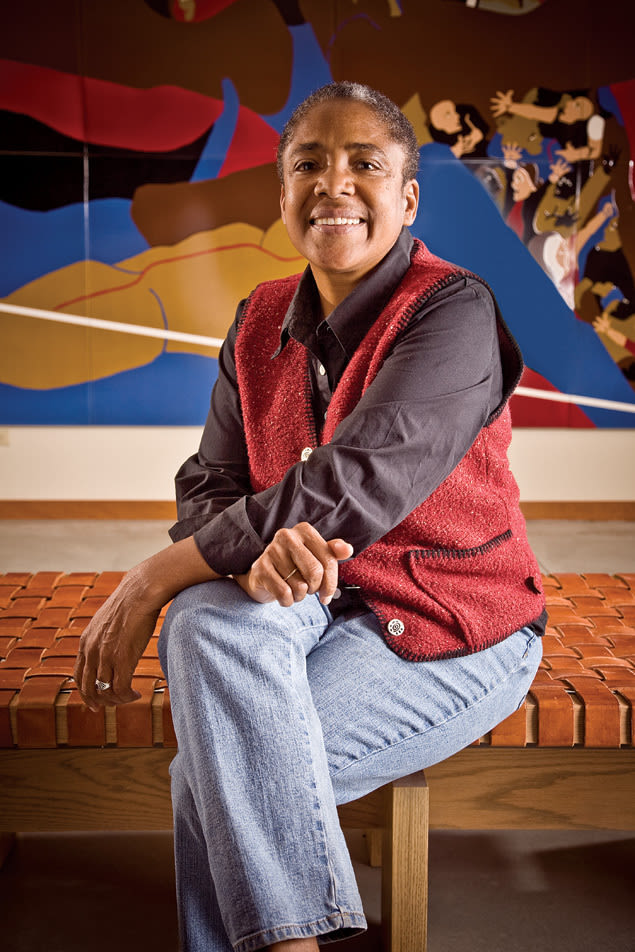
Image: Melissa O’Hearn
Thomas and her program committee addressed this mistrust with “community conversations,” meetings in which volunteers met with groups in Washington, Oregon, Idaho, and British Columbia to gather recommendations and artifacts for NAAM’s exhibits. The process became complicated, with people showing up clutching treasures they’d unearthed in their basements, from stacks of old Jet magazines to the original stained glass windows of Mount Zion church (the latter, preserved for decades by local writer and historian Esther Mumford, did make it into the permanent collection).
“I was concerned, because when you talk to literally hundreds of folks, they have an expectation that their Aunt Sally or their Uncle Henry is going to be in [the museum],” Gayton says. Nonetheless, some people’s aunts (and members of Gayton’s own family) did make it into the Journey Gallery, NAAM’s permanent exhibit, which places local characters and events against the broad sweep of black history. Cardboard cutouts of people like Agnes Oswaha, a Sudanese immigrant in traditional dress, and Thelma Dewitty, Seattle’s first African American teacher, greet visitors in the entryway. Video clips of 1960s race riots in Portland and anti–housing discrimination marches in Seattle are intercut with iconic images of the civil rights struggle, as if to say “Yes—it happened here, too.” Displays on black pioneers, churches, clubs, businesses, and arts offer stirring testaments to African Americans’ successful efforts to make lives and livelihoods in the Northwest, while graphics of their migration routes (the Middle Passage, the Great Migration, and so on) offer a devastating portrait of a people repeatedly uprooted and forced to start fresh in strange surroundings. There was no lack of compelling material. But, says Gayton, refining all the collective memories into a coherent narrative took some work. “The first generation of that exhibit,” he says, “looked like a Christmas tree.”
Aaron Bostick, a recent graduate of Franklin High School, summed up his attitude toward museums prior to joining NAAM’s pilot youth docent program: “The boringness, the tour guides, the boringness.” Along with seven other local high school students Bostick spent six months at NAAM that changed his views. On a warm evening last July, the students who completed the program gathered with friends and family for an opening of exhibits they’d created themselves. Bostick asked his cousin to stand beside him as he presented his project, which included old family R & B records alongside markers of his own achievements, like his first Little League trophy. “[A museum] is very special when you think it’s about you,” he says.
Hodan Hassan, a Somali immigrant who’s now a senior at Franklin, worried at the outset that her display case would be empty. “Everyone else had been here all their lives,” she says. “And when they looked at the Internet, they had a lot more information. It was a drag for me going from Web site to Web site and not finding anything that I could use. Then I started thinking this was a story somebody else didn’t get a chance to do, so I should be the first to put this in the African American museum so other people could see it.” She gathered up precious relics of her family’s long journey from her troubled homeland—a beaded headscarf, family photos, a Somali flag—along with a poem she wrote about the experience of leaving. “In the end,” she marvels, “there wasn’t even room to put in all the objects I had.”
This sort of intimate engagement with the stuff of history is just what NAAM’s education director, Brian J. Carter, had in mind when he planned the youth docent program, which he’s intent on expanding this fall. “We wanted them to feel some type of ownership of the museum,” he says. Carter, who has a masters in museum studies from the University of Washington, is cooking up more plans to engage youth, like expanding the multimedia room, now used as a genealogy research center, to incorporate a recording studio. He reports that over a thousand schoolchildren have toured NAAM since opening day.
While it’s risky to make pronouncements on whether some monolithic Black Community is satisfied, some 8,000 people have passed through the museum’s doors since it opened. Garry Owens, a founding member of Seattle’s Black Panthers, estimates that 75 percent of African Americans in the Central District are happy the museum is open for business. But he adds that the remaining 25 percent are pretty angry and side with the Garretts in their contention that the project was hijacked by a privileged few. “I am proud that it’s finished,” Owens says. “Do I agree with every sentiment that comes out of the mouths of the people that got it finished? No—but I have to say that as a black person in this town, born and raised here, I am glad there’s someplace I can take my children and grandchildren to see some reflection of what our past has been in this area.”
Curator Barbara Earl Thomas concedes that NAAM will never be all things to all African Americans. “To create something is to commit yourself and limit yourself at the same time,” she says. “I get criticism all the time: ‘Why don’t you talk more about Africa?’ or ‘People need to know more about slavery.’ The programming committee had to make a choice about this. We said, ‘We need to tell our story here in the Northwest, because no one else is going to do it.’ ” She is, however, currently planning a 2009 show on recent African immigrants. And she stresses that while NAAM does tell the “hard stories” of slavery, discrimination, and the civil rights struggle, she wants everyone to feel welcome there. “If white people want to be beat up, they need to talk to somebody else,” she says. “I just don’t feel like it.”
NAAM’s most vocal critics are unlikely to be appeased. Omari Tahir-Garrett and his supporters have already brought several lawsuits against the Seattle School District, alleging that the property’s sale to the Urban League was a breach of its own purchase agreement. “They have sued in every court possible,” says James Kelly. “It’s all been thrown out, and the last decision said that because of the frivolousness, any future lawsuits would result in monetary damages against them and their attorneys.” Nevertheless, Tahir-Garrett says he plans on citing the Racketeer Influenced and Corrupt Organizations Act.
Carver Gayton, meanwhile, proves how far the telling of black history has come by citing an experience he had as a teacher at Garfield. “A young man went to the head of the social studies department,” he recalls, “and he said, ‘You have to check out Mr. Gayton, because he’s teaching all these fairy tales about the accomplishments of black people in the sciences and the arts—if it was true, it’d be in the books and in the libraries, and it’s not.’ [The department head] was enlightened, and she said, ‘Carver, you keep on doing what you’re doing.’ But guess who the fellow was? He was an African American.”